Small Cap vs. Large Cap 2026: Performance & Investment Strategy

Small Cap vs. Large Cap 2026: A Performance Comparison for US Equity Portfolios
As we navigate the ever-evolving landscape of financial markets, investors are constantly seeking an edge, a clearer understanding of where the next wave of growth will emerge. One of the most perennial and critical debates in equity investing revolves around the relative merits of small-capitalization (small cap) versus large-capitalization (large cap) stocks. This discussion becomes even more pertinent when looking ahead, as macroeconomic shifts, technological advancements, and geopolitical events can significantly alter market dynamics. For those planning their investment strategies for 2026 and beyond, understanding the potential performance of Small Cap vs Large Cap 2026 in US equity portfolios is not just beneficial, but essential.
The year 2026, while still a few years away, is close enough to begin formulating informed projections. We’ve seen periods where large caps dominate, offering stability and consistent returns, often driven by established market leaders and global reach. Conversely, there are cycles where small caps, with their agility, innovation, and higher growth potential, significantly outperform their larger counterparts. This comprehensive analysis will delve into the factors that could shape the performance of Small Cap vs Large Cap 2026, providing insights for both seasoned investors and those new to the complexities of the stock market.
We will examine historical trends, current economic indicators, and future projections to paint a picture of what investors might expect. From interest rate environments to inflation, technological disruption to consumer spending habits, every element plays a role in determining which segment of the market might offer superior returns. Our goal is to equip you with the knowledge to make strategic decisions, whether you lean towards the established giants or the nimble innovators in your pursuit of investment success.
Understanding Small Cap and Large Cap Stocks
Before we project into 2026, it’s crucial to solidify our understanding of what constitutes small cap and large cap stocks, and the inherent characteristics that define each category. The classifications are generally based on market capitalization, which is the total value of a company’s outstanding shares. While the exact thresholds can vary between indices and financial institutions, a common understanding is as follows:
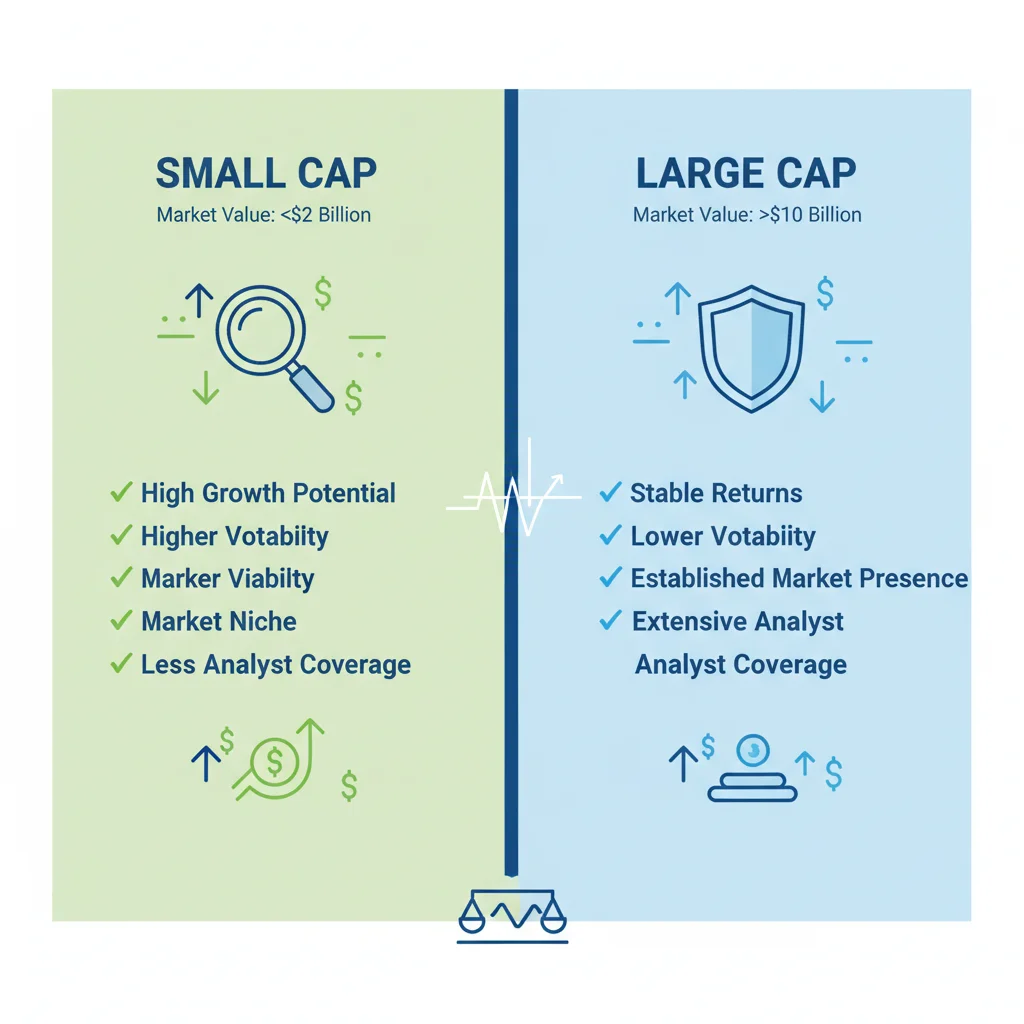
- Large Cap Stocks: Typically defined as companies with a market capitalization of $10 billion or more. These are often well-established, mature companies with significant market share, stable revenue streams, and a proven track record. Examples include tech giants, major financial institutions, and multinational corporations. They tend to be less volatile than small caps and are often seen as ‘blue-chip’ investments.
- Small Cap Stocks: Generally refer to companies with a market capitalization ranging from $300 million to $2 billion. These companies are often younger, more agile, and have significant growth potential. However, they also come with higher risk and volatility due to their smaller scale, susceptibility to economic downturns, and sometimes less diversified revenue streams.
Mid-cap stocks, falling between these two categories (typically $2 billion to $10 billion), often represent a blend of the characteristics of both small and large caps, offering a balance of growth potential and relative stability. However, for the purpose of this deep dive into Small Cap vs Large Cap 2026, we will primarily focus on the two extremes to highlight the contrasting investment theses.
Key Characteristics and Investment Appeals:
Each category presents distinct advantages and disadvantages for investors:
Small Cap Stocks: The Growth Engines
- Higher Growth Potential: Small companies often have more room to grow rapidly. A new product or market penetration can have a disproportionately larger impact on a small company’s revenue and earnings compared to a large, established firm.
- Innovation and Agility: Smaller companies are often at the forefront of innovation, able to adapt quickly to changing market conditions and consumer demands without the bureaucratic hurdles of larger organizations.
- Undervaluation Opportunities: Due to less analyst coverage and institutional interest, small caps can sometimes be overlooked by the broader market, presenting opportunities for astute investors to discover undervalued gems.
- Higher Volatility: This is the flip side of higher growth potential. Small caps are more sensitive to economic cycles, industry-specific headwinds, and investor sentiment. Their stock prices can fluctuate significantly.
- Liquidity Concerns: Shares of small cap companies may be less liquid, meaning it can be harder to buy or sell large blocks of shares without impacting the price.
Large Cap Stocks: The Pillars of Stability
- Stability and Resilience: Large companies often have diversified business models, strong balance sheets, and established market positions, making them more resilient during economic downturns.
- Consistent Dividends: Many large cap companies pay regular dividends, providing a steady income stream for investors.
- Liquidity: Their shares are highly liquid, making them easy to trade without significant price impact.
- Extensive Analyst Coverage: Large caps are typically well-researched by financial analysts, meaning information is readily available, and their prices tend to reflect publicly available knowledge.
- Lower Growth Potential: While they offer stability, their sheer size means that achieving exponential growth rates becomes increasingly challenging.
- Slower Adaptation: Their large scale can sometimes make them slower to adapt to rapid technological changes or shifts in consumer preferences.
Historical Performance: Small Cap vs Large Cap Trends
To forecast the potential performance of Small Cap vs Large Cap 2026, it’s insightful to review historical trends. Over very long periods, small cap stocks have historically outperformed large cap stocks. This phenomenon is often referred to as the ‘small cap premium,’ attributed to the higher risks associated with smaller companies, which investors demand greater compensation for taking.
However, this outperformance is not consistent year-over-year. Market cycles dictate periods of large cap dominance and small cap resurgence. For instance, during periods of strong economic growth and stable interest rates, small caps often thrive as their sensitivity to the economic cycle translates into amplified gains. Conversely, during economic slowdowns or periods of uncertainty, investors often flock to the relative safety and stability of large cap companies, which can better weather storms due to their dominant market positions and diversified revenue streams.
Recent history shows a mixed bag. The post-financial crisis era saw periods where large cap growth stocks, particularly in the technology sector, significantly outperformed. However, there have also been notable rotations where small caps showed strong relative performance, often during periods of economic recovery or when investors sought value opportunities outside of the highly concentrated large cap market.
Understanding these cyclical patterns is crucial for any investor looking to position their portfolio effectively for the future. The question then becomes: what economic and market conditions are we likely to face in 2026, and how will they influence the Small Cap vs Large Cap 2026 dynamic?
Macroeconomic Factors Influencing Small Cap vs Large Cap 2026
The macroeconomic environment is arguably the most significant determinant of which market segment will perform better. Several key factors will likely shape the landscape for Small Cap vs Large Cap 2026:
1. Interest Rates and Inflation:
Interest rates have a profound impact on equity valuations, particularly for companies that rely on borrowing for growth. Small cap companies, often less established and with less access to cheap capital, tend to be more sensitive to rising interest rates. Higher borrowing costs can squeeze their margins and hinder their expansion plans. Large cap companies, with stronger balance sheets and better access to capital markets, are generally more insulated from rate hikes.
Inflation also plays a critical role. While some inflation can be a sign of a healthy economy, persistent high inflation can erode purchasing power and increase input costs for businesses. Small caps, with less pricing power and often more localized supply chains, may struggle more than large caps to pass on these increased costs to consumers. If inflation remains elevated or if the Federal Reserve continues with a hawkish monetary policy into 2026, it could create a headwind for small caps.
2. Economic Growth and Recession Risk:
The overall health of the US economy will be a major factor. A robust economic expansion typically favors small caps. As consumer spending and business investment increase, smaller companies, often more domestically focused, can see significant revenue growth. Their higher operational leverage means that small increases in revenue can lead to substantial profit growth.
Conversely, in a slowing economy or recessionary environment, large caps tend to be more resilient. Their established brands, diversified operations, and global revenue streams provide a buffer against domestic economic downturns. If there’s a heightened risk of recession in 2026, investors might gravitate towards the perceived safety of large cap stocks, impacting the Small Cap vs Large Cap 2026 performance.
3. Geopolitical Landscape and Global Trade:
The geopolitical climate, including international trade relations, conflicts, and supply chain disruptions, can disproportionately affect different market segments. Large multinational corporations, often with complex global supply chains and significant overseas revenue, are directly impacted by international trade policies and geopolitical stability. While disruptions can be challenging, their scale often allows them to adapt or absorb shocks better.
Small caps, especially those with niche products or services tied to specific domestic markets, might be less directly exposed to global trade tensions. However, they can still be affected by broader economic uncertainty or if their supply chains rely on imported components. The interplay of these global factors will add another layer of complexity to the Small Cap vs Large Cap 2026 outlook.
4. Technological Innovation and Disruption:
Technological advancements continue to reshape industries. While large cap tech giants often drive innovation, many small cap companies are emerging as disruptors in various sectors. These agile innovators can carve out significant market share if their technologies gain traction. However, they also face intense competition and the risk of being outmaneuvered by larger players or failing to scale effectively.
For 2026, sectors like artificial intelligence, biotechnology, renewable energy, and advanced manufacturing are expected to continue their rapid evolution. Both small and large caps will be vying for dominance in these areas, but the potential for exponential growth in small, innovative companies cannot be understated. This dynamic will be a key consideration when assessing Small Cap vs Large Cap 2026.

Analyst Expectations and Market Sentiment for 2026
Forecasting market performance is an art as much as a science, and analyst expectations play a significant role in shaping market sentiment. As we look towards 2026, several themes are likely to dominate discussions regarding Small Cap vs Large Cap 2026:
Potential for a ‘Catch-Up’ by Small Caps:
Historically, periods of large cap outperformance are often followed by a rotation into small caps. If large caps have had a prolonged run, some analysts might argue that small caps are undervalued relative to their growth potential, setting the stage for a catch-up rally. This is often fueled by a search for value and diversification outside of the highly concentrated large cap indices.
If economic growth is projected to be moderate but stable, and inflation begins to cool, it could create a more favorable environment for small caps. Lower interest rate expectations would also reduce borrowing costs, benefiting smaller, growth-oriented companies more significantly.
Continued Dominance of Large Cap Tech:
Conversely, some analysts believe that the structural advantages of large cap technology companies – their vast ecosystems, strong network effects, and robust cash flows – will continue to drive their outperformance. These companies often have the resources to invest heavily in R&D, acquire promising smaller competitors, and expand into new markets, maintaining their competitive edge.
If global economic growth remains sluggish in certain regions, or if geopolitical risks persist, the flight to quality might continue to favor these established giants, making the Small Cap vs Large Cap 2026 debate lean towards large caps.
The Role of Mergers and Acquisitions (M&A):
M&A activity can significantly impact small cap performance. Large, cash-rich companies often look to acquire innovative small caps to expand their product offerings, gain market share, or eliminate competition. A strong M&A environment can provide a significant boost to small cap valuations, as acquisition premiums can be substantial. This factor could be a key driver in the performance of Small Cap vs Large Cap 2026, particularly if larger companies seek to integrate new technologies or diversify their portfolios.
Sector-Specific Considerations for Small Cap vs Large Cap 2026
Beyond the broad market capitalization categories, sector-specific performance will also play a crucial role. Certain sectors naturally lean more towards small cap or large cap dominance:
- Technology: While there are massive large cap tech companies, the sector is also a hotbed for innovative small cap startups. The performance will depend on the pace of technological change and the ability of smaller players to disrupt established markets.
- Healthcare and Biotechnology: This sector often features both large pharmaceutical giants and numerous small cap biotech firms developing groundbreaking treatments. Regulatory environments and the success of clinical trials will be critical for small caps.
- Industrials and Materials: These sectors tend to have a mix, but large caps often dominate due to capital intensity and economies of scale. Small caps here might be niche players or specialized service providers.
- Consumer Discretionary: This sector is highly sensitive to consumer spending. Small cap retailers or innovative consumer brands could thrive in a strong economy, while large cap brands might offer more consistent performance.
Investors should consider the sector breakdown within their small cap and large cap allocations, as diversification across industries can mitigate risks and capture diverse growth opportunities. The specific sectors poised for growth in 2026 will undoubtedly influence the overall Small Cap vs Large Cap 2026 dynamic.
Constructing a Balanced US Equity Portfolio for 2026
Given the nuanced outlook for Small Cap vs Large Cap 2026, a diversified approach is often the most prudent strategy. Rarely does one segment consistently outperform the other indefinitely. A balanced portfolio typically includes exposure to both small and large cap stocks, allowing investors to benefit from different market cycles and growth drivers.
Strategic Allocation Considerations:
- Risk Tolerance: Investors with a higher risk tolerance and a longer time horizon might allocate a larger percentage to small caps, aiming to capture their higher growth potential. Those with lower risk tolerance might favor a greater allocation to large caps for stability.
- Investment Objectives: If capital appreciation is the primary goal, small caps might be more appealing. If income generation and capital preservation are priorities, large caps with consistent dividends might be preferred.
- Economic Outlook: If the macroeconomic forecast for 2026 suggests robust economic growth and a favorable interest rate environment, increasing small cap exposure could be beneficial. Conversely, if a slowdown or recession is anticipated, a tilt towards large caps might be warranted.
- Diversification: Beyond market cap, ensure diversification across sectors, industries, and geographies within both small and large cap allocations. This helps to reduce idiosyncratic risks.
- Rebalancing: Regularly review and rebalance your portfolio. If one segment significantly outperforms, its allocation might grow beyond your target. Rebalancing involves selling some of the outperforming asset and buying more of the underperforming one, which can be a disciplined way to ‘buy low and sell high.’
Investment Vehicles:
Investors can gain exposure to small cap and large cap stocks through various vehicles:
- Individual Stocks: For those who conduct thorough research and have conviction in specific companies.
- Exchange-Traded Funds (ETFs): Offer diversified exposure to broad market cap segments or specific sectors. Examples include ETFs tracking the Russell 2000 (small cap) or the S&P 500 (large cap).
- Mutual Funds: Actively managed funds that select stocks based on a specific investment strategy, often categorized by market cap.
The Role of Active vs. Passive Management in 2026
The debate between active and passive management is particularly relevant when discussing Small Cap vs Large Cap 2026. In efficient markets, such as the large cap segment, it can be challenging for active fund managers to consistently outperform broad market indices after fees. This is because large cap stocks are heavily scrutinized by analysts, and information is quickly priced into the market.
However, the small cap segment is often considered less efficient. With less analyst coverage and institutional interest, there may be more opportunities for skilled active managers to identify undervalued companies and generate alpha. Therefore, while passive investing through ETFs might be highly effective for large cap exposure, active management could potentially add more value in the small cap space for 2026.
Conclusion: Navigating the Small Cap vs Large Cap 2026 Dynamic
The future performance of Small Cap vs Large Cap 2026 in US equity portfolios is not set in stone. It will be a complex interplay of macroeconomic forces, corporate fundamentals, technological advancements, and investor sentiment. While historical data suggests a small cap premium over the very long term, short-to-medium term performance is highly cyclical.
As we approach 2026, investors should closely monitor key indicators such as interest rates, inflation, GDP growth, and geopolitical stability. A resilient but not overheated economy with moderating inflation and stable interest rates could create a favorable environment for small caps to shine, potentially leading to a period of outperformance after years of large cap dominance. Conversely, persistent economic uncertainty or rising rates might continue to favor the stability and defensive characteristics of large caps.
Ultimately, a well-diversified portfolio that strategically allocates across both small and large cap segments, tailored to individual risk tolerance and investment objectives, remains the most robust approach. By staying informed, adapting to market shifts, and maintaining a long-term perspective, investors can position themselves to navigate the dynamic landscape of Small Cap vs Large Cap 2026 and optimize their US equity portfolios for sustainable growth.
The journey through financial markets is continuous, and 2026 promises to be another fascinating chapter in the ongoing narrative of equity investing. By understanding the nuances of small cap and large cap dynamics, investors can make more informed decisions, fostering greater confidence in their pursuit of financial goals.