Federal Data Localization Laws: Your 2026 Business Compliance Guide

Federal Data Localization Laws: What Businesses Must Know for 2026 Operations
The digital age has ushered in unprecedented opportunities for global businesses, but it has also brought forth a complex web of regulatory challenges. Among the most significant of these are Federal Data Localization laws. As we approach 2026, businesses operating across borders, or even within a single country with robust federal structures, must grapple with an increasingly stringent landscape of data governance. This comprehensive guide aims to demystify these critical regulations, offering insights and actionable strategies to ensure your business remains compliant and resilient.
The concept of data localization, at its core, mandates that certain types of data generated within a country’s borders must be stored and processed within those same borders. While seemingly straightforward, the implications for multinational corporations, cloud service providers, and even small businesses relying on global digital infrastructure are profound. Non-compliance can lead to hefty fines, reputational damage, and even operational restrictions, making proactive understanding and strategic planning paramount.
This article will delve into the nuances of Federal Data Localization laws, exploring their origins, the diverse forms they take across different jurisdictions, and the specific challenges they pose for businesses. We will also provide a roadmap for developing robust compliance strategies, leveraging technological solutions, and fostering a culture of data governance that can adapt to the ever-evolving regulatory environment. The year 2026 is not far off, and the time to prepare is now.
Understanding the Landscape of Federal Data Localization
To effectively navigate the challenges posed by Federal Data Localization, it’s crucial to first understand its underlying principles and the diverse forms it takes. Data localization is not a monolithic concept; rather, it manifests in various ways, often driven by national security concerns, economic protectionism, and, most commonly, data privacy and sovereignty.
What Exactly is Federal Data Localization?
In essence, Federal Data Localization refers to laws that require data about a nation’s citizens or residents, or data generated within its borders, to be stored and processed on servers physically located within that nation. These laws can vary significantly in their scope:
- Absolute Localization: This is the most stringent form, requiring all data to be stored and processed exclusively within the country. This can be particularly challenging for cloud-based services.
- Conditional Localization: Some laws allow data to be transferred out of the country under certain conditions, such as obtaining explicit consent, ensuring adequate data protection mechanisms are in place (e.g., standard contractual clauses), or adhering to specific certification schemes.
- Mirroring Requirements: Less restrictive, these laws mandate that a copy of the data must be stored locally, while the primary data can reside elsewhere. This provides a balance between local access and global operations.
- Processing Localization: Beyond storage, some regulations dictate that certain data processing activities must also occur within the country’s borders.
The ‘federal’ aspect implies that these laws are enacted at a national level, impacting all states or provinces within that federation. This is distinct from regional or state-level data residency requirements, though federal laws often supersede or set a baseline for these sub-national regulations. For businesses, this means a singular, overarching compliance framework at the national level, which can simplify some aspects but also increase the impact of non-compliance across an entire country.
The Driving Forces Behind Data Localization
Several factors contribute to the proliferation of Federal Data Localization laws:
- National Security: Governments often argue that local data storage is essential for national security, allowing them to access data more easily for intelligence or law enforcement purposes without navigating complex international legal assistance treaties.
- Data Sovereignty: This principle asserts that a nation has complete control over data generated within its borders. It’s often a reaction to perceived foreign surveillance or dominance in the digital sphere.
- Economic Protectionism: By requiring local data infrastructure, governments can stimulate local IT industries, create jobs, and reduce reliance on foreign technology providers.
- Data Privacy and Protection: Many countries believe that local storage offers better protection for their citizens’ data, as it falls directly under their domestic privacy laws and regulatory oversight. This is particularly relevant in the wake of high-profile data breaches and privacy scandals.
- Cybersecurity: Localizing data can be seen as a way to enhance national cybersecurity by reducing exposure to foreign cyber threats and ensuring data remains within a controlled national infrastructure.
Understanding these motivations is key to anticipating future regulatory trends and developing adaptable compliance strategies. As global geopolitical tensions rise and the importance of data continues to grow, it is highly probable that more countries will consider or strengthen their Federal Data Localization mandates.
Key Jurisdictions and Their Federal Data Localization Approaches (Approaching 2026)
While a comprehensive list of every federal law is beyond the scope of this article, it’s important to highlight some prominent examples and trends that illustrate the complexity businesses face. The year 2026 is a significant marker as many existing regulations will have matured, and new ones may be in effect, demanding full compliance.
Examples of Federal Data Localization Laws
- Russia’s Data Localization Law (Federal Law No. 242-FZ): This law, effective since 2015, requires personal data of Russian citizens to be stored on servers located within Russia. It has been enforced with increasing vigor, leading to fines and blocking of non-compliant services. For 2026, businesses must assume full adherence is non-negotiable.
- China’s Cybersecurity Law (CSL) and Data Security Law (DSL): These comprehensive laws impose strict data localization requirements for ‘critical information infrastructure operators’ and for ‘important data’ and ‘personal information.’ Cross-border transfers are subject to security assessments. By 2026, the enforcement mechanisms will be highly sophisticated, requiring robust data mapping and compliance frameworks.
- India’s Proposed Data Protection Framework: While not fully enacted as of writing, India has been actively pursuing data localization requirements, particularly for financial data. Future legislation is expected to include broader mandates for personal data, significantly impacting businesses operating or serving the Indian market. The landscape for 2026 could see these proposals solidified into law.
- Vietnam’s Cybersecurity Law: Enacted in 2019, this law requires both domestic and foreign service providers to store certain user data within Vietnam and open local offices if they collect data on Vietnamese users.
- EU’s GDPR (Indirect Impact): While the GDPR itself doesn’t mandate data localization, its strict rules on international data transfers (e.g., requiring Standard Contractual Clauses, Binding Corporate Rules, or adequacy decisions) often push companies towards local storage or processing as a simpler compliance pathway, especially when dealing with complex data flows and multiple jurisdictions. This indirect pressure for Federal Data Localization compliance will only increase by 2026.
These examples illustrate a global trend. Businesses can no longer assume a ‘one size fits all’ approach to data storage and processing. Each jurisdiction with Federal Data Localization laws requires specific attention and tailored solutions.
Challenges Posed by Federal Data Localization for Businesses
The implications of Federal Data Localization laws are far-reaching, creating significant operational, financial, and legal hurdles for businesses.
Operational Complexities
- Infrastructure Duplication: Businesses may need to establish local data centers or procure local cloud services in each country with localization requirements, leading to increased infrastructure costs and complexity.
- Data Silos: Localized data can lead to information silos, making it harder to implement global analytics, machine learning, and centralized business intelligence initiatives. This can impede efficiency and innovation.
- Latency and Performance: For global applications, routing data through local servers can introduce latency, impacting user experience and application performance.
- Vendor Management: Managing multiple local cloud providers or data center operators across different countries adds layers of complexity to vendor relationship management and service level agreements.
Increased Costs
The financial burden of Federal Data Localization can be substantial:
- Capital Expenditure (CapEx): Investing in new hardware, servers, and data center facilities.
- Operational Expenditure (OpEx): Higher costs for local cloud subscriptions, maintenance, energy, and staffing for local IT operations.
- Legal and Compliance Fees: Engaging legal counsel to interpret complex laws, conduct data mapping, and ensure ongoing compliance.
- Software Licensing: Many enterprise software solutions are licensed globally; data localization might necessitate specific local licenses or configurations.
Legal and Compliance Risks
- Conflicting Laws: Businesses may face situations where one country’s localization law conflicts with another’s data transfer regulations (e.g., a country requiring data to stay local, while another requires it to be transferred for processing).
- Enforcement and Penalties: Non-compliance can result in severe penalties, including hefty fines, suspension of operations, and even criminal charges for executives.
- Data Access Requests: Navigating legal requests for data from local governments while respecting the privacy laws of other jurisdictions becomes incredibly complex.
- Reduced Agility: The need to constantly adapt to new or evolving data localization laws can slow down business expansion and innovation.
Strategies for Achieving Federal Data Localization Compliance by 2026
Proactive planning and a multi-faceted approach are essential for businesses to successfully navigate the increasing demands of Federal Data Localization by 2026. This isn’t just a legal challenge; it’s a strategic business imperative.
1. Conduct a Comprehensive Data Inventory and Mapping
The first and most critical step is to understand what data your organization collects, where it originates, where it is stored, how it is processed, and who has access to it. This involves:
- Data Discovery Tools: Utilize automated tools to identify and classify data across all systems, including databases, cloud storage, and endpoints.
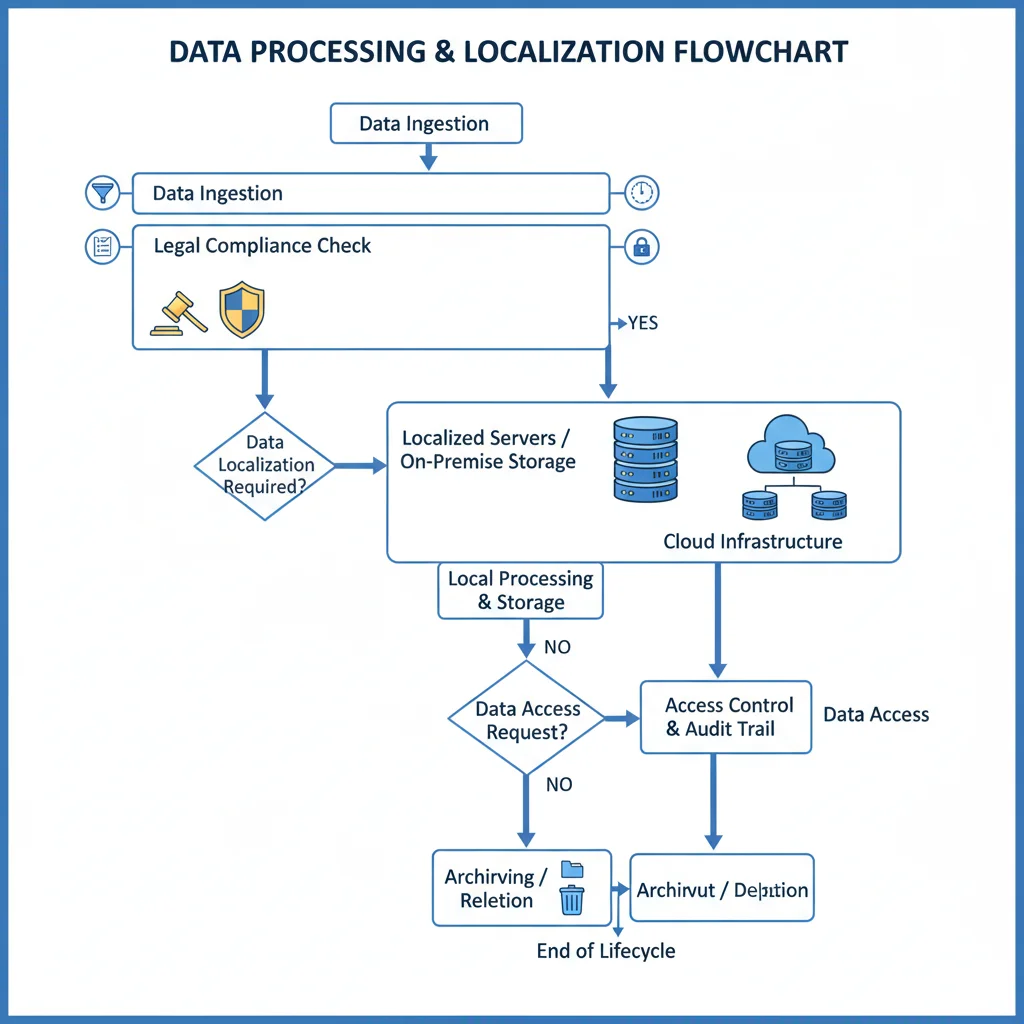
- Data Flow Analysis: Map out the entire lifecycle of data, from collection to deletion, identifying all transfer points, processing locations, and storage repositories.
- Jurisdictional Alignment: Link specific data types and flows to the countries of origin and destination, allowing for the identification of relevant Federal Data Localization requirements.
- Data Classification: Categorize data based on its sensitivity (e.g., personal identifiable information, financial data, health data, trade secrets) as different classifications often trigger different localization rules.
Without a clear understanding of your data landscape, any compliance effort will be built on shaky ground.
2. Implement a Robust Data Governance Framework
A strong data governance framework provides the policies, procedures, and organizational structures needed to manage data effectively and compliantly.
- Policy Development: Create clear, enforceable policies for data collection, storage, processing, transfer, and deletion, explicitly addressing Federal Data Localization requirements.
- Roles and Responsibilities: Define clear roles for data ownership, stewardship, and compliance, including a Chief Data Officer (CDO) or a dedicated data privacy team.
- Training and Awareness: Regularly train employees on data localization policies and their responsibilities to ensure compliance at all levels.
- Regular Audits and Reviews: Conduct periodic audits of data practices and systems to ensure ongoing adherence to regulations and identify areas for improvement.
3. Adopt Strategic Technological Solutions
Technology plays a pivotal role in enabling compliance with Federal Data Localization laws.
- Local Cloud Regions/Hybrid Cloud: Partner with cloud providers that offer local data center regions in countries where localization is required. A hybrid cloud approach, combining on-premise infrastructure with public cloud services, can offer flexibility.
- Data Minimization and Anonymization: Collect only the data necessary for your operations. Where possible, anonymize or pseudonymize data, as localized data often refers specifically to identifiable personal information.
- Encryption and Access Controls: Implement strong encryption for data at rest and in transit. Granular access controls ensure that only authorized personnel can access sensitive data, regardless of its physical location.
- Data Virtualization and Federation: Explore solutions that allow data to remain in its localized storage while still being accessible and usable for global operations through virtualization or federation techniques, without physically moving the data.
- Compliance Management Software: Leverage specialized software that helps track regulatory changes, manage data inventories, and automate compliance tasks related to data residency.
4. Legal Counsel and Expert Consultation
Given the complexity and evolving nature of Federal Data Localization laws, engaging legal experts is non-negotiable.
- Jurisdictional Expertise: Work with legal professionals who specialize in international data privacy and localization laws in the specific countries where you operate.
- Contractual Review: Ensure all vendor contracts (especially with cloud providers, SaaS providers, and data processors) explicitly address data residency, processing locations, and compliance with relevant localization laws.
- Impact Assessments: Conduct Data Protection Impact Assessments (DPIAs) or similar assessments for new projects or data flows that might be affected by localization requirements.
5. Develop an Incident Response Plan
Even with the best preparation, data breaches or compliance incidents can occur. A well-defined incident response plan is crucial.
- Notification Procedures: Understand and document the specific notification requirements for data breaches under each relevant Federal Data Localization law.
- Remediation Strategies: Have clear procedures for mitigating the impact of a breach and restoring compliance.
- Legal and PR Engagement: Include legal counsel and public relations experts in your incident response team to manage communication and legal obligations effectively.
The Future of Federal Data Localization and Business Adaptation
The trend towards Federal Data Localization is unlikely to reverse. Instead, it is expected to intensify, driven by continued concerns over national security, data sovereignty, and privacy. Businesses must view this not as a temporary hurdle, but as a permanent fixture of the global digital economy.
Anticipating Future Trends
- Increased Enforcement: Governments are investing more in enforcement mechanisms, meaning higher fines and more aggressive pursuit of non-compliant entities.
- Broader Scope: Localization requirements may extend beyond personal data to include other categories like industrial data, intellectual property, or specific government data.
- Supply Chain Scrutiny: Businesses will be held increasingly responsible for the compliance of their entire data supply chain, including third-party vendors and sub-processors.
- Interoperability Challenges: As more countries enact diverse localization laws, the challenge of maintaining global interoperability and seamless data exchange will grow.
Building a Resilient Business Model for 2026 and Beyond
To thrive in this environment, businesses need to embed data localization considerations into their core strategy:
- Privacy by Design: Integrate data localization and privacy principles into the design and architecture of all new products, services, and systems from the outset.
- Decentralized Architectures: Explore decentralized data architectures that allow for local storage and processing while maintaining global oversight and control.
- Strategic Partnerships: Form partnerships with local service providers and technology companies that have expertise and infrastructure in key localization jurisdictions.
- Continuous Monitoring and Adaptation: The regulatory landscape is dynamic. Implement systems for continuous monitoring of legal changes and be prepared to adapt your data governance and technical solutions accordingly.
- Educate Leadership: Ensure that senior leadership understands the strategic importance of data localization compliance, securing necessary resources and executive buy-in.

Conclusion: Navigating the Data Localization Imperative
The year 2026 will mark a critical juncture for businesses grappling with Federal Data Localization laws. The era of uninhibited global data flow is giving way to a more fragmented, regulated landscape. For businesses, this shift demands more than just a reactive approach; it requires a fundamental re-evaluation of data strategy, infrastructure, and governance.
By conducting thorough data inventories, implementing robust governance frameworks, leveraging strategic technological solutions, seeking expert legal counsel, and fostering a culture of continuous compliance, businesses can transform the challenge of data localization into an opportunity for enhanced security, trust, and market resilience. The businesses that proactively embrace these changes will be best positioned to succeed in the intricate digital economy of 2026 and beyond.
Remember, compliance with Federal Data Localization is not merely about avoiding penalties; it’s about building trust with your customers, safeguarding sensitive information, and ensuring the long-term viability and ethical standing of your operations in a globally interconnected yet increasingly localized world. Start your preparations today to ensure a smooth and compliant transition into the future of data governance.