Neuromorphic Computing: The Future of AI in the US by 2028

The landscape of artificial intelligence is on the cusp of a profound transformation, driven by an emerging paradigm known as neuromorphic computing. This revolutionary approach, inspired by the intricate and energy-efficient architecture of the human brain, is rapidly gaining traction, particularly within the United States. Experts predict that by 2028, neuromorphic computing could not only rival but potentially outperform traditional AI systems, ushering in an era of unprecedented computational power and efficiency. This article delves deep into the rise of neuromorphic computing US, exploring its underlying principles, its advantages over conventional AI, the key players driving its development, and the significant implications it holds for various industries.
The Dawn of Brain-Inspired Computing: Understanding Neuromorphic Computing
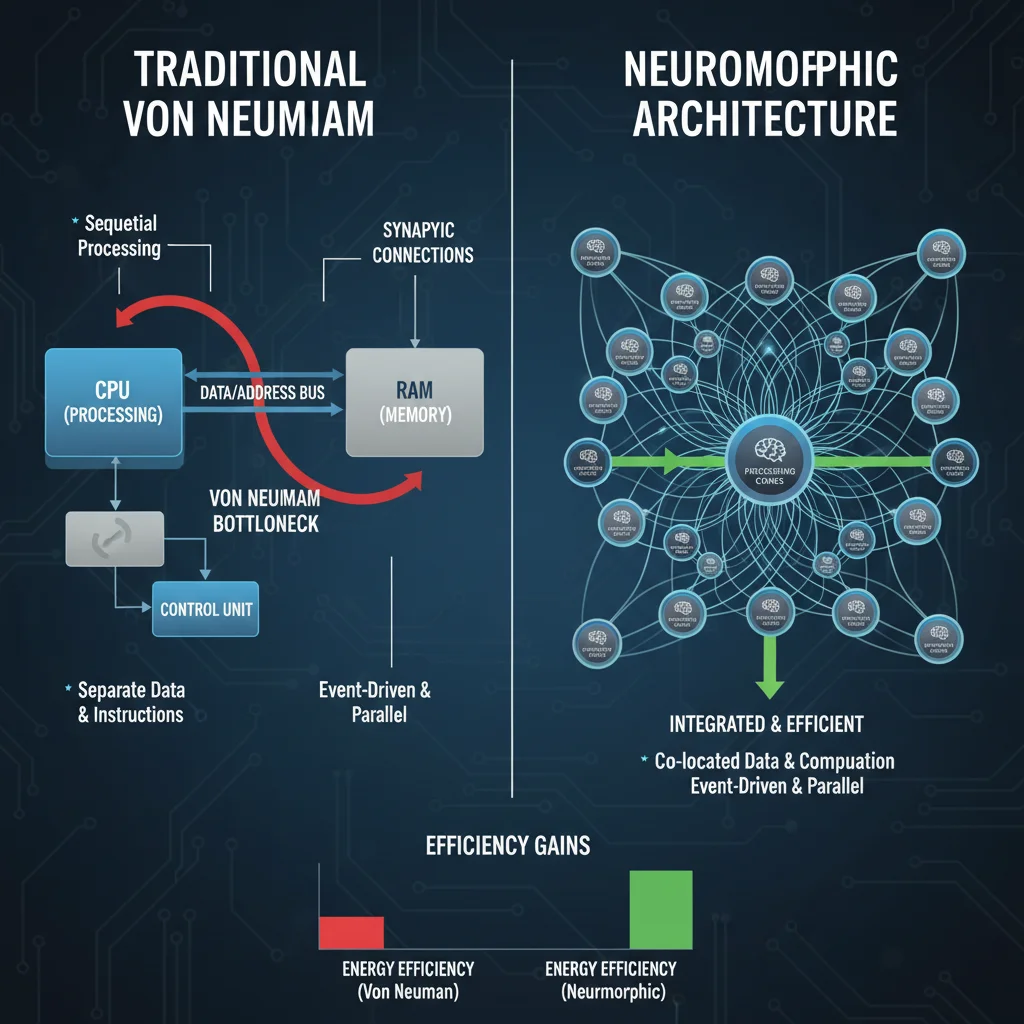
At its core, neuromorphic computing seeks to emulate the brain’s structure and function. Unlike traditional Von Neumann architectures, which separate processing and memory units, leading to the infamous ‘memory wall’ bottleneck, neuromorphic systems integrate these functions. This design allows for highly parallel processing and event-driven communication, mirroring how biological neurons fire and communicate. The goal is to create hardware that can process information with significantly lower power consumption and higher speed, especially for tasks involving pattern recognition, learning, and real-time decision-making – areas where the human brain excels.
The concept isn’t entirely new, with foundational ideas dating back decades. However, recent advancements in materials science, semiconductor technology, and computational neuroscience have propelled neuromorphic computing US from theoretical possibility to tangible reality. Researchers are now building chips that contain ‘artificial neurons’ and ‘synapses’ that can learn and adapt, much like their biological counterparts. These chips are designed to handle vast amounts of unstructured data efficiently, making them ideal for complex AI applications.
The distinction between neuromorphic and traditional AI lies fundamentally in their architectural philosophy. Traditional AI, while powerful, often relies on massive data centers consuming enormous amounts of energy. Its sequential processing model, though effective for many tasks, struggles with the inherent parallelism and real-time adaptability that complex, dynamic environments demand. Neuromorphic systems, by contrast, are inherently designed for parallel processing, continuous learning, and low-power operation, making them a compelling alternative for the next generation of AI. This shift is not merely an incremental improvement but a fundamental rethinking of how we build intelligent machines, promising a future where AI is more pervasive, efficient, and capable.
Why Neuromorphic Computing is Poised to Outperform Traditional AI by 2028
Several critical factors underscore the growing belief that neuromorphic computing US will surpass traditional AI in specific, high-value applications by 2028. These advantages are rooted in the very design principles of neuromorphic systems, directly addressing the limitations of current AI architectures.
Energy Efficiency: A Game Changer
One of the most significant challenges facing the proliferation of AI is its exorbitant energy consumption. Training large language models and running complex neural networks requires immense computational resources, leading to substantial carbon footprints and operational costs. Neuromorphic chips, by mimicking the brain’s energy efficiency, promise to drastically reduce power requirements. The human brain operates on approximately 20 watts, while a modern GPU-based AI system can consume thousands of watts. This orders-of-magnitude difference in efficiency makes neuromorphic computing particularly attractive for edge devices, mobile applications, and large-scale data processing where power is a premium.
Enhanced Learning and Adaptability
Traditional AI often requires extensive retraining when encountering new data or scenarios, a process that is both time-consuming and computationally intensive. Neuromorphic systems, with their inherent ability to learn and adapt continuously (often referred to as ‘online learning’), can process new information and adjust their internal states in real-time. This capability is crucial for dynamic environments such as autonomous vehicles, robotics, and personalized healthcare, where rapid adaptation to unforeseen circumstances is paramount. The ability to learn from experience without constant reprogramming or massive datasets represents a quantum leap in AI capabilities.
Processing Unstructured Data and Sensor Fusion
The real world is messy, filled with unstructured data from various sensors – cameras, microphones, lidar, and more. Traditional AI often struggles with integrating and making sense of this diverse, high-volume data stream efficiently. Neuromorphic architectures are inherently designed for parallel processing of such data, excelling in tasks like real-time sensor fusion and anomaly detection. This makes them exceptionally well-suited for applications requiring a holistic understanding of complex environments, such as smart cities, industrial automation, and advanced surveillance systems. The ability of neuromorphic computing US to integrate and interpret multi-modal sensory input in a biologically plausible manner provides a distinct advantage.
Improved Resilience and Fault Tolerance
The distributed and parallel nature of neuromorphic systems can lead to increased resilience and fault tolerance. In a biological brain, the failure of a few neurons does not typically lead to catastrophic system failure. Similarly, neuromorphic chips can be designed with redundancy and distributed processing that allows them to continue functioning even if individual components fail. This robustness is critical for mission-critical applications where uninterrupted operation is essential, such as aerospace, medical devices, and national security.
Overcoming the ‘Memory Wall’
The Von Neumann bottleneck, where data transfer between the CPU and memory limits processing speed, is a fundamental constraint in traditional computing. Neuromorphic architectures circumvent this by integrating memory and processing, often referred to as ‘in-memory computing’ or ‘processing-in-memory.’ This co-location drastically reduces data movement, leading to significantly faster computation for certain types of workloads, particularly those involving iterative calculations and pattern matching. This architectural innovation is a cornerstone of why neuromorphic computing US is projected to achieve superior performance metrics.
The U.S. at the Forefront: Key Players and Initiatives
The United States has emerged as a global leader in the research, development, and commercialization of neuromorphic computing US. A confluence of academic excellence, government funding, and private sector innovation is driving this rapid progress.
Academic Research Powerhouses
Leading universities across the U.S. are at the vanguard of neuromorphic research. Institutions like Stanford University, MIT, Harvard, and Purdue University have dedicated labs and programs exploring various facets of brain-inspired computing, from novel materials for artificial synapses to advanced algorithms for neuromorphic processors. These academic centers are not only pushing the boundaries of fundamental science but also training the next generation of engineers and scientists critical for this field’s growth.
Government Funding and Strategic Investments
The U.S. government recognizes the strategic importance of neuromorphic computing for national security, economic competitiveness, and technological leadership. Agencies such as DARPA (Defense Advanced Research Agency) have been instrumental in funding ambitious projects aimed at developing scalable, low-power neuromorphic hardware. Initiatives like DARPA’s SyNAPSE (Systems of Neuromorphic Adaptive Plastic Scalable Electronics) program have spurred significant breakthroughs, leading to the creation of early neuromorphic chips. These sustained investments demonstrate a clear commitment to securing a dominant position in this transformative technology.
Industry Giants and Startups Driving Innovation
Major technology companies in the U.S. are heavily investing in neuromorphic research and development. IBM, with its TrueNorth chip, was an early pioneer, demonstrating the feasibility of large-scale neuromorphic systems. Intel’s Loihi research chip continues to advance the state of the art, providing a platform for researchers worldwide to experiment with neuromorphic algorithms. Beyond these giants, a vibrant ecosystem of startups is emerging, focusing on specialized neuromorphic applications, from sensor processing to AI accelerators for specific industries. These companies are crucial for translating laboratory breakthroughs into commercial products and services, accelerating the adoption of neuromorphic computing US.
Applications: Where Neuromorphic Computing Will Shine
The unique capabilities of neuromorphic computing make it particularly well-suited for a wide array of applications, many of which are currently constrained by the limitations of traditional AI. By 2028, we can expect to see significant breakthroughs in these areas:
Edge AI and IoT Devices
The low power consumption and real-time processing capabilities of neuromorphic chips are ideal for AI at the edge – directly on devices rather than in the cloud. This includes smart sensors, wearable technology, and Internet of Things (IoT) devices that require immediate decision-making without constant cloud connectivity. Imagine smart cameras that can identify objects or anomalies in real time with minimal power, or medical implants that can continuously monitor health data and react autonomously. This will revolutionize how we interact with our environment, making intelligent devices truly ubiquitous and responsive.
Autonomous Systems: Vehicles and Robotics
Autonomous vehicles and advanced robotics demand real-time processing of vast amounts of sensory data, rapid decision-making, and continuous learning. Neuromorphic computing offers a powerful solution, enabling vehicles to perceive their surroundings more accurately, adapt to changing road conditions, and make safer, more efficient navigational choices. For robots, it means more natural interaction with dynamic environments, improved object manipulation, and enhanced learning from experience, leading to more versatile and intelligent robotic systems. The ability of neuromorphic computing US to handle complex sensor fusion is a game-changer here.
Healthcare and Biomedical Research
In healthcare, neuromorphic computing can power advanced diagnostic tools, personalized medicine, and brain-computer interfaces. Its ability to process complex biological data streams, such as electroencephalograms (EEGs) or functional magnetic resonance imaging (fMRI), can lead to earlier disease detection and more effective treatments. Furthermore, the development of brain-computer interfaces (BCIs) could be significantly advanced by neuromorphic processors, enabling more intuitive control of prosthetics and assistive devices by directly interpreting neural signals. This field holds immense promise for improving human health and quality of life.
Cybersecurity and Anomaly Detection
The ability of neuromorphic systems to learn patterns and detect deviations in real-time makes them invaluable for cybersecurity. They can analyze network traffic, identify unusual behaviors, and flag potential threats with unprecedented speed and accuracy, providing a proactive defense against cyberattacks. In financial markets, neuromorphic AI could detect fraudulent transactions almost instantaneously, minimizing losses and enhancing security. Their continuous learning capabilities mean they can adapt to new threats as they emerge, staying one step ahead of adversaries.
Scientific Discovery and Materials Science
Neuromorphic computing can accelerate scientific discovery by simulating complex systems, processing experimental data, and identifying novel patterns in materials science, chemistry, and physics. Its efficiency in handling large, multi-dimensional datasets can lead to breakthroughs in drug discovery, new material development, and fundamental scientific understanding. By simulating neural networks and biological processes more accurately, researchers can gain deeper insights into the brain itself, fostering a virtuous cycle of innovation.

Challenges and the Road Ahead for Neuromorphic Computing US
While the promise of neuromorphic computing US is immense, several challenges must be addressed for its widespread adoption and to fully realize its potential by 2028.
Hardware Development and Scalability
Developing robust, scalable neuromorphic hardware is a complex undertaking. Current chips, while impressive, are still relatively small compared to the human brain’s billions of neurons and trillions of synapses. Scaling up these systems while maintaining energy efficiency and fault tolerance requires significant engineering innovation. Research into new materials, fabrication techniques, and 3D integration will be crucial for overcoming these hardware limitations. The manufacturing processes for these specialized chips are also still evolving, requiring significant investment to reach mass production capabilities.
Software and Algorithm Development
The shift from traditional computing paradigms to neuromorphic systems also necessitates a fundamental rethinking of software and algorithms. Conventional programming languages and AI frameworks are not optimized for event-driven, parallel architectures. New programming models, development tools, and algorithms specifically designed for neuromorphic hardware are essential. This includes developing efficient ways to map traditional neural networks onto neuromorphic chips and inventing entirely new algorithms that leverage the unique strengths of brain-inspired computing. The academic and industrial communities are actively working on these software challenges, but it represents a significant hurdle.
Integration with Existing Infrastructure
Integrating neuromorphic systems into existing computational infrastructure poses another challenge. Companies and organizations have made substantial investments in traditional hardware and software. Seamlessly integrating neuromorphic accelerators or entire systems will require developing compatible interfaces, hybrid architectures, and migration strategies. The transition will likely be gradual, with neuromorphic systems initially serving as specialized co-processors before potentially becoming standalone platforms for specific applications.
Standardization and Interoperability
As the field of neuromorphic computing US matures, the need for standardization will become increasingly important. Establishing common interfaces, programming models, and performance benchmarks will facilitate collaboration, foster innovation, and accelerate adoption across different vendors and research groups. Without standardization, fragmentation could hinder the widespread commercialization of neuromorphic technologies.
Talent Gap
The interdisciplinary nature of neuromorphic computing, blending neuroscience, computer science, electrical engineering, and materials science, creates a demand for highly specialized talent. Bridging this talent gap through educational programs and workforce development initiatives is critical for sustaining the momentum of research and development in the U.S. Universities and industry must collaborate to ensure a steady supply of skilled professionals capable of designing, building, and programming these advanced systems.
Conclusion: A Future Redefined by Neuromorphic Computing
The journey towards a future dominated by advanced AI is inextricably linked to the evolution of its underlying hardware. Neuromorphic computing US stands at the precipice of revolutionizing this landscape. Its promise of energy efficiency, real-time learning, enhanced adaptability, and superior processing of unstructured data positions it as a formidable successor to traditional AI in many critical domains. By 2028, we anticipate that neuromorphic systems will have moved beyond the research labs and into mainstream applications, particularly in areas where power, speed, and continuous learning are paramount.
The sustained investment from U.S. government agencies, the relentless innovation from academic institutions, and the strategic commitment from industry leaders are collectively propelling this technology forward. While challenges remain in hardware scalability, software development, and integration, the trajectory is clear. Neuromorphic computing is not just an incremental improvement; it represents a fundamental shift in how we approach artificial intelligence, promising a future where intelligent machines are more intuitive, efficient, and deeply integrated into our lives. The next few years will be pivotal in shaping this future, with the U.S. playing a central role in unlocking the full potential of brain-inspired AI.