Portfolio Rebalancing Strategies 2026: Navigating Volatile US Markets for 10% Growth

In the ever-evolving landscape of financial markets, 2026 is projected to bring its own set of unique challenges and opportunities, particularly within the US economy. For investors aiming to achieve consistent portfolio growth, specifically targeting a robust 10% return, mastering advanced portfolio rebalancing strategies will not just be beneficial—it will be essential. This comprehensive guide delves deep into the nuances of rebalancing, offering actionable insights and sophisticated techniques to navigate volatile US markets effectively.
The concept of portfolio rebalancing is fundamental to sound investment management. It involves adjusting the weightings of different asset classes within a portfolio back to their original or target allocations. Over time, market fluctuations cause these weightings to drift. For instance, a strong bull market might cause your equity holdings to grow significantly, making them a larger proportion of your portfolio than initially intended. Conversely, a downturn in a particular sector could diminish its weighting. Without regular rebalancing, your portfolio’s risk profile can shift dramatically, potentially exposing you to more risk than you’re comfortable with or hindering your ability to capture gains.
As we look towards 2026, several factors suggest that market volatility will remain a significant theme. Geopolitical shifts, evolving monetary policies, technological disruptions, and changing consumer behaviors all contribute to an environment where constant vigilance and strategic adjustments are paramount. Our goal here is to equip you with the knowledge and tools to implement advanced portfolio rebalancing strategies that not only mitigate risks but also actively contribute to achieving your 10% growth target.
Understanding the Core Principles of Portfolio Rebalancing
Before diving into advanced techniques, it’s crucial to solidify our understanding of the core principles. Rebalancing is not merely about selling winners and buying losers; it’s a disciplined approach to risk management and return optimization. It forces investors to sell assets that have performed well (thus taking profits) and buy assets that have underperformed (thus buying low), adhering to the timeless investment adage. This counter-cyclical behavior is often difficult emotionally but is statistically proven to enhance long-term returns and reduce overall portfolio risk.
The primary objectives of rebalancing include:
- Maintaining Desired Risk Level: As asset classes perform differently, the portfolio’s overall risk exposure can change. Rebalancing ensures your portfolio’s risk remains aligned with your risk tolerance.
- Capitalizing on Market Movements: By selling overperforming assets and buying underperforming ones, you inherently follow a ‘buy low, sell high’ philosophy.
- Discipline and Emotional Detachment: Rebalancing imposes a systematic approach, preventing impulsive decisions driven by market euphoria or panic.
- Optimizing Returns: While it might seem counterintuitive to sell assets that are performing well, rebalancing can lead to higher risk-adjusted returns over the long run by preventing overconcentration in any single asset class.
For 2026, with anticipated market turbulence, these principles become even more vital. A well-executed rebalancing plan can be the difference between merely surviving market swings and thriving through them.
Traditional Portfolio Rebalancing Strategies: A Foundation
Let’s briefly review the traditional methods of portfolio rebalancing strategies, as they form the bedrock upon which more advanced techniques are built.
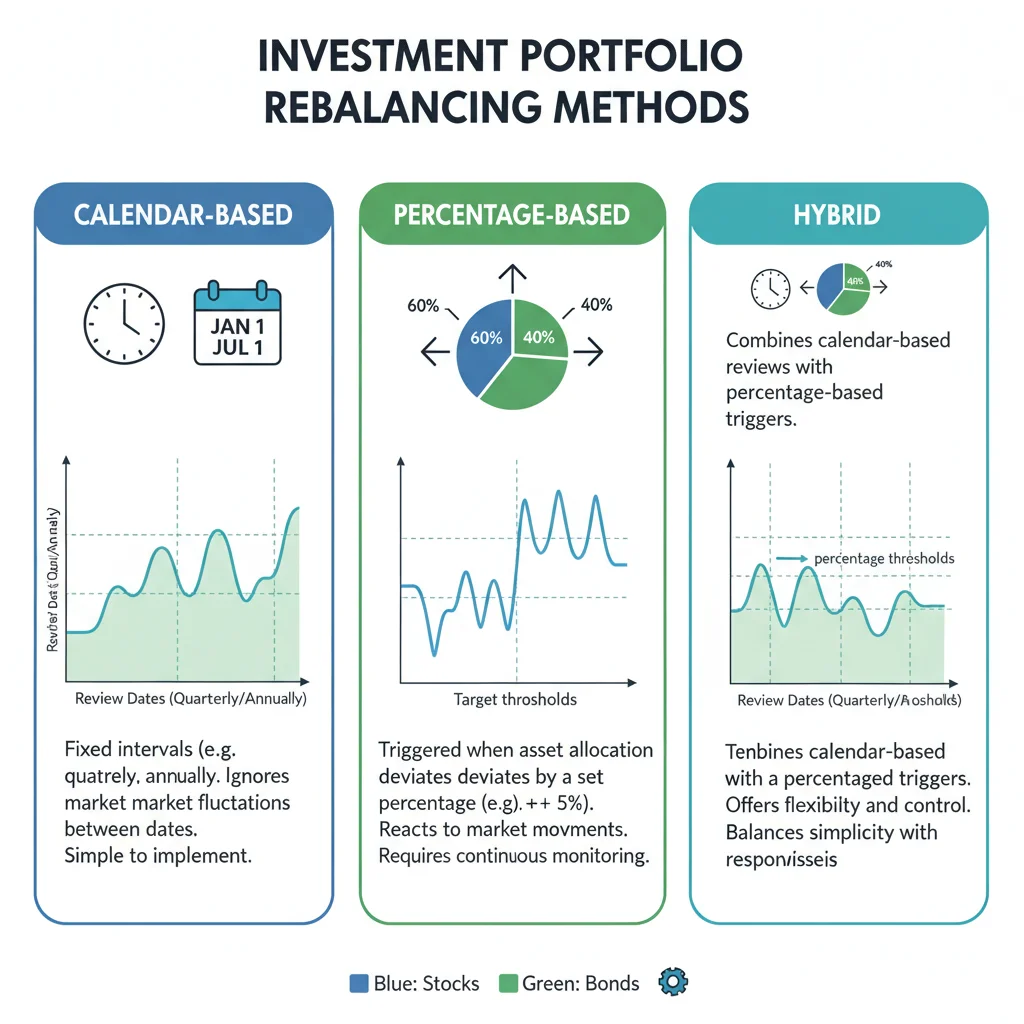
1. Calendar-Based Rebalancing
This is perhaps the simplest and most common method. Investors choose a fixed schedule (e.g., quarterly, semi-annually, or annually) to review and adjust their portfolio back to target allocations. The advantage here is its simplicity and predictability. It removes emotional bias by setting predetermined rebalancing dates. However, it might miss significant market shifts that occur between these dates, potentially leading to suboptimal adjustments.
2. Percentage-Based (Threshold) Rebalancing
Under this method, rebalancing is triggered when an asset class deviates by a certain percentage from its target allocation. For example, if your target allocation to equities is 60%, you might set a threshold of 5%. If equities rise to 65% or fall to 55%, a rebalance is triggered. This method is more adaptive to market movements than calendar-based rebalancing, as it responds directly to significant shifts. The challenge lies in setting appropriate thresholds; too narrow, and you incur excessive transaction costs; too wide, and you risk drifting too far from your target risk profile.
3. Hybrid Rebalancing
As the name suggests, this combines elements of both calendar-based and percentage-based methods. You might set a review date (e.g., quarterly) but only rebalance if certain percentage thresholds are also breached. This offers a good balance between systematic review and responsiveness to market changes, potentially minimizing unnecessary trades while still maintaining control over portfolio drift.
While these traditional methods are effective, the volatile nature of US markets in 2026 demands a more nuanced and proactive approach. This brings us to advanced portfolio rebalancing strategies.
Advanced Portfolio Rebalancing Strategies for 2026 Volatility
Achieving a 10% growth target in potentially turbulent markets requires moving beyond basic rebalancing. Here, we explore sophisticated strategies that integrate market insights, risk modeling, and a more dynamic approach.
1. Dynamic Threshold Rebalancing with Volatility Adjustments
Instead of fixed percentage thresholds, dynamic threshold rebalancing adjusts the trigger points based on market volatility. In periods of high volatility, you might widen your thresholds to avoid excessive trading and associated costs, as asset prices swing wildly. Conversely, in periods of lower volatility, you might narrow thresholds to keep the portfolio closer to its target allocation, capturing smaller, more consistent gains. This requires real-time monitoring of market volatility metrics (e.g., VIX index for equity volatility).
2. Tactical Asset Allocation (TAA) Integration
While traditional rebalancing is purely systematic, integrating Tactical Asset Allocation (TAA) adds a discretionary layer. TAA involves making short-to-medium-term adjustments to asset allocations based on market forecasts, economic outlooks, or specific investment themes. For example, if you foresee a strong performance in a particular sector due to policy changes or technological breakthroughs, you might temporarily overweight that sector beyond your strategic allocation. When the market conditions shift, you would then rebalance back to your strategic allocation. This strategy requires strong analytical capabilities and a robust understanding of macroeconomic trends.
3. Risk-Based Rebalancing
Traditional rebalancing often focuses on asset class percentages. Risk-based rebalancing, however, focuses on maintaining a constant level of risk contribution from each asset class or factor. This is particularly relevant in volatile markets where the risk characteristics of assets can change rapidly. For instance, if an asset class suddenly becomes much riskier (e.g., due to increased correlation with other assets or higher intrinsic volatility), you might reduce its allocation even if its percentage weight hasn’t significantly deviated. This approach often utilizes metrics like Value-at-Risk (VaR) or Conditional Value-at-Risk (CVaR) to manage portfolio risk more precisely.
4. Factor-Based Rebalancing
Instead of rebalancing based purely on asset classes (e.g., stocks, bonds), factor-based rebalancing focuses on underlying investment factors such as value, growth, momentum, quality, and low volatility. If your portfolio is designed to have a certain exposure to these factors, you would rebalance when the actual factor exposures drift. For example, if your portfolio’s exposure to the ‘value’ factor decreases significantly, you would rebalance by adding more value-oriented stocks. This provides a more granular control over the drivers of your portfolio’s returns and risks, crucial for navigating complex market dynamics.
5. Rebalancing with Derivatives and Hedging
For sophisticated investors, derivatives (like options and futures) can be used to rebalance more efficiently or to hedge against specific risks without necessarily selling underlying assets. For example, if your equity allocation becomes too high, instead of selling stocks, you could sell equity index futures or buy put options to reduce your effective equity exposure. This can be particularly useful for large portfolios where selling significant blocks of assets might impact market prices or trigger higher tax events. However, this strategy introduces its own complexities and risks, requiring a deep understanding of derivatives markets.
Implementing Portfolio Rebalancing Strategies for 10% Growth in 2026
Achieving a 10% growth target is ambitious, especially in volatile markets. Your rebalancing strategy must be integrated with your overall investment philosophy and goals. Here’s how to practically implement these strategies:
1. Define Your Target Asset Allocation and Risk Tolerance
Before any rebalancing, clearly define your long-term strategic asset allocation based on your financial goals, time horizon, and risk tolerance. This is your baseline. For a 10% growth target, your portfolio will likely lean towards growth-oriented assets, but with careful diversification.
2. Choose Your Rebalancing Frequency and Triggers
Decide whether you will use calendar-based, threshold-based, or a hybrid approach. For advanced strategies, consider dynamic thresholds or integrating TAA review periods. Regular monitoring is key, even if rebalancing isn’t triggered.
3. Automate Where Possible
Many robo-advisors and brokerage platforms offer automated rebalancing services. While these are often based on simpler methods, they can be a great starting point, especially for smaller portfolios. For advanced strategies, you might need more hands-on involvement or sophisticated analytical tools.
4. Consider Tax Implications
Rebalancing often involves selling assets, which can trigger capital gains taxes. Be mindful of whether you are selling assets in taxable or tax-advantaged accounts. Tax-loss harvesting can sometimes be integrated with rebalancing to offset gains. For example, if you need to sell a winning asset, consider selling a losing asset to realize a loss that can offset capital gains.
5. Stay Informed and Adapt
The market environment of 2026 will not be static. Stay abreast of macroeconomic developments, geopolitical events, and technological trends. Be prepared to adapt your rebalancing strategy if the underlying market dynamics fundamentally shift. This doesn’t mean constant tinkering, but rather periodic strategic reviews.
Case Study: Navigating a Hypothetical 2026 Market Scenario
Imagine a scenario in early 2026 where inflation unexpectedly resurges, leading the Federal Reserve to adopt a more hawkish stance, causing a sharp, but temporary, correction in growth stocks. Simultaneously, commodities experience a boom due to supply chain disruptions. Your initial portfolio target was 60% US Equities (split between large-cap growth and value), 30% Fixed Income, and 10% Real Assets (including commodities).
Without Rebalancing: Your growth stock allocation might shrink significantly, while commodities could balloon, altering your risk profile and potentially diminishing overall returns as growth stocks recover.
With Advanced Rebalancing Strategies:
- Dynamic Thresholds: You might have wider thresholds for growth stocks during this volatile period, preventing premature selling at the bottom. However, as commodities surge past their threshold, you would trim them, taking profits.
- Tactical Overlay: Recognizing the temporary nature of the growth stock correction and the potential for a rebound, you might tactically reallocate a small portion from overperforming commodities or stable fixed income into undervalued growth stocks, effectively buying low.
- Risk-Based Adjustment: If your risk models indicate that the correlation between your fixed income and equity holdings has increased (reducing diversification benefits), you might adjust the bond allocation to maintain overall portfolio risk, perhaps by diversifying into different types of fixed income or alternative assets.
This proactive approach, guided by advanced portfolio rebalancing strategies, allows you to capitalize on market dislocations, protect capital, and position your portfolio for sustained growth even amidst volatility.

Common Pitfalls to Avoid in Portfolio Rebalancing
Even with the best intentions, investors can make mistakes. Be aware of these common pitfalls:
1. Over-Rebalancing
Rebalancing too frequently or with overly tight thresholds can lead to excessive transaction costs and potential tax liabilities, eroding returns. The goal is efficient rebalancing, not constant trading.
2. Emotional Decision-Making
The temptation to abandon a rebalancing plan during extreme market conditions (fear during downturns, greed during upswings) is strong. Stick to your predefined strategy. Rebalancing is a discipline.
3. Ignoring Tax Efficiency
Failing to consider the tax implications of selling assets can significantly reduce net returns. Always evaluate trades in light of their tax consequences.
4. Neglecting Long-Term Goals
While tactical adjustments are part of advanced strategies, ensure they don’t fundamentally derail your long-term financial objectives. Every adjustment should ultimately serve your overarching goals.
5. Lack of Diversification
Rebalancing is most effective in a well-diversified portfolio. If your portfolio is heavily concentrated, rebalancing might have limited impact or even expose you to unmanaged risks.
Conclusion: Mastering Portfolio Rebalancing for 2026 and Beyond
Navigating the US markets in 2026 with an aim to achieve 10% portfolio growth will require more than just a passive investment approach. It demands a sophisticated understanding and diligent application of advanced portfolio rebalancing strategies. By moving beyond traditional methods and incorporating dynamic thresholds, tactical asset allocation, risk-based adjustments, and even derivatives, investors can build a resilient portfolio capable of not just weathering volatility but actively leveraging it for superior returns.
Remember that the most effective strategy is one that is tailored to your specific circumstances, continuously monitored, and consistently applied. The discipline of rebalancing, combined with informed decision-making, will be your most powerful ally in achieving your financial objectives in the years to come. Start planning your 2026 rebalancing strategy now, and position yourself for success in an ever-changing market landscape.