Navigating the Department of Labor Overtime Rule Changes 2026: A Comprehensive Employer’s Guide
The landscape of employment law is in constant flux, and few changes carry as much weight for businesses as those emanating from the Department of Labor (DOL). As we approach 2026, employers across the United States are bracing for significant updates to the Fair Labor Standards Act (FLSA) overtime regulations. These impending changes, particularly concerning the salary thresholds for executive, administrative, and professional (EAP) exemptions, known as the ‘white-collar’ exemptions, are poised to redefine who is eligible for overtime pay and, consequently, impact payroll costs, staffing strategies, and overall operational budgets. Understanding the nuances of the new DOL Overtime Rule 2026 is not merely a matter of compliance; it’s a strategic imperative for every business.
For years, the FLSA has mandated that most employees in the U.S. receive at least the federal minimum wage for all hours worked and overtime pay at a rate of not less than one and one-half times their regular rate of pay for all hours worked over 40 in a workweek. However, certain employees are exempt from both minimum wage and overtime requirements. These include, most notably, the EAP exemptions. To qualify for these exemptions, employees must meet specific criteria related to their job duties, be paid on a salary basis, and earn a salary above a certain threshold. It is this salary threshold that the DOL is significantly increasing, culminating in the 2026 adjustments.
The primary goal of these rule changes, according to the DOL, is to restore and extend overtime protections to millions of lower-paid salaried workers. This initiative aims to ensure that more employees who perform non-exempt duties are properly compensated for their extra hours, aligning with the original intent of the FLSA. While this move is lauded by worker advocates, it presents a substantial challenge for employers, particularly small and medium-sized businesses, who must re-evaluate their classifications, compensation structures, and potentially their entire business models to remain compliant.
This comprehensive guide will delve into the specifics of the DOL Overtime Rule 2026, breaking down the new salary thresholds, explaining the various exemption tests, and outlining the critical steps employers must take to prepare for these changes. We will explore the potential impacts on different industries, discuss effective compliance strategies, and provide a roadmap for proactive planning to mitigate risks and ensure a smooth transition. By understanding and strategically addressing these updates now, businesses can avoid costly penalties, maintain employee morale, and sustain their operational efficiency in the evolving regulatory landscape.
Understanding the New Salary Thresholds for DOL Overtime Rule 2026
The cornerstone of the DOL Overtime Rule 2026 changes lies in the revised salary thresholds for the white-collar exemptions. Historically, these thresholds have been adjusted periodically to reflect economic changes and inflation, but the upcoming adjustments are particularly significant due to their magnitude and phased implementation. Employers need to be acutely aware of these new figures to correctly classify their employees and ensure compliance.
The Phased Approach to Salary Threshold Increases
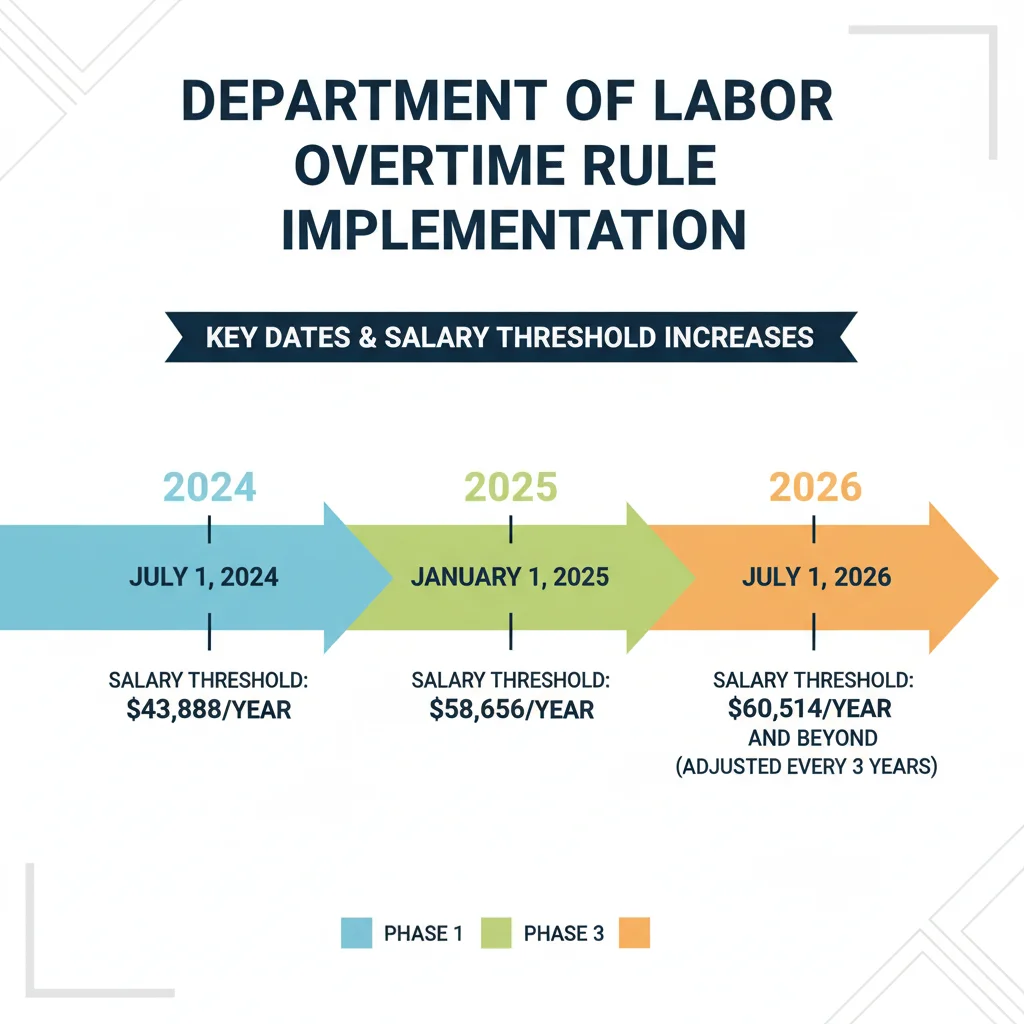
The DOL has opted for a multi-stage approach to implement the new salary thresholds, providing businesses with a window to adjust. This phased implementation is crucial for employers to monitor and plan for:
- July 1, 2024: The first increase sets the standard salary level for EAP exemptions to $844 per week ($43,888 annually). This is a foundational step, and many employers have already begun to assess its immediate impact.
- January 1, 2025: A further increase will raise the standard salary level to $1,128 per week ($58,656 annually). This adjustment represents a more substantial jump and will require many businesses to re-evaluate a broader range of their salaried workforce.
- July 1, 2026: The final and most impactful increase will set the standard salary level to $1,160 per week ($60,320 annually). This is the key threshold that employers must focus on for long-term planning and compliance under the DOL Overtime Rule 2026.
It’s important to note that these thresholds are not static. Going forward, the DOL intends to update the salary thresholds every three years, using a methodology tied to wage data. This means that compliance will be an ongoing process, requiring continuous monitoring and adaptation from employers.
Highly Compensated Employee (HCE) Thresholds
In addition to the standard EAP exemptions, the FLSA also includes an exemption for Highly Compensated Employees (HCEs). These employees are subject to a less stringent duties test but must meet a significantly higher salary threshold. The DOL’s rule changes also impact the HCE threshold:
- July 1, 2024: The HCE total annual compensation threshold increases to $132,604.
- January 1, 2025: The HCE total annual compensation threshold further increases to $145,100.
- July 1, 2026: The final HCE total annual compensation threshold will be $151,164.
Employers with highly paid staff should pay close attention to these figures, as misclassifying an HCE can lead to significant liabilities. The HCE exemption still requires that a portion of the compensation meets the standard salary level ($844/week in 2024, $1,128/week in 2025, and $1,160/week in 2026) on a salary basis, and the employee must customarily and regularly perform at least one of the exempt duties of an executive, administrative, or professional employee.
Beyond Salary: The Duties Test and DOL Overtime Rule 2026
While the salary threshold receives much of the attention, it’s crucial to remember that merely meeting the salary requirement does not automatically qualify an employee for an EAP exemption. The DOL Overtime Rule 2026, like previous iterations, maintains the importance of the "duties test." Employees must satisfy both the salary basis test (being paid a predetermined, fixed salary) and the salary level test (earning above the threshold), AND their primary job duties must fall within the definitions of executive, administrative, or professional work.
Executive Exemption Duties
To qualify for the executive exemption, an employee’s primary duty must be managing the enterprise, or a customarily recognized department or subdivision thereof. They must customarily and regularly direct the work of two or more other full-time employees or their equivalent, and have the authority to hire or fire other employees, or their suggestions and recommendations as to the hiring, firing, advancement, promotion, or any other change of status of other employees must be given particular weight.
Administrative Exemption Duties
For the administrative exemption, the employee’s primary duty must be the performance of office or non-manual work directly related to the management or general business operations of the employer or the employer’s customers. Additionally, their primary duty must include the exercise of discretion and independent judgment with respect to matters of significance.
Professional Exemption Duties
The professional exemption generally applies to employees whose primary duty is the performance of work requiring advanced knowledge in a field of science or learning customarily acquired by a prolonged course of specialized intellectual instruction (learned professionals), or work requiring invention, imagination, originality, or talent in a recognized field of artistic endeavor (creative professionals).
Employers often make the mistake of assuming that simply giving an employee a "manager" or "director" title automatically makes them exempt. This is a dangerous misconception. The DOL rigorously examines the actual duties performed, not just job titles. With the new DOL Overtime Rule 2026, it is more critical than ever to conduct thorough job duty analyses for all salaried employees to ensure they genuinely meet the duties test criteria in addition to the new salary thresholds.
Impact on Businesses: Preparing for DOL Overtime Rule 2026
The impending DOL Overtime Rule 2026 changes are not merely administrative adjustments; they represent a significant shift that will have far-reaching operational and financial implications for businesses across all sectors. Proactive preparation is key to mitigating negative impacts and ensuring a smooth transition.
Financial Implications and Budgeting
The most immediate and obvious impact will be on payroll costs. For employees currently classified as exempt but earning below the new salary thresholds, employers will have several options:
- Raise Salaries: Increase the employee’s salary to meet the new threshold, thus maintaining their exempt status. This is often the simplest solution for employees whose salaries are close to the new threshold.
- Reclassify to Non-Exempt: Reclassify the employee as non-exempt, meaning they will be eligible for overtime pay for hours worked over 40 in a workweek. This requires meticulous tracking of hours and careful management of overtime.
- Adjust Workloads/Hours: For reclassified employees, employers might need to adjust workloads, redistribute tasks, or hire additional staff to ensure that non-exempt employees do not regularly work over 40 hours, thereby minimizing overtime costs.
- Combination Approach: A hybrid approach, where some employees receive salary increases and others are reclassified, might be the most practical solution for many businesses.
Each of these options carries distinct financial implications. Raising salaries directly increases fixed costs. Reclassifying employees can lead to unpredictable overtime expenses, especially in industries with fluctuating demand. Employers must analyze their current payroll, project potential overtime hours, and model the financial impact of each strategy. This analysis should inform budgeting decisions for 2025 and 2026.
Operational Adjustments and Workforce Management
Beyond finances, the DOL Overtime Rule 2026 will necessitate operational adjustments. Reclassifying employees as non-exempt introduces new administrative burdens:
- Time Tracking: Non-exempt employees must accurately track all hours worked, includiing breaks, which requires robust timekeeping systems and clear policies.
- Scheduling: Managers will need to be trained on how to schedule non-exempt employees to minimize or manage overtime hours effectively. This might involve staggered shifts, stricter adherence to 40-hour workweeks, or cross-training employees to cover peak periods.
- Communication: Clear and transparent communication with employees regarding their classification changes, new compensation structures, and timekeeping requirements is paramount to maintain morale and avoid confusion.
- Productivity: Businesses will need to assess if existing workflows and staffing levels can maintain productivity without incurring excessive overtime. This could be an opportunity to optimize processes or invest in automation.
Industries heavily reliant on salaried employees just above the current thresholds, such as retail, hospitality, non-profits, and certain administrative sectors, are likely to feel the most significant effects. These businesses often operate with tight margins and may need to make substantial adjustments to their staffing and service delivery models.
Compliance Strategies for the DOL Overtime Rule 2026
Effective compliance with the DOL Overtime Rule 2026 requires a multi-faceted strategy that goes beyond simply adjusting salaries. It demands a thorough review of current practices, proactive planning, and ongoing vigilance.
Conduct a Comprehensive Audit
The first step is to conduct a detailed audit of your current workforce. This audit should include:
- Identify All Salaried Employees: Create a list of all employees currently classified as exempt.
- Review Current Salaries: Compare each exempt employee’s current salary against the new thresholds for July 2024, January 2025, and July 2026.
- Analyze Job Duties: For each exempt employee, meticulously review their job description and actual duties performed to ensure they genuinely meet the EAP (or HCE) duties tests. Do not rely solely on job titles. This is often where employers fall short.
- Assess Historical Overtime: For employees likely to be reclassified, analyze historical working patterns to estimate potential overtime hours and associated costs.
Develop a Reclassification and Compensation Strategy
Based on your audit, develop a clear strategy for each affected employee:
- Raise to Threshold: For those whose salaries are slightly below the new threshold and who clearly meet the duties test, consider raising their salaries to maintain exempt status.
- Reclassify to Non-Exempt: For those significantly below the threshold or who do not meet the duties test, reclassify them as non-exempt. Determine how you will compensate them – hourly wage, salaried non-exempt (with overtime), or a combination.
- "Fluctuating Workweek" Method: Explore alternative compensation methods like the "fluctuating workweek" method, where non-exempt employees receive a fixed salary for fluctuating hours, plus half-time for overtime hours. This method has specific requirements and should be implemented with legal counsel.
- Review Bonus Structures: Ensure any bonuses or incentive payments are correctly factored into the regular rate of pay for overtime calculations, especially for non-exempt employees.
Update Policies and Procedures
The DOL Overtime Rule 2026 will necessitate updates to various internal documents and processes:
- Employee Handbooks: Revise policies related to overtime, timekeeping, meal and rest breaks, and employee classifications.
- Job Descriptions: Update job descriptions to accurately reflect the duties and exempt/non-exempt status of positions.
- Timekeeping Systems: Implement or upgrade timekeeping systems to accurately capture all hours worked by non-exempt employees. This is non-negotiable for compliance.
- Payroll Systems: Ensure your payroll system can accurately calculate regular rates of pay and overtime compensation according to FLSA requirements.

Training and Communication
Effective implementation hinges on proper training and clear communication:
- Manager Training: Train all managers and supervisors on the new DOL Overtime Rule 2026, focusing on proper classification, timekeeping requirements for non-exempt employees, and strategies for managing overtime. They are on the front lines of compliance.
- Employee Communication: Clearly communicate any changes in classification, compensation, or timekeeping procedures to affected employees well in advance. Explain the reasons for the changes and address any concerns. Transparency can help mitigate negative reactions.
- HR Team Education: Ensure your HR team is fully versed in the new regulations, capable of answering employee questions, and equipped to handle compliance issues.
Long-Term Planning and the Future of Overtime Rules
The DOL Overtime Rule 2026 should not be viewed as a one-time hurdle but rather as an integral part of ongoing workforce management. With the DOL’s commitment to regular updates every three years, employers must embed continuous review and adaptation into their HR and payroll processes.
Continuous Monitoring and Review
Establish a regular cadence for reviewing employee classifications and compensation plans. This should ideally occur annually, but at a minimum, before each scheduled salary threshold increase. Stay informed about future DOL guidance and potential amendments to the FLSA.
Leveraging Technology
Invest in robust HR and payroll technologies that can automate time tracking, calculate overtime accurately, and provide data for compliance audits. Modern HRIS (Human Resources Information Systems) can be invaluable tools for managing these complexities.
Seeking Expert Guidance
Given the complexity and potential liability associated with wage and hour laws, consulting with legal counsel and HR experts is highly recommended. They can provide tailored advice, review your compliance strategies, and help navigate specific challenges unique to your business or industry. This is particularly important when considering nuanced situations or implementing alternative compensation models.
The penalties for non-compliance with FLSA regulations can be severe, including back wages, liquidated damages (often double the back wages), civil money penalties, and legal fees. Proactive compliance is not just good practice; it’s a financial necessity.
Conclusion: Embracing Change with the DOL Overtime Rule 2026
The DOL Overtime Rule 2026 represents a significant evolution in federal wage and hour regulations, designed to extend overtime protections to a broader segment of the salaried workforce. While these changes present challenges for employers, they also offer an opportunity to review and optimize compensation strategies, improve workforce planning, and reinforce a culture of compliance and fair compensation.
By understanding the new salary thresholds, meticulously evaluating job duties, and implementing comprehensive compliance strategies, businesses can successfully navigate these updates. The phased implementation provides a valuable window for preparation, but timely action is crucial. Engage your HR, payroll, legal, and operational teams now to conduct audits, make necessary adjustments, and communicate effectively with your employees.
Ultimately, preparing for the DOL Overtime Rule 2026 is about more than just avoiding penalties; it’s about building a resilient, compliant, and well-compensated workforce that can thrive in the evolving economic and regulatory environment. Proactive planning today will ensure your business is well-positioned for success tomorrow.