Navigating FDA Digital Health Regulations: Your 2026 Approval Blueprint
The landscape of healthcare is undergoing a profound transformation, driven by the rapid advancements in digital health technologies. From mobile health apps and wearable sensors to artificial intelligence-powered diagnostics and telehealth platforms, these innovations promise to revolutionize patient care, enhance accessibility, and improve health outcomes. However, with great innovation comes the critical need for robust regulatory oversight to ensure safety, efficacy, and data privacy. This is where the FDA Digital Health Regulations come into play, shaping the future of how these cutting-edge products are developed, marketed, and utilized.
For companies operating in this dynamic sector, understanding and proactively adhering to the latest FDA guidelines is not merely a compliance burden but a strategic imperative. The goal for many is not just to launch a product, but to achieve 100% FDA approval, especially as we look towards the ambitious target of 2026. This comprehensive guide aims to demystify the complex world of FDA Digital Health Regulations, providing a clear blueprint for success and ensuring your innovations meet the highest standards of regulatory excellence.
The FDA’s approach to digital health is continuously evolving, reflecting the pace of technological change. Historically, medical device regulations were primarily geared towards hardware. However, the rise of software as a medical device (SaMD) and other digital health tools has necessitated a more agile and nuanced regulatory framework. This evolution is designed to foster innovation while safeguarding public health, a delicate balance that the FDA strives to maintain.
Achieving 100% approval by 2026 requires a deep dive into the current regulatory environment, an understanding of anticipated changes, and a proactive strategy for compliance. This article will explore the key definitions, classifications, and regulatory pathways pertinent to digital health products. We will delve into the critical aspects of premarket submissions, quality system requirements, cybersecurity considerations, and real-world performance monitoring. Furthermore, we will highlight the importance of early engagement with the FDA and the benefits of adopting a ‘quality by design’ philosophy from the outset of product development.
The journey to FDA approval can be arduous, but with careful planning, expert guidance, and a thorough understanding of the FDA Digital Health Regulations, it is an achievable goal. Our aim is to equip you with the knowledge and insights needed to navigate this path successfully, transforming regulatory challenges into opportunities for growth and market leadership in the rapidly expanding digital health ecosystem.
Understanding the Core of FDA Digital Health Regulations
To effectively navigate the regulatory landscape, it’s crucial to grasp the fundamental concepts underpinning FDA Digital Health Regulations. The FDA defines digital health as a broad category encompassing mobile health (mHealth), health information technology (IT), wearable devices, telehealth and telemedicine, and personalized medicine. These technologies leverage computing platforms, connectivity, software, and sensors for healthcare and related uses.
What Constitutes a Medical Device in the Digital Realm?
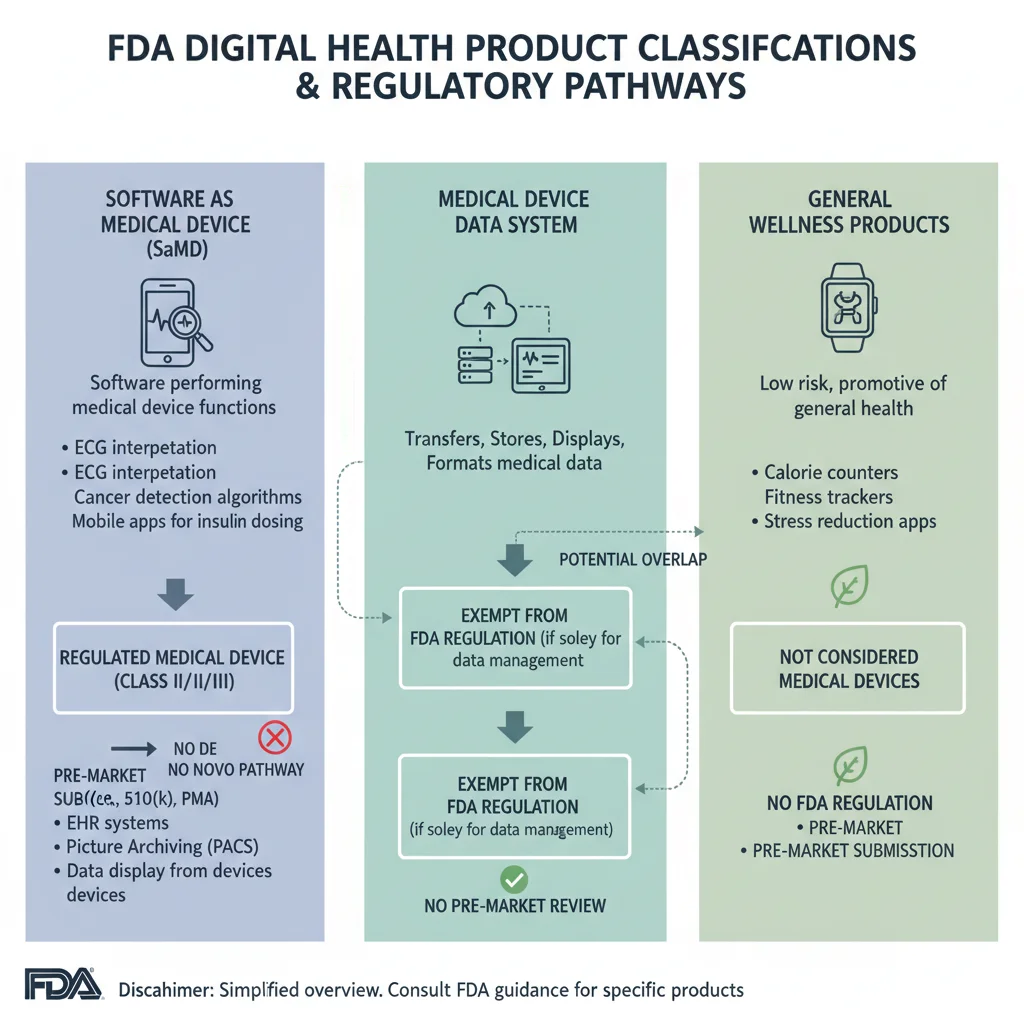
Not all digital health products fall under the purview of FDA medical device regulations. A key distinction lies in whether a product is intended for use in the diagnosis of disease or other conditions, or in the cure, mitigation, treatment, or prevention of disease. For example, a general wellness app that tracks steps or calories might not be considered a medical device, whereas an app that analyzes glucose levels to recommend insulin dosages almost certainly would be.
The FDA has provided guidance to clarify these distinctions, notably through its ‘General Wellness: Policy for Low Risk Devices’ guidance and its ‘Clinical Decision Support Software’ guidance. These documents help innovators determine if their product is a medical device and, if so, what level of regulatory scrutiny it will undergo. Understanding these distinctions early in the development cycle can save significant time and resources.
Software as a Medical Device (SaMD)
A particularly important category within digital health is Software as a Medical Device (SaMD). SaMD refers to software intended to be used for one or more medical purposes without being part of a hardware medical device. Examples include software that analyzes medical images for diagnostic purposes, or algorithms that predict the risk of disease based on patient data. The regulatory approach to SaMD is distinct and often more complex than for traditional hardware devices due to its inherent flexibility and potential for frequent updates.
The International Medical Device Regulators Forum (IMDRF) has developed a framework for SaMD classification based on the impact of the information provided by the SaMD on healthcare decisions and the state of the healthcare situation or condition. This framework is widely adopted by regulatory bodies, including the FDA, and helps in determining the appropriate regulatory pathway and the level of evidence required for approval.
Classifications and Regulatory Pathways for Digital Health Products
Once it’s determined that a digital health product is indeed a medical device, the next step is to understand its classification and the corresponding regulatory pathway. The FDA classifies medical devices into three categories based on risk: Class I, Class II, and Class III.
Class I Devices: Low Risk
Class I devices present the lowest risk to patients and users. Many digital health products, particularly those considered general wellness or low-risk SaMD, may fall into this category. Most Class I devices are exempt from premarket notification (510(k)) requirements, meaning they do not need FDA clearance before marketing, though they must still adhere to general controls such as good manufacturing practices (GMPs), labeling requirements, and adverse event reporting.
Class II Devices: Moderate Risk
The majority of digital health medical devices fall into Class II. These devices pose a moderate risk and typically require premarket notification (510(k)) clearance. A 510(k) submission demonstrates that the device is substantially equivalent to a legally marketed predicate device. This pathway often involves demonstrating performance testing, risk management, and sometimes even clinical data, depending on the device’s complexity and intended use.
Examples of Class II digital health devices include many diagnostic software applications, certain wearable sensors that monitor physiological parameters for medical purposes, and some telehealth platforms that facilitate remote patient monitoring with diagnostic capabilities. Navigating the 510(k) process for digital health products requires a thorough understanding of FDA expectations regarding software validation, cybersecurity, and usability.
Class III Devices: High Risk
Class III devices are those that support or sustain human life, are of substantial importance in preventing impairment of human health, or present a potential unreasonable risk of illness or injury. These devices typically require Premarket Approval (PMA), the most stringent regulatory pathway. A PMA application requires extensive scientific evidence to demonstrate the device’s safety and effectiveness, often involving large-scale clinical trials.
While fewer digital health products fall into Class III, some highly innovative or life-sustaining technologies, such as certain AI-powered diagnostic tools for critical conditions or closed-loop insulin delivery systems, might be classified as such. The PMA process is resource-intensive and demands a high level of scientific rigor and regulatory expertise.
Key Considerations for 100% FDA Approval by 2026
Achieving 100% FDA approval for your digital health product by 2026 is an ambitious yet attainable goal. It requires a proactive and comprehensive strategy that integrates regulatory compliance throughout the entire product lifecycle. Here are the critical areas to focus on:
1. Early Regulatory Strategy and Predetermination
The single most important step is to engage with regulatory experts and, if necessary, with the FDA itself, early in the product development process. Utilizing FDA programs like the Pre-Submission (Pre-Sub) program allows manufacturers to obtain FDA feedback on their proposed regulatory pathway, study design, and data requirements before formal submission. This early dialogue can significantly de-risk the approval process and prevent costly delays.
Determining whether your product is a medical device, its classification, and the appropriate regulatory pathway at the outset is fundamental. Misclassifications can lead to significant setbacks and rework.
2. Quality Management System (QMS) Compliance
All medical device manufacturers, including those developing digital health products, must establish and maintain a Quality Management System (QMS) that complies with 21 CFR Part 820 (Quality System Regulation). For software, this includes robust processes for design controls, software validation, risk management, configuration management, and complaint handling. A well-implemented QMS is the cornerstone of demonstrating product safety and effectiveness, and it’s essential for navigating FDA Digital Health Regulations.
For SaMD and other software-heavy devices, specific attention must be paid to IEC 62304 (Medical device software – Software life cycle processes) and ISO 14971 (Medical devices – Application of risk management to medical devices). Integrating these standards into your QMS from the design phase ensures compliance and builds a strong foundation for regulatory submissions.
3. Software Validation and Verification
Software validation is paramount for digital health products. It involves confirming that the software meets its intended use and user needs. This goes beyond simple testing; it encompasses the entire software development lifecycle, from requirements definition to deployment and maintenance. The FDA expects thorough documentation of all validation activities, including test plans, protocols, results, and traceability to requirements and risk analyses.
Verification, on the other hand, ensures that the software design outputs meet the design inputs. Together, validation and verification provide confidence that the software is robust, reliable, and performs as intended, which is a critical component of FDA Digital Health Regulations compliance.
4. Cybersecurity by Design
Given the increasing threat of cyberattacks and the sensitive nature of health data, cybersecurity is a top priority for the FDA. Manufacturers must implement cybersecurity controls throughout the product lifecycle, from design to post-market surveillance. This includes conducting threat modeling, risk assessments, and implementing measures to protect against unauthorized access, data breaches, and other cyber threats.
The FDA has issued extensive guidance on cybersecurity in medical devices, emphasizing the need for a total product lifecycle approach. Demonstrating a robust cybersecurity framework is no longer optional; it is a mandatory element for successful FDA approval, especially for devices connected to networks or handling patient data. Proactive engagement with cybersecurity best practices is crucial for navigating FDA Digital Health Regulations.
5. Clinical Evidence and Performance Data
The level of clinical evidence required depends on the device’s classification and intended use. For Class II devices, performance data demonstrating substantial equivalence to a predicate device is often sufficient. This can include bench testing, non-clinical studies, and sometimes limited clinical data. For Class III devices, comprehensive clinical trials are typically required to establish safety and effectiveness.
For digital health products, the FDA is increasingly interested in real-world evidence (RWE) and real-world data (RWD) to support regulatory decisions. This includes data gathered from electronic health records, claims and billing activities, product registries, patient-generated data, and other sources. Leveraging RWE can provide valuable insights into a product’s performance in actual clinical settings and potentially streamline the approval process.
6. Usability and Human Factors Engineering
Digital health products are often designed for direct patient or clinician interaction, making usability a critical factor for safety and effectiveness. Human Factors Engineering (HFE) involves designing devices to minimize use errors and optimize user experience. The FDA expects manufacturers to conduct HFE studies to identify potential use errors and mitigate associated risks. This ensures that the device can be used safely and effectively by its intended users in the intended use environment.
The Evolving Landscape: Future Trends in FDA Digital Health Regulations
The FDA’s regulatory framework for digital health is not static; it is continually evolving to keep pace with technological advancements and emerging public health needs. Staying abreast of these trends is vital for ensuring long-term compliance and achieving 100% approval by 2026 and beyond.
Artificial Intelligence and Machine Learning (AI/ML)
The proliferation of AI/ML in digital health presents unique regulatory challenges and opportunities. AI/ML algorithms can learn and adapt over time, raising questions about how to regulate such ‘adaptive’ software. The FDA has acknowledged this by developing a proposed regulatory framework for AI/ML-based SaMD, focusing on a ‘total product lifecycle’ approach that would allow for modifications to algorithms while ensuring safety and effectiveness.
Key aspects of this framework include a predetermined change control plan, which outlines the types of modifications that can be made and the methods for validating and verifying those changes, and a focus on real-world performance monitoring. Companies developing AI/ML-driven digital health products must pay close attention to these evolving guidelines to ensure their products meet future FDA Digital Health Regulations.
Decentralized Clinical Trials (DCTs)
The COVID-19 pandemic accelerated the adoption of decentralized clinical trials, which leverage digital health technologies to collect data remotely. The FDA has provided guidance on conducting DCTs, recognizing their potential to improve patient access, reduce costs, and enhance the efficiency of clinical research. Companies should explore how DCTs can be integrated into their clinical development plans to gather evidence for FDA submissions, especially for digital health products.
Interoperability and Data Exchange
The ability of digital health products to seamlessly exchange data with other health IT systems (e.g., Electronic Health Records) is becoming increasingly important for integrated care. The FDA, in collaboration with other federal agencies, is promoting interoperability standards to ensure that data can flow securely and effectively across different platforms. Manufacturers should design their products with interoperability in mind, adhering to relevant standards and ensuring data privacy and security during exchange.
Personalized Medicine and Digital Biomarkers
Digital health is playing a crucial role in advancing personalized medicine, where treatments are tailored to individual patient characteristics. Digital biomarkers, derived from wearable sensors and other digital tools, offer new ways to monitor health, predict disease, and assess treatment response. As these technologies mature, the FDA will continue to refine its regulatory approach to ensure the robustness and reliability of digital biomarkers for clinical decision-making.

Strategic Approaches for Ensuring 100% Approval by 2026
To achieve the ambitious goal of 100% FDA approval by 2026, a strategic and integrated approach is essential. This goes beyond mere compliance; it involves embedding regulatory thinking into the very fabric of your organization and product development process.
1. Invest in Regulatory Expertise
Building an in-house regulatory team with deep expertise in digital health or partnering with experienced regulatory consultants is critical. The nuances of FDA Digital Health Regulations require specialized knowledge that general medical device regulatory affairs professionals might not possess. This expertise will be invaluable in navigating complex guidance documents, preparing robust submissions, and engaging effectively with the FDA.
2. Adopt a ‘Quality by Design’ Philosophy
Integrate regulatory requirements and quality considerations from the earliest stages of product design and development. This ‘quality by design’ approach ensures that compliance is not an afterthought but an intrinsic part of the product’s DNA. It minimizes the need for costly rework and significantly streamlines the approval process. This includes incorporating cybersecurity, usability, and data privacy considerations from day one.
3. Proactive Engagement with the FDA
Don’t wait until your submission is ready to engage with the FDA. Utilize pre-submission meetings, participate in FDA workshops and public forums, and stay informed about new guidance documents. Proactive communication can clarify expectations, address potential concerns early, and build a collaborative relationship with the agency. This is particularly important for novel or complex digital health technologies where established regulatory pathways may not fully apply.
4. Robust Documentation and Traceability
For digital health products, especially SaMD, meticulous documentation is non-negotiable. Maintain comprehensive records of design inputs and outputs, risk analyses, software validation activities, testing results, and change control. Ensure full traceability from user needs to testing protocols. This detailed documentation will form the backbone of your FDA submission and demonstrate your adherence to FDA Digital Health Regulations.
5. Continuous Monitoring and Post-Market Surveillance
FDA approval is not the end of the regulatory journey; it’s an ongoing commitment. Establish robust post-market surveillance systems to monitor product performance, collect real-world data, and identify any adverse events or quality issues. This continuous monitoring not only ensures ongoing compliance but also provides valuable data for product improvements and future regulatory submissions, especially for adaptive AI/ML algorithms. Being prepared for post-market audits and inspections is also crucial.
6. Stay Updated on Evolving Guidance
The digital health space is dynamic, and FDA guidance is regularly updated. Subscribe to FDA newsletters, monitor their website for new publications, and participate in industry groups to stay informed about the latest changes to FDA Digital Health Regulations. A dedicated regulatory intelligence function within your organization can ensure you are always ahead of the curve.
Conclusion: Paving the Way for Digital Health Innovation and Approval
The journey to achieving 100% FDA approval for digital health products by 2026 is multifaceted, demanding a blend of technological innovation, regulatory acumen, and strategic foresight. The FDA Digital Health Regulations are designed to ensure that these transformative technologies are safe, effective, and beneficial to public health, while also fostering an environment conducive to innovation.
By understanding the core definitions, navigating the classification systems, and meticulously adhering to quality system requirements, software validation, and cybersecurity best practices, companies can build a strong foundation for regulatory success. Proactive engagement with the FDA, a ‘quality by design’ philosophy, and continuous vigilance over evolving guidance, especially concerning AI/ML and real-world evidence, will be critical differentiators.
The digital health revolution is here to stay, promising a future of more accessible, personalized, and efficient healthcare. For innovators, embracing the challenge of FDA compliance is not just about avoiding penalties; it’s about building trust, ensuring patient safety, and ultimately, bringing life-changing technologies to those who need them most. By meticulously preparing and strategically executing your regulatory plan, your digital health product can not only meet but exceed the FDA’s rigorous standards, securing its place in the healthcare landscape of 2026 and beyond.
The opportunity to make a significant impact on global health through digital innovation is immense. By treating FDA Digital Health Regulations not as hurdles but as integral components of product excellence, companies can pave the way for a healthier, more connected future.