Hedge Fund Replication: Beat the US Market by 7% Annually
Hedge Fund Replication: Building a US Market-Beating Portfolio with a 7% Outperformance Goal.
In the relentless pursuit of superior investment returns, many retail and institutional investors often look towards the seemingly enigmatic world of hedge funds. These elite investment vehicles, known for their sophisticated strategies and often hefty fees, promise to deliver ‘alpha’ – returns in excess of market benchmarks. While direct investment in many hedge funds remains out of reach for the average investor, the concept of Hedge Fund Replication has emerged as a powerful and accessible alternative. This article delves into the intricacies of building a US market-beating portfolio with an ambitious yet achievable goal of 7% outperformance annually, leveraging the principles of hedge fund replication.
The allure of hedge funds is undeniable. They employ a diverse array of strategies, from long/short equity to global macro, arbitrage, and managed futures, aiming to generate returns irrespective of market direction. However, their high fees (often ‘2 and 20’ – 2% management fee and 20% of profits) and illiquidity can significantly erode net returns. This is where Hedge Fund Replication steps in. Instead of directly investing in hedge funds, replication strategies seek to mimic their return profiles by investing in a portfolio of liquid, transparent, and low-cost assets, such as stocks, bonds, and derivatives, that capture the underlying risk factors and systematic biases present in hedge fund strategies.
Our objective is clear: to construct a portfolio capable of consistently outperforming the broad US market (e.g., the S&P 500 or Russell 3000) by an average of 7% per year. This is an ambitious target, requiring a deep understanding of market dynamics, quantitative analysis, and disciplined execution. We will explore the theoretical underpinnings, practical components, and advanced techniques necessary to achieve this significant outperformance through a well-structured hedge fund replication approach.
Understanding the Alpha Puzzle: Deconstructing Hedge Fund Returns
The first step in replicating hedge fund performance is to understand what drives their returns. Academic research and industry analysis have increasingly shown that a significant portion of hedge fund returns, often attributed to skill (alpha), can actually be explained by exposure to a set of well-documented risk factors and systematic strategies. This realization is the cornerstone of Hedge Fund Replication.
Systematic Risk Factors: The Building Blocks of Return
Modern portfolio theory and subsequent developments have identified several key systematic risk factors that explain a large part of asset price movements and, consequently, investment returns. While the Capital Asset Pricing Model (CAPM) introduced market risk (beta), subsequent models, such as Fama-French three-factor and five-factor models, expanded on this by including:
- Value (HML – High Minus Low): The tendency for value stocks (low price-to-book, low price-to-earnings) to outperform growth stocks over long periods.
- Size (SMB – Small Minus Big): The historical outperformance of small-capitalization stocks compared to large-capitalization stocks.
- Momentum (UMD – Up Minus Down): The tendency for stocks that have performed well recently to continue performing well, and vice versa.
- Quality (RMW – Robust Minus Weak, or other quality metrics): Companies with high profitability, stable earnings, and strong balance sheets tending to outperform those with lower quality.
- Low Volatility (Conservative Minus Aggressive): Stocks with lower volatility often outperforming those with higher volatility, especially on a risk-adjusted basis.
- Investment (CMA – Conservative Minus Aggressive Investment): Companies that invest less conservatively tend to have higher returns.
Many hedge fund strategies, consciously or unconsciously, harvest these factor premiums. For instance, a long/short equity fund might systematically go long value stocks and short growth stocks, effectively taking a value factor bet. By identifying and strategically combining these factors, we can construct a portfolio that mirrors the risk-return characteristics of many hedge funds, but with lower costs and greater transparency.
Hedge Fund Style Analysis and Factor Mapping
The field of Hedge Fund Replication often begins with a ‘style analysis’ of various hedge fund indices or individual funds. This involves regressing their historical returns against a set of known market and factor benchmarks. The coefficients from these regressions reveal the underlying factor exposures. For example, a global macro fund might show significant exposure to currency movements, commodity prices, and interest rate changes, in addition to equity market beta.
Once these factor exposures are identified, the replication process involves constructing a portfolio of liquid assets that has similar exposures. This is a quantitative exercise, often involving sophisticated econometric models and optimization techniques to match the target fund’s factor sensitivities while minimizing tracking error.
Building Your Replicating Portfolio: Practical Strategies for Outperformance
Achieving a 7% outperformance over the US market requires a multi-pronged approach, integrating factor investing, tactical allocation, and potentially the judicious use of alternative data. The goal is not just to match hedge fund returns but to improve upon them by eliminating their high fees and illiquidity premiums.
Factor-Based Portfolio Construction
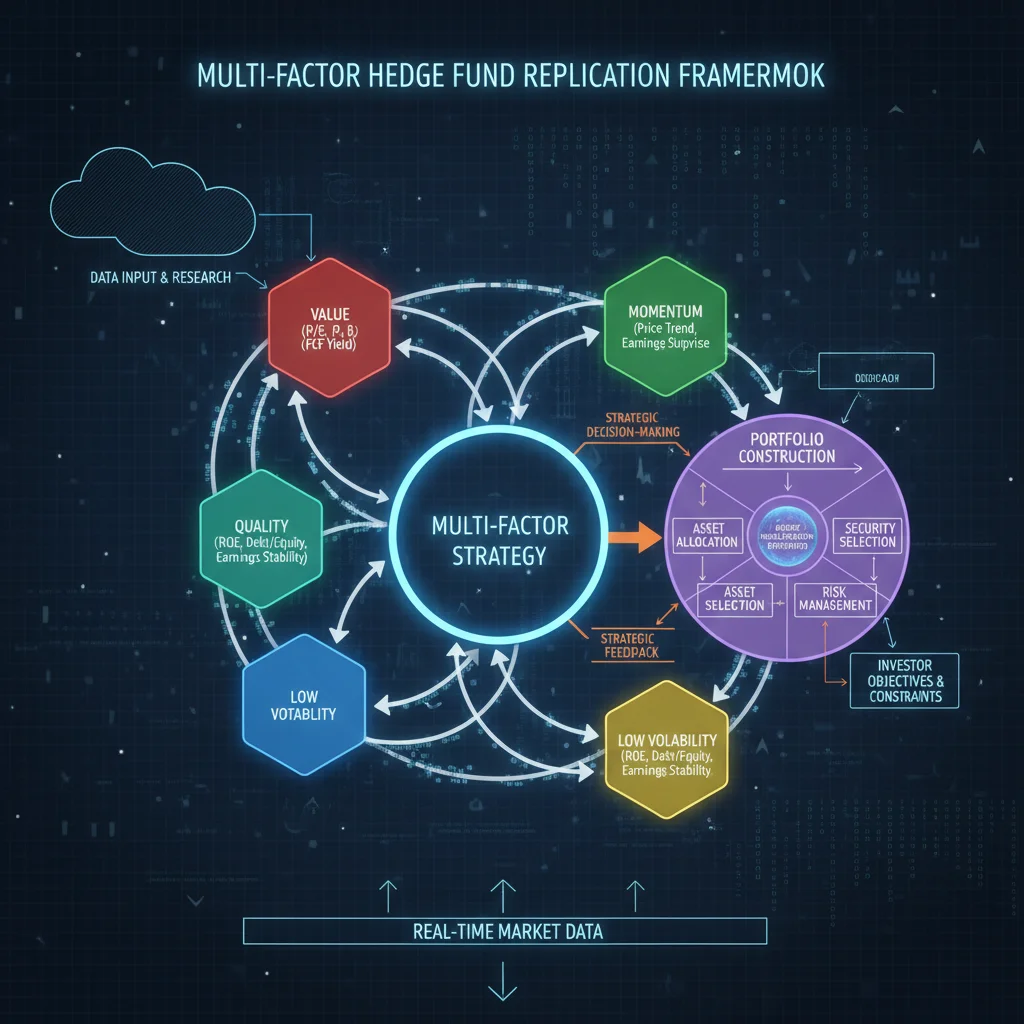
At the core of our Hedge Fund Replication strategy lies factor investing. Instead of picking individual stocks based on fundamental analysis (which is often what hedge funds do, but we are replicating their aggregate behavior), we focus on building a portfolio that systematically tilts towards factors historically associated with outperformance. For a US market-beating strategy, this would involve:
- Identifying Key US Market Factors: While global factors exist, our focus on the US market means we prioritize factors that have shown robust premiums within the US equity and fixed income landscape. Value, momentum, quality, and low volatility are often strong contenders.
- Factor Screening and Stock Selection: This involves systematically identifying US stocks that exhibit strong characteristics of the desired factors. For example, for value, we might screen for stocks with low P/E, P/B, or high dividend yields. For momentum, we look for stocks with strong recent price performance.
- Portfolio Weighting and Optimization: Once stocks are selected based on factor exposure, they need to be weighted appropriately. Equal weighting, market-cap weighting within factor buckets, or more sophisticated optimization techniques (e.g., minimum variance, maximum Sharpe ratio) can be employed to construct the final portfolio. The aim is to maximize desired factor exposure while managing overall portfolio risk and diversification.
- Rebalancing: Factor premiums can ebb and flow, and individual stock characteristics change. Regular rebalancing (e.g., quarterly or semi-annually) is crucial to maintain desired factor exposures and harvest premiums effectively.
Leveraging Alternative Data for Alpha Generation
While traditional factor investing captures systematic premiums, true hedge fund alpha often comes from proprietary insights derived from non-traditional information sources. This is where alternative data plays a crucial role in pushing beyond simple factor replication towards a 7% outperformance goal. Alternative data refers to data sets used by investment professionals to gain an informational edge, beyond traditional sources like financial statements and press releases. Examples include:
- Satellite Imagery: Tracking foot traffic in retail parking lots, oil storage levels, or agricultural yields to predict company performance or commodity prices.
- Credit Card Transaction Data: Analyzing consumer spending patterns at specific retailers or across industries.
- Web Scraping and Social Media Sentiment: Gauging public opinion, product interest, or potential disruptions for companies.
- Geospatial Data: Understanding supply chain movements, real estate trends, or infrastructure development.
- Supply Chain Data: Mapping company suppliers and customers to identify potential vulnerabilities or growth opportunities.
Integrating alternative data into a Hedge Fund Replication strategy is complex and often requires significant technological and analytical capabilities. However, for those with the resources, it offers a path to generate unique insights and potentially achieve the desired level of outperformance. The process involves:
- Data Acquisition and Cleaning: Sourcing relevant alternative data sets and ensuring their accuracy and usability.
- Feature Engineering: Transforming raw data into actionable investment signals. For example, converting satellite images into a ‘retail foot traffic index’.
- Model Development: Building quantitative models (e.g., machine learning algorithms) that can identify correlations and predictive relationships between alternative data signals and asset prices or company fundamentals.
- Signal Integration: Combining these alternative data-driven signals with traditional factor models to create a more robust and predictive investment strategy.
Tactical Asset Allocation and Market Timing
While strategic factor allocation provides a foundational layer of outperformance, tactical asset allocation (TAA) and selective market timing can contribute significantly to the 7% outperformance target. This involves making active decisions to overweight or underweight certain asset classes, sectors, or factors based on prevailing market conditions, macroeconomic outlook, or proprietary signals.
- Economic Cycle Analysis: Adjusting portfolio exposures based on the current stage of the economic cycle. For example, favoring defensive sectors during economic downturns and cyclical sectors during expansions.
- Valuation Metrics: Shifting allocations towards asset classes or factors that appear undervalued relative to their historical averages or intrinsic worth.
- Momentum and Trend Following: Utilizing trends in asset prices or factor performance to make tactical shifts.
- Volatility Regimes: Adapting risk exposures based on periods of high versus low market volatility.
Successful TAA requires robust models, a deep understanding of market dynamics, and the discipline to adhere to predefined rules rather than emotional responses. It’s a challenging but potentially highly rewarding aspect of advanced Hedge Fund Replication.
Implementing Your Strategy: Tools and Considerations
Translating theoretical concepts of Hedge Fund Replication into a live, market-beating portfolio requires practical tools, careful consideration of costs, and a robust risk management framework.
Investment Vehicles and Cost Efficiency
The primary advantage of hedge fund replication is cost efficiency. Instead of paying high hedge fund fees, investors can utilize low-cost investment vehicles:
- Exchange-Traded Funds (ETFs): A vast array of factor-based ETFs (e.g., value ETFs, momentum ETFs, low volatility ETFs) allows for easy and cost-effective exposure to various systematic factors. Sector-specific ETFs can also be used for tactical allocation.
- Mutual Funds: Similar to ETFs, but generally less flexible for intra-day trading and potentially higher expense ratios, though actively managed factor funds exist.
- Individual Stocks: For sophisticated investors, directly investing in individual stocks based on factor screens and alternative data insights can further reduce costs and offer greater control, but requires more active management and analytical capabilities.
- Derivatives (Options and Futures): Can be used for hedging, gaining leveraged exposure, or implementing more complex strategies, but introduce additional risks and require advanced understanding.
Minimizing expense ratios and trading costs is paramount, as these can quickly erode the targeted 7% outperformance. Every basis point saved contributes directly to net returns.
Quantitative Tools and Platforms
Building and managing a sophisticated Hedge Fund Replication portfolio, especially one incorporating alternative data, necessitates quantitative tools:
- Programming Languages: Python (with libraries like Pandas, NumPy, SciPy, scikit-learn, Zipline for backtesting) and R are industry standards for data analysis, model building, and backtesting.
- Financial Data Providers: Access to clean, comprehensive historical financial data (e.g., Bloomberg, Refinitiv, Quandl, Alpha Vantage) is essential for factor screening and backtesting.
- Alternative Data Vendors: Specialized providers offer curated alternative data sets (e.g., S&P Global Market Intelligence, FactSet, various niche providers).
- Backtesting Platforms: Tools that allow investors to test their strategies against historical data to assess their potential performance and risk characteristics before real-money deployment.
- Portfolio Management Software: For tracking performance, managing trades, and monitoring risk in a live portfolio.

Risk Management: Guarding Against Drawdowns
Achieving significant outperformance inevitably comes with increased risk. A robust risk management framework is crucial to protect capital and ensure the long-term viability of the Hedge Fund Replication strategy. Key considerations include:
- Diversification: Beyond diversifying across different stocks, diversify across factors. Relying on a single factor (e.g., just value) can lead to concentrated risks during periods when that factor underperforms. A multi-factor approach smooths returns.
- Position Sizing: Carefully manage the size of individual positions to avoid overconcentration in any single stock or sector.
- Stop-Loss Orders and Hedging: Implement mechanisms to limit potential losses on individual positions or the overall portfolio. Derivatives can be used to hedge against specific market risks.
- Stress Testing: Regularly evaluate how the portfolio would perform under various adverse market scenarios (e.g., financial crises, interest rate spikes, geopolitical events).
- Liquidity Management: Ensure that the portfolio holds sufficiently liquid assets to meet any potential redemption needs or to rebalance without significant market impact.
- Drawdown Control: Define acceptable drawdown limits and have a plan in place for how to react if these limits are approached (e.g., reducing risk, reallocating capital).
Challenges and Considerations for 7% Outperformance
While the goal of 7% outperformance through Hedge Fund Replication is ambitious, it’s important to acknowledge the challenges and potential pitfalls:
Factor Timing and Decay
Factor premiums are not constant; they can vary over time, and some factors may experience periods of underperformance or even decay. Successfully timing factors is notoriously difficult. A diversified multi-factor approach helps mitigate this, but vigilance is required.
Data Availability and Quality
Accessing high-quality, clean, and comprehensive financial and alternative data can be expensive and challenging, especially for individual investors. Poor data quality can lead to flawed models and suboptimal investment decisions.
Model Risk and Overfitting
Quantitative models, particularly those incorporating machine learning and alternative data, are susceptible to ‘model risk’ (errors in model design or implementation) and ‘overfitting’ (building a model that performs exceptionally well on historical data but fails in real-world application). Rigorous out-of-sample testing and walk-forward analysis are essential.
Market Efficiency and Arbitrage Erosion
As more investors adopt factor-based or alternative data-driven strategies, the efficiency of these strategies may decrease, leading to an erosion of the associated premiums. Constant innovation and adaptation are necessary to maintain an edge.
Behavioral Biases
Even with a quantitative, rules-based approach, human behavioral biases (e.g., fear, greed, overconfidence) can lead to deviations from the strategy, undermining long-term performance. Strict adherence to the investment process is critical.
Conclusion: The Path to Market-Beating Returns
Building a US market-beating portfolio with a 7% outperformance goal through Hedge Fund Replication is a sophisticated endeavor that combines the best aspects of quantitative finance, factor investing, and potentially cutting-edge alternative data analysis. It offers a compelling alternative to traditional hedge fund investments, promising similar return profiles without the exorbitant fees and illiquidity.
The journey involves:
- Deconstructing hedge fund returns into their underlying systematic factor exposures.
- Constructing diversified, factor-tilted portfolios using low-cost vehicles.
- Strategically integrating alternative data for unique alpha generation.
- Employing tactical asset allocation to navigate changing market conditions.
- Implementing a robust risk management framework to protect capital.
While challenging, the rewards of successfully implementing such a strategy can be substantial, leading to significant wealth creation over the long term. For the diligent and analytically inclined investor, Hedge Fund Replication represents a powerful pathway to unlocking superior investment performance and achieving that ambitious 7% annual outperformance over the US market. Embrace the quantitative revolution, understand the drivers of return, and embark on your journey to becoming a more sophisticated and successful investor.