Unlocking Value from IoT Data: 7 Analytics Frameworks for U.S. Businesses in 2026
In an increasingly interconnected world, the Internet of Things (IoT) has transcended from a futuristic concept to a present-day reality, fundamentally reshaping how businesses operate across the United States. From smart factories optimizing production lines to intelligent cities managing traffic flow, and from connected healthcare devices monitoring patient vitals to agricultural sensors enhancing crop yields, IoT devices are generating an unprecedented volume, velocity, and variety of data. This deluge of information presents both an immense opportunity and a significant challenge. The true value of IoT doesn’t lie merely in the collection of data, but in the ability to transform this raw, often disparate, information into actionable insights that drive business growth, efficiency, and innovation.
As we look towards 2026, U.S. businesses are at a critical juncture. Those that master the art and science of IoT data analytics will be the ones that thrive, gaining a competitive edge by making data-driven decisions that impact everything from operational expenditure to customer experience. However, navigating the complex landscape of IoT data requires robust frameworks and strategic approaches. Without a clear framework, businesses risk drowning in data, failing to extract meaningful intelligence, and ultimately missing out on the transformative potential that IoT promises.
This comprehensive guide delves into seven essential IoT data analytics frameworks that U.S. businesses should consider adopting and refining by 2026. These frameworks are not just theoretical constructs; they are practical methodologies and technological architectures designed to help organizations move beyond mere data collection to sophisticated analysis, predictive modeling, and prescriptive actions. By understanding and implementing these frameworks, businesses can unlock the full value of their IoT investments, optimize processes, anticipate challenges, and innovate at an accelerated pace. Let’s explore how these frameworks can empower your business to harness the power of IoT data.
1. The Edge-to-Cloud Analytics Framework
The sheer volume of data generated by IoT devices often makes it impractical or inefficient to send all raw data to a centralized cloud for processing. This is where the Edge-to-Cloud Analytics Framework becomes indispensable. This framework advocates for a distributed approach to IoT data analytics, where some processing occurs closer to the data source (at the ‘edge’) while more complex, long-term analysis and storage happen in the cloud.
Why Edge Analytics?
- Reduced Latency: Critical decisions, such as those in autonomous vehicles or industrial control systems, require real-time responses. Edge computing minimizes the time taken for data to travel to a central server and back, enabling near-instantaneous actions.
- Bandwidth Optimization: By processing data at the edge, businesses can filter out irrelevant information or aggregate data before sending it to the cloud. This significantly reduces the amount of data transmitted, saving bandwidth costs and reducing network congestion.
- Enhanced Security and Privacy: Processing sensitive data locally can reduce exposure to cyber threats during transmission and help comply with data privacy regulations, especially for U.S. businesses dealing with PII (Personally Identifiable Information) or proprietary operational data.
- Offline Operation: Edge devices can continue to operate and process data even when connectivity to the cloud is intermittent or unavailable, crucial for remote operations or environments with unreliable networks.
The Cloud’s Role
While edge computing handles immediate processing, the cloud remains vital for:
- Big Data Storage: Storing vast historical datasets for long-term trend analysis, compliance, and auditing.
- Advanced Analytics: Leveraging powerful cloud-based machine learning (ML) and artificial intelligence (AI) services for predictive modeling, anomaly detection, and deep learning that requires significant computational resources.
- Centralized Management: Providing a unified platform for managing thousands or millions of IoT devices, their data streams, and deployed applications.
- Global Scalability: Offering the elastic scalability required to accommodate growing data volumes and analytical demands without significant upfront infrastructure investments.
For U.S. businesses, implementing an Edge-to-Cloud framework means strategically distributing computing power. For instance, a manufacturing plant might use edge devices to monitor machine health and trigger immediate alerts for anomalies, while sending aggregated performance data to the cloud for quarterly predictive maintenance scheduling and overall production optimization. This hybrid approach to IoT data analytics ensures both responsiveness and comprehensive insights.
2. The Real-time Stream Analytics Framework
In many IoT applications, the value of data diminishes rapidly over time. For example, a sudden temperature spike in a cold storage unit needs immediate attention, not an end-of-day report. The Real-time Stream Analytics Framework is designed to process and analyze data as it is generated, enabling businesses to react to events and make decisions in milliseconds or seconds rather than minutes or hours.
Core Components:
- Data Ingestion: High-throughput data pipelines capable of ingesting massive streams of data from diverse IoT devices (e.g., Kafka, Amazon Kinesis, Azure Event Hubs).
- Stream Processing Engines: Technologies that can process data on the fly, performing calculations, filtering, aggregations, and pattern detection (e.g., Apache Flink, Apache Spark Streaming, Storm).
- Real-time Dashboards and Alerts: Visualization tools and notification systems that provide immediate insights and trigger automated actions or human interventions when predefined conditions are met.
- Complex Event Processing (CEP): Identifying meaningful events or patterns from a multitude of raw events, often across different data streams, to detect critical situations.
Industries like logistics, finance (fraud detection), healthcare (patient monitoring), and utilities (grid management) heavily rely on real-time IoT data analytics. For a U.S. logistics company, real-time tracking of refrigerated trucks can immediately alert them to temperature deviations, preventing spoilage and ensuring compliance. In smart cities, real-time traffic sensor data can dynamically adjust traffic light timings to alleviate congestion. This framework is crucial for any business where timely intervention can prevent losses, improve safety, or enhance customer satisfaction.
3. The Predictive and Prescriptive Analytics Framework
Moving beyond understanding what happened (descriptive analytics) and why it happened (diagnostic analytics), the Predictive and Prescriptive Analytics Framework focuses on what will happen and what actions should be taken. This is where the power of AI and Machine Learning truly shines in IoT data analytics.
Predictive Analytics:
Utilizes historical IoT data to forecast future outcomes. Common applications include:
- Predictive Maintenance: Anticipating equipment failures before they occur, enabling maintenance to be scheduled proactively, reducing downtime and costs.
- Demand Forecasting: Predicting future demand for products or services based on IoT data from supply chains, customer behavior, and environmental factors.
- Anomaly Detection: Identifying unusual patterns in data that might indicate security breaches, operational inefficiencies, or equipment malfunctions.
Prescriptive Analytics:
Takes predictive insights a step further by recommending specific actions to achieve desired outcomes or mitigate predicted risks. It answers the question, ‘What should we do?’
- Optimized Resource Allocation: Recommending the best distribution of resources (e.g., energy, personnel, inventory) based on predicted demand and operational constraints.
- Automated Decision-Making: In some highly automated systems, prescriptive models can directly trigger actions, such as adjusting thermostat settings in smart buildings or rerouting vehicles in a smart transportation system.
- Personalized Recommendations: For consumer-facing IoT, prescribing personalized experiences or product suggestions based on user behavior and preferences.
Implementing this framework requires robust data warehousing, advanced statistical modeling, and machine learning expertise. U.S. businesses in manufacturing, energy, retail, and healthcare are increasingly leveraging this framework to move from reactive to proactive and ultimately, autonomous operations. A smart grid, for instance, can predict energy demand and proactively adjust power distribution to prevent outages and optimize costs.
4. The Data Lakehouse Architecture for IoT Data
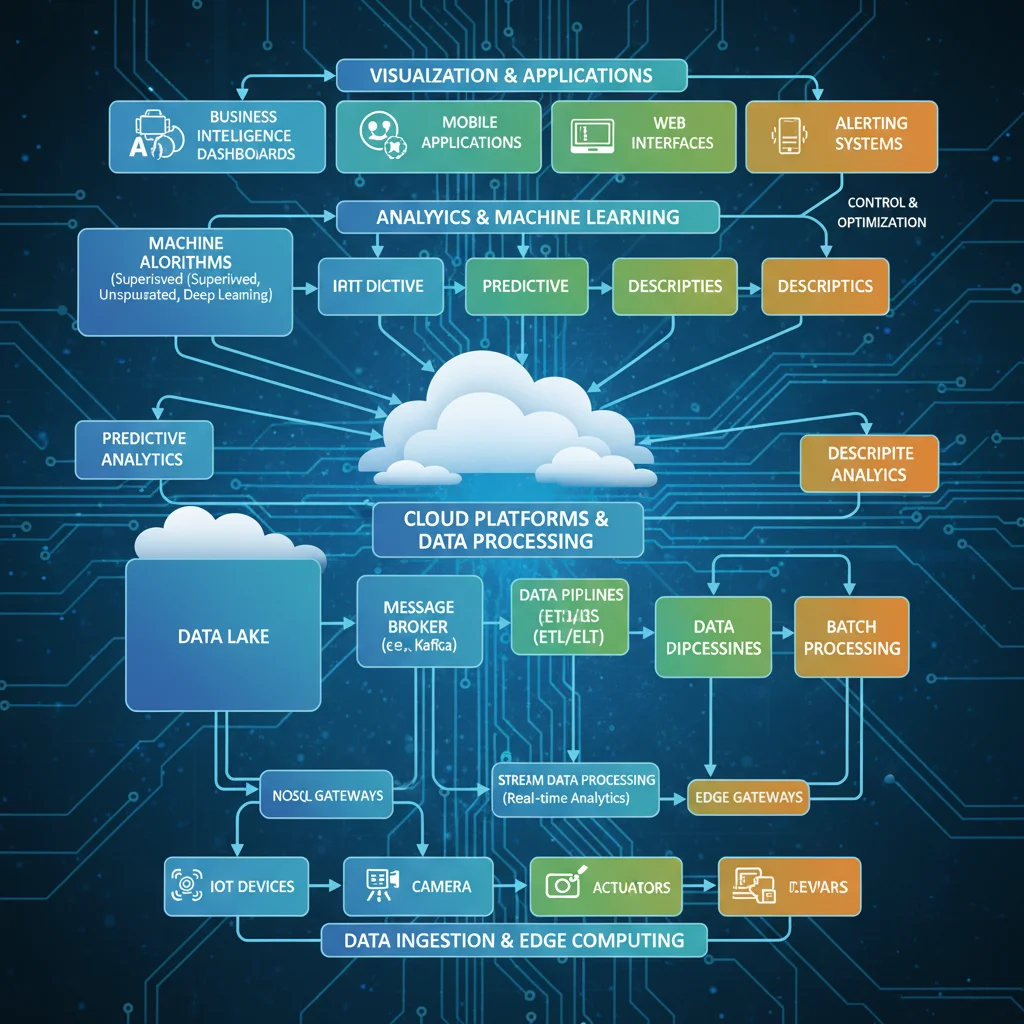
The traditional distinction between data warehouses (structured, optimized for reporting) and data lakes (unstructured, raw data for exploration) often creates silos, hindering comprehensive IoT data analytics. The Data Lakehouse Architecture emerges as a powerful hybrid, combining the flexibility and scalability of a data lake with the data management and performance capabilities of a data warehouse.
Key Characteristics:
- Open Formats: Stores data in open formats like Parquet or ORC, ensuring interoperability and avoiding vendor lock-in.
- Schema Enforcement and Governance: Provides schema enforcement capabilities, transactions (ACID properties), and robust data governance features, typically found in data warehouses.
- Direct Access: Allows various tools (SQL engines, ML frameworks, BI tools) to directly access data without needing to move or transform it repeatedly.
- Support for Structured and Unstructured Data: Can handle the diverse data types characteristic of IoT – from sensor readings to video feeds and log files.
For U.S. businesses dealing with the heterogeneous nature of IoT data, a data lakehouse provides a unified platform for all analytical workloads. It simplifies data pipelines, reduces data duplication, and ensures data quality and consistency across different analytical teams. For example, an automotive manufacturer can store raw sensor data from vehicles (unstructured) alongside structured telematics data in the same lakehouse, enabling comprehensive analysis for product improvement, warranty prediction, and new service development.
5. The Digital Twin Analytics Framework
A Digital Twin is a virtual replica of a physical object, process, or system. The Digital Twin Analytics Framework leverages this virtual model to simulate, predict, and optimize the performance of its physical counterpart. This framework is particularly transformative for complex industrial assets, infrastructure, and even entire cities.
How it Works:
- Data Ingestion: Real-time data from IoT sensors on the physical asset is continuously fed into the digital twin.
- Modeling and Simulation: The digital twin uses physics-based models, historical data, and AI algorithms to simulate the physical asset’s behavior under various conditions.
- Analytics and Insights: By comparing simulated performance with actual performance, the framework can identify deviations, predict potential failures, and suggest optimal operating parameters.
- Feedback Loop: Insights from the digital twin can be fed back to control the physical asset, creating a closed-loop optimization system.
U.S. businesses in aerospace, manufacturing, energy, and construction are pioneering the use of digital twins. An aircraft engine manufacturer, for instance, can create a digital twin for each engine. By continuously feeding flight data, maintenance logs, and environmental conditions into the twin, they can predict component wear, optimize maintenance schedules, and even design better future engines. This framework moves beyond simple IoT data analytics to create a living, breathing, analytical representation of physical reality, enabling unparalleled control and optimization.
6. The AI/ML-Driven Anomaly Detection Framework
With the sheer volume and complexity of IoT data, manually identifying anomalies is nearly impossible. The AI/ML-Driven Anomaly Detection Framework automates the process of finding unusual patterns or outliers in IoT data that could indicate critical issues such as equipment failure, security breaches, operational inefficiencies, or fraudulent activities.
Techniques Employed:
- Supervised Learning: Training models on historical data labeled as ‘normal’ or ‘anomalous’ to classify new data points.
- Unsupervised Learning: Identifying anomalies without prior labels, often by clustering normal data and flagging data points that fall outside these clusters (e.g., K-means, Isolation Forest).
- Time Series Analysis: Detecting anomalies in sequential data, recognizing deviations from expected temporal patterns (e.g., ARIMA, Prophet).
- Deep Learning: Using neural networks (e.g., Autoencoders) to learn complex representations of normal behavior and identify deviations.
This framework is critical for maintaining the integrity, security, and efficiency of IoT deployments. A U.S. smart building management system can use this framework to detect unusual energy consumption patterns that might indicate a faulty HVAC unit or an unauthorized access attempt. In cybersecurity, anomaly detection is vital for identifying novel threats that signature-based systems might miss. By leveraging AI/ML for IoT data analytics, businesses can proactively address problems before they escalate, saving significant costs and enhancing reliability.
7. The IoT Data Governance and Security Analytics Framework
As IoT deployments grow, so do the challenges related to data governance, privacy, and security. The IoT Data Governance and Security Analytics Framework focuses on ensuring that IoT data is collected, stored, processed, and used in a compliant, secure, and ethical manner. This isn’t just about preventing breaches; it’s about building trust and adhering to regulations.
Key Pillars:
- Data Lineage and Auditability: Tracking the origin, transformations, and usage of IoT data to ensure transparency and accountability.
- Access Control and Encryption: Implementing robust authentication, authorization, and encryption mechanisms for data at rest and in transit.
- Compliance Monitoring: Ensuring adherence to relevant regulations such as GDPR, CCPA, HIPAA (for healthcare IoT), and industry-specific standards. This involves continuous monitoring and reporting on data practices.
- Threat Detection and Response: Using analytics to monitor IoT device behavior and network traffic for suspicious activities, vulnerabilities, and potential cyberattacks, followed by automated or manual incident response protocols.
- Data Minimization and Retention Policies: Establishing clear rules on what data is collected, how long it is stored, and when it is deleted to minimize risk and comply with privacy laws.

For any U.S. business, particularly those in highly regulated sectors, this framework is non-negotiable. A healthcare provider using IoT medical devices must ensure patient data privacy and security (HIPAA compliance), requiring stringent governance and continuous security analytics. A smart home device manufacturer must build consumer trust through transparent data practices and robust security. By embedding governance and security into the core of their IoT data analytics strategy, businesses can mitigate risks, avoid costly fines, and protect their reputation.
Implementing IoT Data Analytics Frameworks: Best Practices for U.S. Businesses
Adopting these frameworks is not a one-time project but an ongoing journey. Here are some best practices for U.S. businesses to ensure successful implementation:
- Start Small, Think Big: Begin with pilot projects to demonstrate value and build internal expertise before scaling across the organization.
- Define Clear KPIs: Establish specific, measurable, achievable, relevant, and time-bound key performance indicators (KPIs) to track the success of your IoT analytics initiatives.
- Invest in the Right Talent: Build or acquire teams with expertise in data science, machine learning, cloud engineering, and IoT security.
- Choose the Right Technology Stack: Select platforms and tools that align with your specific business needs, scalability requirements, and existing infrastructure. Cloud providers like AWS, Azure, and Google Cloud offer comprehensive IoT and analytics services.
- Foster a Data-Driven Culture: Encourage employees at all levels to embrace data as a strategic asset and integrate data insights into daily decision-making processes.
- Prioritize Security and Compliance from Day One: Integrate security measures and privacy-by-design principles throughout the entire IoT data lifecycle.
- Embrace Interoperability: Design your IoT systems to be open and interoperable, allowing for easier integration with other systems and future technologies.
- Continuous Learning and Adaptation: The IoT landscape is rapidly evolving. Regularly review and update your analytics frameworks to incorporate new technologies and address emerging challenges.
The Future of IoT Data Analytics in the U.S.
Looking ahead to 2026 and beyond, the convergence of IoT with other cutting-edge technologies like 5G, AI, and blockchain will further amplify the need for sophisticated IoT data analytics frameworks. 5G will enable even faster data transmission, pushing the boundaries of real-time analytics. Advanced AI will unlock deeper insights from complex, multimodal IoT data, leading to more intelligent automation. Blockchain could offer enhanced security and transparency for IoT data transactions, particularly in supply chain and asset tracking.
U.S. businesses that proactively invest in and refine their IoT data analytics capabilities will not only optimize their current operations but also discover entirely new business models and revenue streams. From creating personalized customer experiences to building resilient and sustainable supply chains, the ability to harness IoT data is becoming a fundamental differentiator.
Conclusion
The journey to unlock the full potential of IoT data is multifaceted, requiring a strategic blend of technology, talent, and robust frameworks. The seven IoT data analytics frameworks discussed – Edge-to-Cloud, Real-time Stream, Predictive and Prescriptive, Data Lakehouse, Digital Twin, AI/ML-Driven Anomaly Detection, and IoT Data Governance and Security Analytics – provide a comprehensive roadmap for U.S. businesses aiming to thrive in the data-rich environment of 2026. By systematically adopting and integrating these approaches, organizations can transform raw sensor data into a powerful engine for innovation, efficiency, and sustained competitive advantage. The time to invest in a sophisticated IoT data analytics strategy is now, ensuring your business is not just participating in the IoT revolution, but leading it.