Mastering IRS Cryptocurrency Reporting for 2026: A Complete Compliance Guide

Mastering IRS Cryptocurrency Reporting for 2026: A Complete Compliance Guide
The world of cryptocurrency is dynamic, innovative, and increasingly integrated into the global financial landscape. As its adoption grows, so does the scrutiny from regulatory bodies, particularly the Internal Revenue Service (IRS). For taxpayers, navigating the ever-evolving regulations surrounding digital assets can feel like a complex maze. With 2026 fast approaching, understanding the latest IRS Crypto Reporting 2026 requirements is not just advisable, it’s absolutely crucial for avoiding penalties and ensuring compliance.
This comprehensive guide is designed to demystify the IRS Crypto Reporting 2026 landscape. We’ll delve into the foundational principles of cryptocurrency taxation, explore the significant changes and clarifications expected, and provide a step-by-step approach to ensure you are fully prepared. Whether you’re an individual investor, a seasoned trader, or a business dealing with digital assets, this article will equip you with the knowledge needed to confidently meet your tax obligations.
The IRS has made it clear: virtual currencies are treated as property for tax purposes, meaning transactions involving them are subject to capital gains and losses, as well as ordinary income rules, depending on the nature of the transaction. This fundamental classification underpins all reporting requirements. However, the specifics of what needs to be reported, by whom, and on which forms, continue to be refined. The period leading up to and including 2026 is anticipated to bring further clarity and potentially new enforcement mechanisms, making proactive preparation more important than ever.
We will cover everything from basic definitions and common taxable events to advanced strategies for record-keeping and utilizing tax software. Our aim is to provide a practical, actionable resource that translates complex tax jargon into clear, understandable advice. By the end of this guide, you will have a robust understanding of your responsibilities and the tools to navigate the IRS Crypto Reporting 2026 season with confidence.
Understanding the Fundamentals: What is Cryptocurrency for Tax Purposes?
Before diving into specific reporting requirements, it’s essential to grasp how the IRS defines and treats cryptocurrency. The IRS Notice 2014-21 established that virtual currency is treated as property for U.S. federal tax purposes. This means that general tax principles applicable to property transactions apply to transactions using virtual currency. This fundamental classification has significant implications for how gains, losses, and income are calculated and reported.
Under this classification, when you sell, exchange, or otherwise dispose of cryptocurrency, you are generally subject to capital gains or losses. If you hold cryptocurrency for more than one year before disposing of it, any gain or loss is considered long-term capital gain or loss, which typically benefits from lower tax rates. If held for one year or less, it’s considered a short-term capital gain or loss, taxed at ordinary income rates.
Beyond sales and exchanges, various other cryptocurrency activities can trigger tax events. These include:
- Mining: Income from mining cryptocurrency is generally considered ordinary income at the fair market value of the cryptocurrency on the date it’s received.
- Staking: Rewards received from staking are also typically treated as ordinary income at the fair market value of the cryptocurrency when received.
- Airdrops and Forks: Cryptocurrency received from an airdrop or a hard fork is generally considered ordinary income at its fair market value on the date it’s received.
- Payments for Goods and Services: If you use cryptocurrency to pay for goods or services, this is considered a disposition of property. You’ll realize a capital gain or loss based on the difference between the fair market value of the cryptocurrency at the time of payment and your cost basis in that cryptocurrency.
- Wages Paid in Crypto: If you receive cryptocurrency as payment for services, it’s treated as ordinary income and subject to employment taxes.
It’s crucial to understand that simply holding cryptocurrency, even if its value increases, does not trigger a taxable event. The tax event occurs when there is a ‘disposition’ or ‘receipt’ of new cryptocurrency. This distinction is vital for accurate IRS Crypto Reporting 2026.
The IRS’s stance is continuously evolving, and while the core principle of property treatment remains, new guidance and enforcement efforts are always on the horizon. Staying informed about these foundational rules is the first step toward effective tax planning and compliance.
Key Changes and Anticipated Clarifications for 2026
The cryptocurrency tax landscape is not static. The IRS, in conjunction with the Treasury Department, has been actively working to provide more clarity and establish stricter reporting mechanisms. For IRS Crypto Reporting 2026, several significant developments are expected to take full effect, stemming primarily from the Infrastructure Investment and Jobs Act (IIJA) of 2021.
Broker Reporting Requirements (Form 1099-DA)
Perhaps the most impactful change for 2026 will be the implementation of new broker reporting requirements. The IIJA expanded the definition of a ‘broker’ to include entities that facilitate digital asset transfers, such as cryptocurrency exchanges and hosted wallet providers. These brokers will be required to report certain customer information and transaction details to the IRS, similar to how traditional financial brokers report stock and bond transactions.
This new reporting will likely be done via a new Form 1099-DA (Digital Asset Proceeds). This form is expected to include:
- The gross proceeds from digital asset sales.
- The date of acquisition and disposition.
- The cost basis of the digital assets (if known by the broker).
- The type of digital asset.
This change significantly shifts the burden of reporting transaction details from individual taxpayers to exchanges. While this may simplify reporting for some, it also means the IRS will have a much clearer picture of taxpayer activity. Discrepancies between what taxpayers report and what brokers report will likely trigger IRS inquiries. Taxpayers must ensure their own records align with what exchanges will be reporting.
Additional Guidance on DeFi, NFTs, and Staking
While the IIJA primarily focused on broker reporting, the IRS is also expected to issue further guidance on more complex areas of cryptocurrency, such as Decentralized Finance (DeFi), Non-Fungible Tokens (NFTs), and specific rules around staking rewards. The current guidance can be ambiguous for these nascent areas, leading to uncertainty for taxpayers.
- DeFi: Clarifications on lending protocols, liquidity pools, and yield farming are highly anticipated. Questions around when income is realized, how to determine cost basis in complex swaps, and the tax implications of wrapped tokens are critical.
- NFTs: While NFTs are generally treated as property, their unique characteristics (e.g., royalties to creators, fractional ownership) may warrant specific guidance on valuation, gains/losses, and income generation.
- Staking: The timing of income recognition for staking rewards has been a point of contention. Further guidance is expected to clarify whether income is realized when rewards are earned, when they are claimed, or when they can be freely transferred.
Taxpayers involved in these activities should closely monitor IRS announcements and consult with tax professionals specializing in digital assets to ensure compliance with the latest interpretations for IRS Crypto Reporting 2026.
Essential Record-Keeping for Cryptocurrency Transactions
Accurate and meticulous record-keeping is the cornerstone of compliant IRS Crypto Reporting 2026. Without proper records, it’s nearly impossible to correctly calculate your capital gains, losses, and ordinary income. Even with new broker reporting, you are ultimately responsible for the accuracy of your tax return.
What Records You Need to Keep:
- Dates of Acquisition and Disposition: Crucial for determining short-term vs. long-term capital gains/losses.
- Fair Market Value (FMV) at Acquisition and Disposition: This is the price of the cryptocurrency in U.S. dollars at the time of the transaction. For purchases, it’s your cost basis. For sales, it’s the proceeds.
- Cost Basis: This includes the purchase price plus any fees or commissions paid to acquire the cryptocurrency.
- Transaction Type: Clearly document whether it was a purchase, sale, exchange, gift, mining reward, staking reward, airdrop, etc.
- Wallet Addresses and Transaction IDs: These provide an immutable record on the blockchain.
- Exchange Statements: Download and save all monthly and annual statements from every exchange you use.
- Mining/Staking Logs: Keep detailed records of when you earned crypto from mining or staking, and its FMV at that time.
- Gift Records: If you receive or send crypto as a gift, document the date, FMV, and sender/recipient.
Imagine trying to reconstruct years of crypto trades across multiple platforms without detailed records. It would be a nightmare. The IRS expects you to have these records readily available if audited.
Tools for Record-Keeping:
Given the complexity and volume of transactions many crypto users undertake, manual record-keeping is often impractical. Fortunately, several tools can assist:
- Crypto Tax Software: Dedicated software like CoinTracker, Koinly, TaxBit, or Accointing can integrate with your exchanges and wallets, automatically import transaction data, calculate gains/losses using various accounting methods (FIFO, LIFO, specific identification), and generate the necessary tax forms. These tools are becoming indispensable for accurate IRS Crypto Reporting 2026.
- Spreadsheets: For those with fewer transactions or a preference for manual control, a well-organized spreadsheet can work. However, this requires diligent data entry and careful calculation.
- Blockchain Explorers: These public tools allow you to verify transaction details on various blockchains using wallet addresses or transaction IDs.
The importance of accurate record-keeping cannot be overstated. It not only ensures compliance but also allows you to calculate your tax liability correctly, potentially minimizing your tax burden by accurately tracking your cost basis and utilizing capital losses.

Navigating IRS Tax Forms for Cryptocurrency
Understanding which IRS forms to use for your cryptocurrency activities is a critical component of IRS Crypto Reporting 2026. While the new Form 1099-DA will aid in reporting, taxpayers still have primary responsibility for accurately filing their returns.
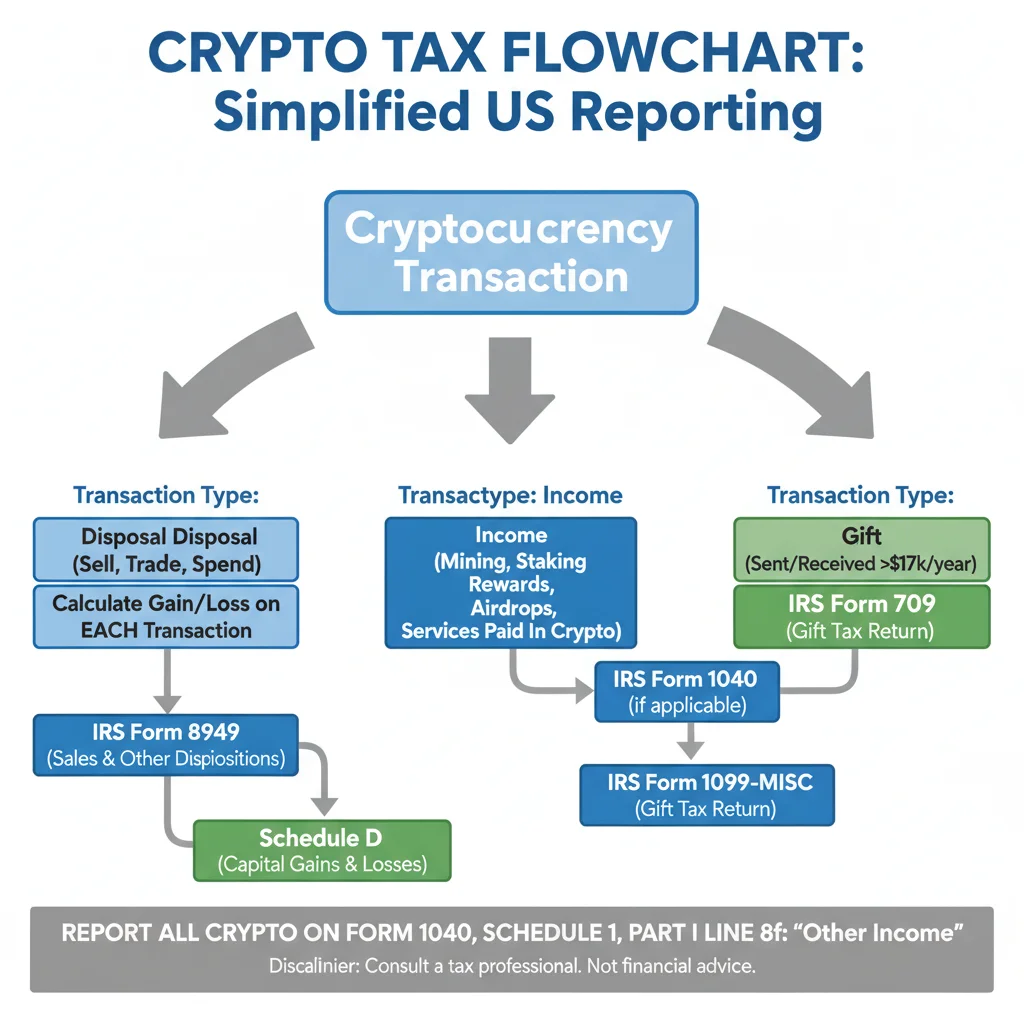
Form 8949, Sales and Other Dispositions of Capital Assets, and Schedule D, Capital Gains and Losses:
This is where most cryptocurrency sales and exchanges are reported. Every time you sell, trade one crypto for another, or use crypto to purchase goods/services, you’re generally disposing of a capital asset. The details of each disposition (date acquired, date sold, proceeds, cost basis) are listed on Form 8949. The totals from Form 8949 then flow to Schedule D, where your net capital gain or loss is calculated.
- Short-Term vs. Long-Term: Remember to distinguish between short-term (held one year or less) and long-term (held more than one year) transactions on these forms, as they are taxed at different rates.
- Cost Basis Methods: The IRS allows different cost basis methods, such as First-In, First-Out (FIFO), Last-In, First-Out (LIFO), or Specific Identification. Choosing the right method can significantly impact your tax liability, especially in volatile markets. Specific identification, where you choose which specific units of crypto to sell, often yields the most tax-efficient outcome but requires meticulous record-keeping.
Schedule 1, Additional Income and Adjustments to Income:
Certain cryptocurrency income, such as mining rewards, staking rewards, airdrops, and hard fork receipts, are generally reported as ordinary income on Schedule 1 (Form 1040). The fair market value of the cryptocurrency at the time you receive it is the amount of income to report.
Schedule C, Profit or Loss From Business (Sole Proprietorship):
If your cryptocurrency activities constitute a trade or business (e.g., professional mining operations, operating a crypto exchange, or providing crypto services as a sole proprietor), you would report your income and expenses on Schedule C. This allows for deductions related to business operations.
Form 1040, U.S. Individual Income Tax Return:
At the very beginning of Form 1040, there is a question asking, ‘At any time during [tax year], did you receive, sell, send, exchange, or otherwise acquire any financial interest in any virtual currency?’ You must answer this question accurately. Answering ‘No’ when you have engaged in taxable crypto activities can be a red flag for the IRS.
Future Forms (Form 1099-DA):
As mentioned, for IRS Crypto Reporting 2026, expect to receive Form 1099-DA from exchanges and other brokers. This form will report your sales proceeds and potentially your cost basis. You will then use this information to complete Form 8949 and Schedule D. It’s crucial to reconcile the information on your 1099-DA with your own records to ensure accuracy.
The interplay between these forms can be complex, and errors can lead to penalties. If you have significant or complex crypto transactions, consulting with a tax professional experienced in digital assets is highly recommended.
Common Taxable Events and How to Report Them
Understanding the various scenarios that trigger a taxable event is fundamental for accurate IRS Crypto Reporting 2026. Here’s a breakdown of common events and their reporting implications:
Selling Cryptocurrency for Fiat Currency:
This is the most straightforward taxable event. When you sell Bitcoin for USD, for example, the difference between your sale price and your cost basis is a capital gain or loss. This must be reported on Form 8949 and Schedule D.
Trading One Cryptocurrency for Another:
Often misunderstood, trading crypto for crypto (e.g., Bitcoin for Ethereum) is a taxable event. The IRS views this as two dispositions: you ‘sold’ the first crypto for its fair market value in USD at the time of the trade, realizing a gain or loss, and then ‘purchased’ the second crypto with those USD proceeds. Both sides of this transaction need to be recorded, and the gain/loss on the first crypto reported on Form 8949 and Schedule D.
Using Cryptocurrency to Purchase Goods or Services:
Similar to trading crypto for crypto, using crypto to buy a coffee or a car is a taxable event. You are disposing of the cryptocurrency, and any difference between its fair market value at the time of the purchase and its cost basis is a capital gain or loss. This also goes on Form 8949 and Schedule D.
Receiving Cryptocurrency as Income (Mining, Staking, Airdrops):
As discussed, these are generally treated as ordinary income. The fair market value of the cryptocurrency at the moment you receive it is your income amount, reported on Schedule 1. This also establishes your cost basis for that crypto. If you later sell it, any subsequent gain or loss is a capital gain/loss.
Gifting Cryptocurrency:
Gifting cryptocurrency is generally not a taxable event for the giver, as long as the gift is below the annual gift tax exclusion amount ($18,000 per recipient in 2024, subject to change). If the gift exceeds this amount, you may need to file Form 709, United States Gift (and Generation-Skipping Transfer) Tax Return. The recipient takes on the donor’s cost basis. It’s crucial not to confuse gifting with selling at a loss to a related party, which can be disallowed for tax purposes.
Donating Cryptocurrency to Charity:
Donating appreciated cryptocurrency directly to a qualified charity can be highly tax-efficient. You generally avoid paying capital gains tax on the appreciated amount and can deduct the fair market value of the donation (subject to AGI limitations). This is similar to donating appreciated stock. Proper documentation from the charity is essential.
Losses and the Wash Sale Rule:
Capital losses from cryptocurrency can offset capital gains and up to $3,000 of ordinary income per year. However, the ‘wash sale’ rule, which prevents taxpayers from claiming a loss on a security if they buy a substantially identical security within 30 days before or after the sale, traditionally hasn’t applied to crypto. This is because crypto is treated as property, not securities. However, there’s ongoing debate and potential for this to change. Stay informed for IRS Crypto Reporting 2026, as any legislative changes would significantly impact loss harvesting strategies.
Each of these events requires careful tracking and accurate reporting. The complexity multiplies when you engage in multiple types of transactions across various platforms.
Strategies for Minimizing Your Crypto Tax Burden
While paying taxes is inevitable, there are legitimate strategies you can employ to minimize your IRS Crypto Reporting 2026 tax burden. These strategies require planning and careful execution.
1. Tax-Loss Harvesting:
This is a powerful strategy where you sell cryptocurrency at a loss to offset capital gains and potentially up to $3,000 of ordinary income. If you have significant unrealized losses, strategically selling them before year-end can reduce your overall tax liability. Remember the potential future implications of the wash sale rule, though currently, it doesn’t apply to crypto. If it were to apply, you’d need to be careful not to immediately repurchase the same crypto.
2. Holding for Long-Term Capital Gains:
If you anticipate a significant gain on a particular cryptocurrency, consider holding it for more than one year before selling. Long-term capital gains are taxed at lower rates (0%, 15%, or 20% depending on your income bracket) compared to short-term gains, which are taxed at your ordinary income rate.
3. Specific Identification Cost Basis Method:
Instead of FIFO (First-In, First-Out), which assumes you sell your oldest crypto first, the specific identification method allows you to choose which specific units of crypto to sell. If you bought Bitcoin at various prices, you could choose to sell the units with the highest cost basis to minimize your gain, or units with a loss to maximize your loss harvesting. This requires impeccable record-keeping.
4. Charitable Donations of Appreciated Crypto:
As mentioned, donating appreciated crypto directly to a qualified charity can offer a double tax benefit: you avoid capital gains tax on the appreciation and can deduct the fair market value of the donation. This is particularly effective for highly appreciated assets you no longer wish to hold.
5. Utilizing Retirement Accounts (If Applicable):
While direct crypto investments in traditional IRAs or 401(k)s are generally limited, some self-directed IRAs allow for crypto investments. Gains within these tax-advantaged accounts can grow tax-deferred or tax-free (in a Roth IRA) until withdrawal, significantly impacting your long-term tax burden. Consult with a financial advisor experienced in self-directed retirement accounts.
6. Understand Your Tax Bracket:
Your overall income and tax bracket will significantly influence the impact of your crypto gains and losses. Understanding your marginal tax rate helps in making informed decisions about when to realize gains or losses.
7. Consult a Tax Professional:
For complex situations or significant holdings, a qualified tax professional specializing in digital assets is invaluable. They can help you navigate intricate rules, optimize your tax strategy, and ensure full compliance with IRS Crypto Reporting 2026.
The Role of Tax Software and Professional Advisors
As the complexity of IRS Crypto Reporting 2026 grows, so does the reliance on specialized tools and expert advice. Attempting to manage crypto taxes manually, especially with numerous transactions across multiple platforms, is becoming increasingly challenging and prone to errors.
Leveraging Crypto Tax Software:
- Automated Data Import: They can connect to hundreds of exchanges, wallets, and blockchain protocols to automatically import your transaction history, saving countless hours of manual data entry.
- Cost Basis Calculation: The software automatically calculates your cost basis using various accounting methods (FIFO, LIFO, HIFO, specific identification), allowing you to choose the most tax-efficient option.
- Gain/Loss Calculation: It precisely calculates your capital gains and losses for every taxable event.
- Form Generation: Most software can generate filled-out IRS forms like Form 8949, Schedule D, and Schedule 1, ready for submission or import into standard tax preparation software like TurboTax or H&R Block.
- Error Reduction: By automating calculations and data aggregation, these tools significantly reduce the likelihood of human error.
- Audit Trail: They provide a comprehensive, organized record of all your transactions, invaluable in case of an IRS inquiry or audit.
Popular choices include CoinTracker, Koinly, TaxBit, Accointing, and CryptoTaxCalculator. Each offers different features and pricing models, so it’s worth exploring which one best fits your needs.
When to Consult a Tax Professional:
- Complex Transactions: If you’re heavily involved in DeFi, NFTs, margin trading, futures, or other advanced crypto activities, the tax implications can be highly nuanced. A professional can provide tailored advice.
- High-Value Holdings: For individuals or businesses with significant crypto portfolios, the potential tax liabilities are substantial, making expert guidance a wise investment.
- International Considerations: If you have crypto holdings or engage in transactions across different jurisdictions, international tax laws add another layer of complexity that requires expert knowledge.
- IRS Inquiries or Audits: If you receive a letter from the IRS regarding your crypto activities, a tax attorney or CPA specializing in crypto can represent you and help navigate the process.
- Business Use of Crypto: Businesses accepting crypto payments, engaging in crypto payroll, or holding crypto on their balance sheets have unique accounting and tax considerations.
- Uncertainty or Lack of Time: If you feel overwhelmed by the process or simply lack the time to manage your crypto taxes, outsourcing to a professional can provide peace of mind and ensure compliance.
The synergy between robust crypto tax software and an experienced tax professional offers the most comprehensive approach to managing your IRS Crypto Reporting 2026 obligations effectively.
Penalties for Non-Compliance and How to Avoid Them
The IRS is increasingly sophisticated in identifying unreported cryptocurrency transactions. With the new broker reporting requirements coming into full effect for IRS Crypto Reporting 2026, the agency will have unprecedented visibility into taxpayer activity. Non-compliance can lead to significant penalties, making it crucial to understand the risks and how to mitigate them.
Types of Penalties:
- Failure to File Penalty: If you don’t file your tax return by the due date (including extensions), the penalty is 5% of the unpaid taxes for each month or part of a month that a return is late, capped at 25% of your unpaid tax.
- Failure to Pay Penalty: If you don’t pay your taxes by the due date, the penalty is 0.5% of the unpaid taxes for each month or part of a month that taxes remain unpaid, capped at 25% of your unpaid tax.
- Accuracy-Related Penalties: These apply if you underpay your tax due to negligence or disregard of rules or regulations, or a substantial understatement of income tax. The penalty is typically 20% of the underpayment.
- Fraud Penalties: For cases of intentional misrepresentation or concealment, the IRS can impose civil fraud penalties, which are 75% of the underpayment due to fraud. In severe cases, criminal charges can be brought, leading to much harsher consequences, including imprisonment.
- Information Reporting Penalties: While primarily for brokers, if you are deemed a ‘broker’ or fail to provide necessary information to the IRS (e.g., if you run a crypto business), you could face penalties for failure to file correct information returns.
The IRS is serious about enforcing crypto tax laws. They have sent out warning letters to taxpayers, initiated audits, and are actively using data analytics to identify non-compliant individuals. The increased data from exchanges for IRS Crypto Reporting 2026 will only amplify these efforts.
How to Avoid Penalties:
- Be Proactive: Don’t wait until tax season to gather your records. Start now.
- Keep Meticulous Records: As discussed, this is your first line of defense. Use tax software or a detailed spreadsheet.
- Understand Taxable Events: Know which of your crypto activities trigger a tax liability.
- Report All Income and Gains: Even if you think a transaction is small, it contributes to your overall tax picture.
- Reconcile Broker Statements: When you receive Form 1099-DA (or other forms), compare it against your own records and address any discrepancies.
- Consult a Professional: If you’re unsure, seek expert advice. It’s far cheaper to pay for professional guidance than to pay penalties and interest to the IRS.
- File on Time: Even if you can’t pay the full amount, file your return on time to avoid failure-to-file penalties. You can then set up a payment plan with the IRS.
- Amend Past Returns: If you realize you made an error on a previous year’s return, you can file an amended return (Form 1040-X) to correct it. This often shows good faith to the IRS.
The message from the IRS is clear: ignorance is not an excuse. With the enhanced reporting for IRS Crypto Reporting 2026, compliance will be more critical than ever.
Future Outlook and Staying Informed
The landscape of cryptocurrency taxation is continually evolving, driven by technological advancements, market developments, and governmental efforts to regulate and tax digital assets effectively. For IRS Crypto Reporting 2026 and beyond, taxpayers should anticipate further changes and remain vigilant.
Anticipated Trends:
- Increased Enforcement: The IRS will continue to ramp up its enforcement efforts, utilizing advanced data analytics and the new broker reporting data to identify non-compliance.
- Global Standardization: There’s a growing international push for standardized crypto reporting, such as the Crypto-Asset Reporting Framework (CARF) proposed by the OECD. While this directly impacts international reporting, it could influence future U.S. regulations.
- Clarification on Complex Areas: Expect more detailed guidance on DeFi, NFTs, DAOs, and other emerging areas as the IRS better understands these technologies.
- Potential Legislative Changes: Congress may consider further legislation to clarify the tax treatment of digital assets, potentially even reclassifying certain cryptocurrencies for tax purposes.
- Improved Tax Software: Crypto tax software will likely become even more sophisticated, offering broader integrations and more advanced features to handle increasingly complex transactions.
How to Stay Informed:
- Follow IRS Official Guidance: Regularly check the IRS website for new notices, revenue rulings, and FAQs related to virtual currency.
- Subscribe to Reputable Tax News Sources: Many financial news outlets and tax publications cover crypto tax developments.
- Engage with Crypto Tax Professionals: Tax advisors specializing in digital assets often provide updates and insights into regulatory changes.
- Join Relevant Online Communities: Participate in forums or groups where crypto tax discussions are held, but always verify information with official sources or professionals.
Staying informed is your best defense against unexpected tax liabilities and penalties. The proactive approach taken in preparing for IRS Crypto Reporting 2026 should be a continuous effort for any individual or entity involved in the digital asset space.
Conclusion: Your Path to Compliant IRS Crypto Reporting in 2026
The journey through IRS Crypto Reporting 2026 is undeniably complex, but with the right knowledge, tools, and proactive planning, it’s a journey you can navigate successfully. The shift towards increased transparency, particularly with the new broker reporting requirements, underscores the IRS’s commitment to ensuring all digital asset transactions are accurately reported and taxed.
Remember the core tenets:
- Understand the Fundamentals: Cryptocurrency is property for tax purposes, and nearly every disposition triggers a taxable event.
- Prioritize Record-Keeping: Meticulous records of dates, fair market values, cost basis, and transaction types are non-negotiable.
- Know Your Forms: Familiarize yourself with Form 8949, Schedule D, Schedule 1, and the upcoming Form 1099-DA.
- Strategize for Tax Efficiency: Explore options like tax-loss harvesting, long-term holding, and specific identification to minimize your tax burden legally.
- Leverage Technology and Expertise: Utilize crypto tax software and don’t hesitate to consult a qualified tax professional for complex situations.
- Stay Informed: The crypto tax landscape is dynamic; continuous learning is essential for ongoing compliance.
By embracing these principles, you not only ensure compliance with IRS Crypto Reporting 2026 but also empower yourself with a clearer understanding of your financial position in the digital economy. The future of finance is digital, and understanding its tax implications is a critical skill for every participant. Take control of your crypto taxes today, and approach the 2026 tax season with confidence and peace of mind.