Mastering US Option Spreads: Generate Consistent 2% Monthly Income

In the dynamic world of financial markets, the pursuit of consistent income is a goal for many investors. While traditional investments often offer modest returns, the realm of options trading presents opportunities for potentially higher yields, especially when approached with a structured strategy. Among the myriad of options strategies, Option Spreads Income stands out as a powerful technique for generating predictable returns, even in volatile markets. This comprehensive guide will delve into mastering US option spreads, outlining a 5-step approach designed to help you achieve a consistent 2% monthly income. We’ll explore the intricacies of these strategies, emphasizing risk management, selection criteria, and practical execution.
The allure of a 2% monthly return, translating to a substantial 24% annually, is undeniably attractive. However, it’s crucial to understand that such returns come with inherent risks. Our aim is not to promise guaranteed riches but to equip you with the knowledge and tools to navigate the options market intelligently, mitigating risks while maximizing potential gains. By focusing on well-defined strategies and disciplined execution, generating consistent Option Spreads Income becomes an achievable objective for informed traders.
This article is structured to provide a clear, actionable roadmap. We will begin by demystifying option spreads, explaining why they are particularly suited for income generation. Then, we’ll walk through the five essential steps: understanding the fundamentals, selecting the right underlying assets, choosing appropriate spread strategies, implementing robust risk management, and finally, executing and adjusting your trades. Whether you are a seasoned trader looking to refine your approach or a curious investor eager to explore new income streams, this guide will serve as your essential companion to mastering US option spreads for consistent monthly income.
Understanding Option Spreads for Income Generation
Before diving into the 5-step process, let’s establish a foundational understanding of what option spreads are and why they are effective for generating income. An option spread involves simultaneously buying and selling two or more options of the same class (calls or puts) on the same underlying asset, but with different strike prices or expiration dates. This strategy allows traders to define their maximum profit and maximum loss upfront, making risk management a more predictable endeavor compared to trading single options.
Why Option Spreads?
- Defined Risk and Reward: Unlike naked options, spreads limit potential losses, providing a clearer picture of your exposure. This is paramount when aiming for consistent Option Spreads Income.
- Capital Efficiency: Spreads often require less capital than outright stock purchases or naked option selling, freeing up capital for other opportunities.
- Versatility: They can be tailored to various market outlooks – bullish, bearish, or neutral – allowing traders to profit from different market conditions.
- Time Decay (Theta) Advantage: Many income-generating spreads, particularly credit spreads, benefit from time decay, meaning the value of the options decreases as they approach expiration, which can be profitable for the seller.
Types of Option Spreads for Income
While numerous spread strategies exist, some are more suitable for consistent income generation. These typically involve selling options to collect premium, with the purchase of another option to cap potential losses. Key examples include:
- Credit Spreads (Bear Call Spreads and Bull Put Spreads): These are the most common strategies for generating Option Spreads Income. You receive a net credit when opening the trade, and your maximum profit is this credit if the options expire worthless.
- Iron Condors: A combination of a bull put spread and a bear call spread, designed to profit from a stock staying within a defined range. This strategy offers higher potential income but also requires more active management.
- Calendar Spreads: Involve options with different expiration dates but the same strike price. They are often used to profit from time decay or anticipated volatility changes.
For the purpose of generating consistent 2% monthly income, credit spreads will be our primary focus due to their straightforward nature and favorable risk-reward profiles when managed correctly.
Step 1: Master the Fundamentals of Options and Spreads
Before placing any trades, a solid understanding of options fundamentals is non-negotiable. This isn’t just about knowing definitions; it’s about internalizing how options behave under different market conditions. This foundational knowledge is critical for successfully generating Option Spreads Income.
Key Concepts to Master:
- Calls and Puts: Understand the rights and obligations associated with buying and selling both call and put options.
- Strike Price: The price at which the underlying asset can be bought or sold.
- Expiration Date: The last day an option can be exercised. Time decay accelerates as this date approaches.
- Premium: The price of an option, determined by intrinsic and extrinsic value.
- Intrinsic Value: The in-the-money portion of an option’s premium.
- Extrinsic Value (Time Value): The portion of an option’s premium derived from time until expiration and implied volatility. This is what income traders aim to capture.
- In-the-Money (ITM), At-the-Money (ATM), Out-of-the-Money (OTM): Understand these classifications and their implications for option pricing and probability of expiring worthless.
- The Greeks (Delta, Gamma, Theta, Vega): While intimidating at first, a basic understanding of these metrics is crucial. For income strategies, Theta (time decay) is your ally, and Vega (volatility) can be a significant factor. Delta helps estimate the probability of an option expiring in or out of the money.
Focus on Extrinsic Value and Time Decay
When selling option spreads for income, your primary objective is to capture extrinsic value as it decays over time. This means you are essentially betting that the underlying asset will stay within a certain price range, allowing the options you sold to expire worthless or significantly devalued. This is the core mechanism behind consistent Option Spreads Income.
Step 2: Selecting the Right Underlying Assets
The choice of underlying asset is as important as the strategy itself. Not all stocks or ETFs are suitable for generating consistent Option Spreads Income. Careful selection can significantly impact your success rate and risk profile.
Characteristics of Ideal Underlying Assets:
- High Liquidity: Choose stocks or ETFs with high trading volume and tight bid-ask spreads for both the underlying asset and its options. This ensures you can enter and exit trades efficiently without significant slippage.
- Moderate Volatility: Extremely volatile assets can lead to rapid price swings that challenge spread strategies. Conversely, extremely low volatility might not offer enough premium to make income strategies worthwhile. Look for assets with a stable yet active price movement.
- Established Companies/ETFs: Focus on well-known, fundamentally sound companies or broad-market ETFs (e.g., SPY, QQQ). Avoid highly speculative stocks or those with impending major announcements that could cause unpredictable price movements.
- Predictable Price Action: While no asset is entirely predictable, some exhibit clearer technical patterns or tend to trade within established ranges.
- Actively Traded Options: Ensure the option chain for your chosen asset is robust, with plenty of open interest and volume across various strike prices and expiration dates.
Examples of Suitable Assets:
Index ETFs like SPY (S&P 500) and QQQ (Nasdaq 100) are often preferred due to their high liquidity, diversified nature, and generally predictable movements. Large-cap tech stocks (e.g., Apple, Microsoft) and established financial institutions can also be good candidates if they meet the aforementioned criteria.
Perform thorough due diligence on any underlying asset. Analyze its historical price action, volatility trends, and any upcoming events that could impact its price. This step is foundational to building a reliable source of Option Spreads Income.
Step 3: Choosing the Right Spread Strategies for 2% Monthly Income
With a solid understanding of options and carefully selected underlying assets, the next step is to choose and construct the appropriate option spread strategies. As mentioned, credit spreads are often the go-to for income generation due to their premium collection mechanism.
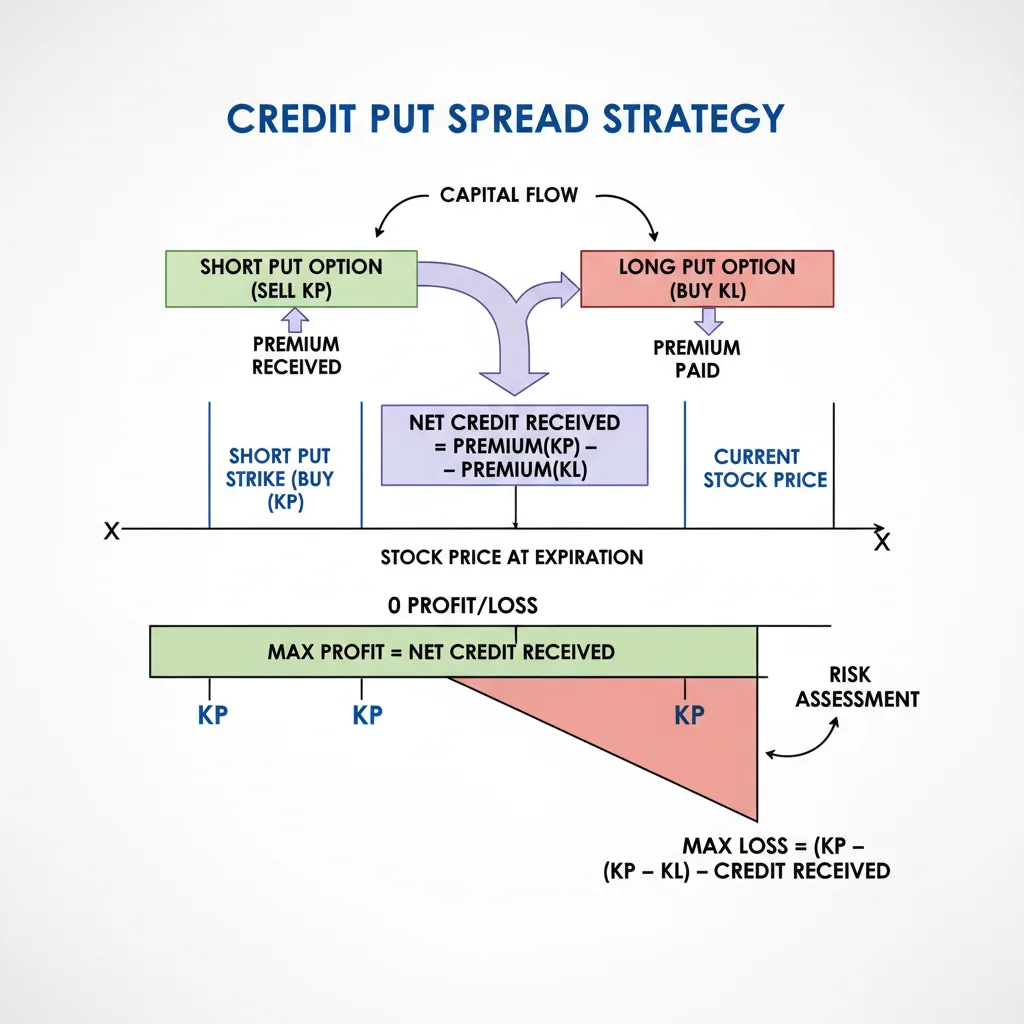
Bull Put Spreads (Selling Puts)
Market Outlook: Slightly bullish or neutral.
How it works: You sell an out-of-the-money (OTM) put option and buy a further OTM put option with the same expiration date. You receive a net credit. You profit if the underlying asset stays above your sold strike price and expires above both strike prices.
Example: If a stock is trading at $100, you might sell the $95 put and buy the $90 put. If the stock remains above $95, both options expire worthless, and you keep the initial credit. Your maximum loss is the difference between the strike prices minus the credit received.
Bear Call Spreads (Selling Calls)
Market Outlook: Slightly bearish or neutral.
How it works: You sell an out-of-the-money (OTM) call option and buy a further OTM call option with the same expiration date. You receive a net credit. You profit if the underlying asset stays below your sold strike price and expires below both strike prices.
Example: If a stock is trading at $100, you might sell the $105 call and buy the $110 call. If the stock remains below $105, both options expire worthless, and you keep the initial credit. Your maximum loss is the difference between the strike prices minus the credit received.
Iron Condors (Combination of Bull Put and Bear Call Spreads)
Market Outlook: Neutral (expecting the stock to trade within a range).
How it works: You combine a bull put spread and a bear call spread. This strategy involves selling two OTM options (one put, one call) and buying two further OTM options (one put, one call) as protection. You receive a larger net credit. You profit if the underlying asset stays between your two sold strike prices.
Considerations for a 2% Monthly Target:
- Probability of Profit (POP): Aim for strategies with a high POP, typically 70% or higher. This often means selling options that are further out-of-the-money.
- Risk-Reward Ratio: While a high POP is good, ensure your potential profit (credit received) is reasonable compared to your maximum potential loss. A common guideline is to aim for a credit that is at least 1/3 to 1/2 of the width of the spread.
- Expiration Cycle: For monthly income, focus on options expiring in 30-45 days. This provides a good balance between time decay and time for the trade to play out.
- Implied Volatility (IV): Selling options when implied volatility is relatively high can lead to larger premiums, increasing your potential Option Spreads Income. However, high IV also signals higher risk of price swings.
The key here is to select strategies that align with your market outlook and risk tolerance, always with an eye on achieving that consistent 2% monthly return target while managing risk.
Step 4: Implementing Robust Risk Management
Generating consistent Option Spreads Income is as much about managing risk as it is about selecting profitable trades. Without a disciplined risk management framework, even the best strategies can lead to significant losses. This is arguably the most critical step.
Key Risk Management Principles:
- Position Sizing: Never allocate more than a small percentage of your total trading capital to a single trade. A common rule of thumb is to risk no more than 1-2% of your account on any given spread. This prevents a single losing trade from severely impacting your portfolio.
- Defined Max Loss: One of the primary advantages of spreads is their defined maximum loss. Always know your worst-case scenario before entering a trade. Ensure this max loss is acceptable within your risk tolerance.
- Stop-Loss Orders (or Mental Stops): While not always practical for complex spreads, having a clear exit plan for when a trade goes against you is crucial. For credit spreads, a common rule is to close the spread if the loss reaches 1x or 2x the credit received. For example, if you received $0.50 per share, you might close the trade if the loss hits $1.00 per share.
- Diversification: Do not put all your capital into one underlying asset or one type of spread. Diversify across different assets and even different strategies if appropriate.
- Avoid Earnings and Major Events: Trading options around earnings announcements or other significant company news can be akin to gambling. Implied volatility often spikes, leading to inflated premiums, but the subsequent price movement can be drastic and unpredictable. For consistent income, these events should generally be avoided.
- Monitor Implied Volatility: High IV means higher premiums, but also higher risk. Be cautious about selling spreads into extremely high IV, as a reversion to the mean can work against you if the underlying moves unfavorably.
- Capital Preservation: Your primary goal is to preserve capital. Profits will follow if you consistently manage your risk effectively.
The 2% Monthly Target and Risk
To achieve a 2% monthly return, you will need to take calculated risks. The key is to ensure these risks are well-defined and controlled. If your average winning trade yields 0.5% of your capital, you might need four successful trades a month. If one trade goes wrong, your risk management plan should prevent it from wiping out the gains of multiple successful trades. This disciplined approach is what allows for consistent Option Spreads Income.
Step 5: Execution, Monitoring, and Adjustment
The final step involves the practical aspects of placing trades, monitoring their performance, and making necessary adjustments. This is where theory meets reality, and disciplined execution separates successful traders from the rest.
Entering the Trade:
- Use Limit Orders: Always use limit orders when entering and exiting spreads to ensure you get your desired premium. Market orders can lead to significant slippage, especially in less liquid options.
- Check Bid-Ask Spreads: Ensure the bid-ask spread is tight enough to allow for efficient entry and exit. Wide spreads eat into your profits.
- Understand Brokerage Fees: Factor in commissions and fees, as these can impact your net Option Spreads Income, especially on smaller trades.
Monitoring Your Trades:
- Daily Review: Even if you are trading monthly options, review your positions daily. Look for significant price movements in the underlying, changes in implied volatility, or news that could impact your trade.
- Track Your P&L (Profit & Loss): Keep a detailed trading journal to track your performance, identify patterns, and learn from both winning and losing trades.
- Be Aware of Assignment Risk: While credit spreads aim for options to expire worthless, there’s always a theoretical risk of early assignment, especially for in-the-money options. Most brokers handle this automatically, but it’s good to be aware.
Adjusting and Exiting Trades:
Not every trade will go perfectly. Knowing when and how to adjust or exit is crucial for protecting your capital and maintaining consistent Option Spreads Income.
- Taking Profits Early: If your spread has achieved a significant portion of its maximum profit (e.g., 50-70% of the credit received) well before expiration, consider closing the trade. The remaining premium is often minimal, and holding exposes you to unnecessary risk for diminishing returns.
- Rolling the Spread: If a spread is moving against you but hasn’t hit your stop-loss, you might consider rolling it. This involves closing the current spread and opening a new one with a later expiration date and/or different strike prices, often to collect more premium or give the trade more time to recover. This is an advanced technique that requires careful consideration.
- Cutting Losses: This is perhaps the most important adjustment. If your stop-loss level is hit, close the trade without hesitation. Emotional attachment to a losing trade is a common pitfall. Adhering to your pre-defined risk parameters is paramount for long-term success in generating Option Spreads Income.
- Expiration Management: As expiration approaches, if your options are still near the money, you might need to make a decision: let them expire (risking assignment if they are ITM), or close them to avoid last-minute volatility.

Advanced Considerations for Maximizing Option Spreads Income
Once you’ve mastered the foundational 5 steps, there are additional techniques and considerations that can further refine your approach to generating consistent Option Spreads Income.
Leveraging Weekly vs. Monthly Options
While we primarily discussed monthly options for their balanced time decay, weekly options can offer more frequent opportunities for income. However, they also come with accelerated time decay and less time for adjustments. Some traders use a combination, deploying weekly spreads on highly liquid assets to fine-tune their monthly income targets.
Understanding Implied Volatility Skew and Smile
Implied volatility isn’t uniform across all strike prices and expiration dates. The ‘skew’ refers to the phenomenon where OTM puts often have higher implied volatility than OTM calls (or vice-versa), reflecting market participants’ demand for protection. Understanding this can help you identify where you can sell options with higher premiums relative to their perceived risk, thus optimizing your Option Spreads Income.
Combining Strategies
For more experienced traders, combining different spread strategies can create more nuanced risk-reward profiles. For instance, an iron condor is a combination of two credit spreads. Exploring other combinations, such as ratio spreads or even combining spreads with underlying stock positions (e.g., covered calls or cash-secured puts with a spread overlay), can open new avenues for income generation.
Tax Implications of Options Trading
It’s crucial to understand the tax treatment of options profits and losses in the US. Section 1256 contracts often receive favorable 60/40 tax treatment (60% long-term, 40% short-term capital gains), but not all options strategies qualify. Consult with a tax professional to understand how your specific Option Spreads Income will be taxed.
The Psychological Aspect of Trading
Trading, especially for consistent income, requires significant emotional discipline. Fear of missing out (FOMO), greed, and fear of loss can lead to impulsive decisions that derail a well-planned strategy. Stick to your trading plan, accept small losses as part of the game, and avoid overtrading. Consistency in behavior leads to consistency in returns when pursuing Option Spreads Income.
Common Pitfalls to Avoid
Even with a robust strategy, certain pitfalls can derail your efforts to generate consistent Option Spreads Income. Being aware of these can help you navigate the market more effectively.
- Over-Leveraging: Using too much capital on too few trades can magnify losses and quickly deplete your account.
- Chasing High Premiums: High premiums often come with higher implied volatility and thus higher risk. Don’t let the allure of large credits blind you to the underlying risk.
- Ignoring Small Losses: Allowing small losses to turn into large ones by not adhering to stop-loss rules is a common and costly mistake.
- Lack of Diversification: Concentrating all your capital in one or two underlying assets exposes you to specific company risk.
- Emotional Trading: Making decisions based on fear or greed rather than your pre-defined strategy.
- Not Understanding the Greeks: While you don’t need to be a mathematician, a basic grasp of how Delta, Gamma, Theta, and Vega impact your spread is essential for informed decision-making.
- Poor Brokerage Choice: High fees, unreliable platforms, or limited access to options data can hinder your ability to execute effectively.
Conclusion: Your Path to Consistent 2% Monthly Option Spreads Income
Generating a consistent 2% monthly income through US option spreads is an ambitious yet achievable goal for disciplined and knowledgeable traders. This 5-step guide provides a comprehensive framework, from understanding the fundamentals to executing and managing your trades with robust risk controls. By mastering these steps, you position yourself to extract consistent Option Spreads Income from the market while effectively managing potential downsides.
Remember, options trading is a skill that improves with practice and continuous learning. Start small, focus on understanding each component of your strategy, and meticulously track your results. Adaptability is key; market conditions change, and your strategies may need to evolve. With patience, discipline, and a commitment to continuous education, the goal of consistent 2% monthly income through option spreads is well within your reach. Embrace the journey, and happy trading!