Understanding the SEC’s New Climate Disclosure Rules: A 6-Month Action Plan for Public Companies (RECENT UPDATES, TIME-SENSITIVE)
The landscape of corporate reporting is undergoing a monumental shift, driven by an increasing global focus on climate change and its financial implications. For public companies, the U.S. Securities and Exchange Commission (SEC) has ushered in a new era of transparency with its groundbreaking climate disclosure rules. These rules, while subject to ongoing legal challenges and potential adjustments, represent a significant evolution in how companies must account for and communicate their climate-related risks and opportunities. This isn’t merely a compliance exercise; it’s a strategic imperative that demands immediate and meticulous attention. The clock is ticking, and a well-structured, proactive approach is no longer optional but essential. This comprehensive guide provides a detailed 6-month action plan designed to help public companies navigate the complexities of the SEC’s new climate disclosure rules, ensuring they are not only compliant but also strategically positioned for future sustainability reporting.
The SEC’s final rule, ‘The Enhancement and Standardization of Climate-Related Disclosures for Investors,’ aims to provide investors with consistent, comparable, and reliable information about climate-related risks. While the rule has faced legal hurdles, including a temporary stay, the underlying intent and the eventual need for robust climate reporting remain undeniable. Companies that delay their preparation do so at their peril. This guide will delve into the critical aspects of the rules, recent updates, and provide a practical, phased approach to achieving compliance.
The Urgency of SEC Climate Disclosure: Why Act Now?
The recent developments surrounding the SEC’s climate disclosure rules underscore the dynamic and often unpredictable nature of regulatory environments. While a temporary stay was issued by the Fifth Circuit Court of Appeals, and the rule faces ongoing legal challenges, the fundamental direction of travel for corporate climate reporting is clear. Investors, regulators, and the public are increasingly demanding greater transparency regarding climate-related risks and opportunities. Public companies that choose to wait for absolute certainty before acting risk falling significantly behind their peers and facing substantial challenges when compliance eventually becomes mandatory.
The SEC’s initiative is not an isolated event; it aligns with a broader global movement towards standardized sustainability reporting, exemplified by frameworks like the International Sustainability Standards Board (ISSB) and the European Union’s Corporate Sustainability Reporting Directive (CSRD). Even if the SEC’s specific rules are modified or delayed, the principles of climate-related financial disclosures are becoming embedded in global capital markets. Therefore, understanding and preparing for the core tenets of the SEC Climate Disclosure rules is a strategic investment, not just a reactive measure.
Early preparation offers numerous advantages. It allows companies to identify data gaps, build internal capabilities, develop robust governance structures, and integrate climate considerations into their broader business strategy. This proactive stance can mitigate risks, enhance reputation, attract ESG-focused investors, and potentially uncover new business opportunities. Conversely, a delayed response can lead to rushed implementation, inaccurate reporting, increased costs, and potential legal or reputational damage. The time to initiate your SEC Climate Disclosure action plan is now.
Key Components of the SEC Climate Disclosure Rules (Recent Updates & Considerations)
Although the final rule has seen some modifications from its initial proposal – notably, the exclusion of Scope 3 emissions for most companies and a phased-in compliance timeline – its core requirements remain substantial. Public companies must understand these key components to effectively prepare for SEC Climate Disclosure.
Climate-Related Risks and Their Material Impact
Companies will be required to disclose material climate-related risks, both physical (e.g., extreme weather events, rising sea levels) and transition (e.g., policy changes, technological shifts, market changes). Crucially, these disclosures must detail the actual or likely material impacts of these risks on the company’s business, strategy, and outlook. This goes beyond simply listing risks; it demands an analysis of their financial implications.
Governance and Risk Management
The rules mandate disclosure of the company’s governance of climate-related risks and its processes for identifying, assessing, and managing such risks. This includes identifying the board or committee responsible for climate oversight, management’s role, and how climate risk management is integrated into the company’s overall risk management framework. Strong governance is a cornerstone of effective SEC Climate Disclosure.
Greenhouse Gas (GHG) Emissions
Perhaps the most challenging aspect for many companies is the requirement to disclose Scope 1 (direct) and Scope 2 (indirect from purchased energy) GHG emissions, if material. Accelerated filers and large accelerated filers will also need to obtain independent assurance for their Scope 1 and/or Scope 2 emissions disclosures, initially at a limited assurance level and later at a reasonable assurance level. This necessitates robust data collection, calculation methodologies, and verification processes. The materiality threshold for GHG emissions is a key area for careful consideration and legal interpretation.
Climate-Related Targets and Goals
If a company has set climate-related targets or goals, it must disclose information about these targets, including the scope of activities and emissions included, the timeline, and how the company intends to achieve them. This provides investors with insight into the company’s long-term climate strategy and commitment.
Financial Statement Metrics and Disclosures
The rules require qualitative and quantitative disclosures in a company’s financial statements regarding the impact of climate-related events and transition activities. This includes capitalized costs, expenditures, charges, and losses incurred as a result of severe weather events and other natural conditions, as well as the impact of carbon offsets and renewable energy credits (RECs). This integration of climate data into financial statements is a significant departure from previous reporting norms.
Recent Updates and Legal Landscape
The legal challenges to the SEC Climate Disclosure rule have introduced a degree of uncertainty. However, it is crucial to remember that these challenges primarily focus on the SEC’s authority and specific aspects of the rule, rather than the fundamental need for climate transparency. Companies should monitor these developments closely but not allow them to paralyze their preparation efforts. A flexible and adaptable approach, centered on building foundational climate data and governance capabilities, will serve companies well regardless of the final outcome of the legal battles.
A 6-Month Action Plan for SEC Climate Disclosure Readiness
Preparing for the SEC’s new climate disclosure rules requires a structured, multi-disciplinary approach. This 6-month action plan provides a strategic roadmap for public companies to navigate the complexities and build a robust foundation for compliance. Each phase builds upon the last, ensuring a systematic and efficient preparation process for SEC Climate Disclosure.
Month 1-2: Foundation & Gap Analysis
Establish a Cross-Functional Task Force
Action: Assemble a dedicated team comprising representatives from finance, legal, sustainability, risk management, operations, investor relations, and internal audit. This cross-functional approach is critical as climate disclosure impacts multiple facets of the organization. Assign clear roles and responsibilities, and identify a project lead.
Rationale: Effective SEC Climate Disclosure requires input and collaboration from diverse departments. A dedicated task force ensures coordinated effort and ownership.
Conduct a Comprehensive Materiality Assessment
Action: Perform a thorough assessment to identify climate-related risks and opportunities that are material to your business. This should consider both physical risks (e.g., extreme weather, resource scarcity) and transition risks (e.g., policy changes, technological disruption, market shifts, reputational risks). Engage with key stakeholders, including investors, customers, and suppliers, to understand their perspectives on climate-related materiality.
Rationale: The SEC’s rules are focused on material impacts. Understanding what is material to your specific business is paramount for effective SEC Climate Disclosure and avoiding over- or under-reporting.
Inventory Existing Climate Data & Systems
Action: Document all current climate-related data collection processes, systems, and reporting. This includes existing GHG emissions data (Scope 1, 2, and any Scope 3), energy consumption, water usage, waste generation, and any climate-related financial impacts already tracked. Identify data owners and current reporting frameworks (e.g., CDP, TCFD, SASB).
Rationale: This inventory will highlight current strengths and, more importantly, expose critical data gaps that need to be addressed for SEC Climate Disclosure compliance.
Perform a Gap Analysis Against SEC Requirements
Action: Compare your current climate-related disclosures, data, and processes against the specific requirements of the SEC’s final rule. This includes governance structures, risk management processes, GHG emissions quantification (Scope 1 and 2), climate targets, and financial statement impact disclosures. Prioritize the identified gaps based on their significance and the effort required to address them.
Rationale: A robust gap analysis forms the bedrock of your action plan, providing a clear roadmap for what needs to be developed or improved for SEC Climate Disclosure.
Month 3-4: Data Enhancement & Governance Development
Enhance Data Collection & Management Systems
Action: Implement or upgrade systems and processes for collecting, validating, and managing climate-related data, particularly for Scope 1 and Scope 2 GHG emissions. This may involve investing in specialized software, enhancing existing ERP systems, or developing new internal protocols. Ensure data quality, accuracy, and completeness.
Rationale: Reliable and auditable data is non-negotiable for SEC Climate Disclosure. Robust systems are essential for efficient and accurate reporting.
Develop or Refine GHG Emissions Calculation Methodologies
Action: Standardize and document your methodologies for calculating Scope 1 and Scope 2 GHG emissions. Ensure alignment with recognized standards (e.g., GHG Protocol). If required, begin the process of identifying and engaging with independent assurance providers for Scope 1 and/or Scope 2 emissions.
Rationale: Consistent and verifiable GHG emissions calculations are a core requirement. Early engagement with assurance providers is crucial given the phased-in assurance requirements for SEC Climate Disclosure.
Strengthen Governance & Risk Management Frameworks
Action: Formalize or refine the board’s oversight of climate-related risks and opportunities. Clearly define the roles and responsibilities of board committees and management in climate risk management. Integrate climate risk into the company’s existing enterprise risk management (ERM) framework. Document these processes thoroughly.
Rationale: The SEC demands clear articulation of how climate risks are governed and managed. Strong frameworks demonstrate commitment and control.
Assess Financial Statement Impacts
Action: Begin to assess and quantify the potential financial impacts of climate-related events and transition activities on your financial statements. This includes identifying relevant accounts (e.g., capitalized costs, expenditures, charges, losses) and developing methodologies for tracking and disclosing these impacts. Consult with external accounting experts as needed.
Rationale: This is a new and complex area for many companies. Early assessment helps in understanding the scope and developing appropriate accounting treatments for SEC Climate Disclosure.
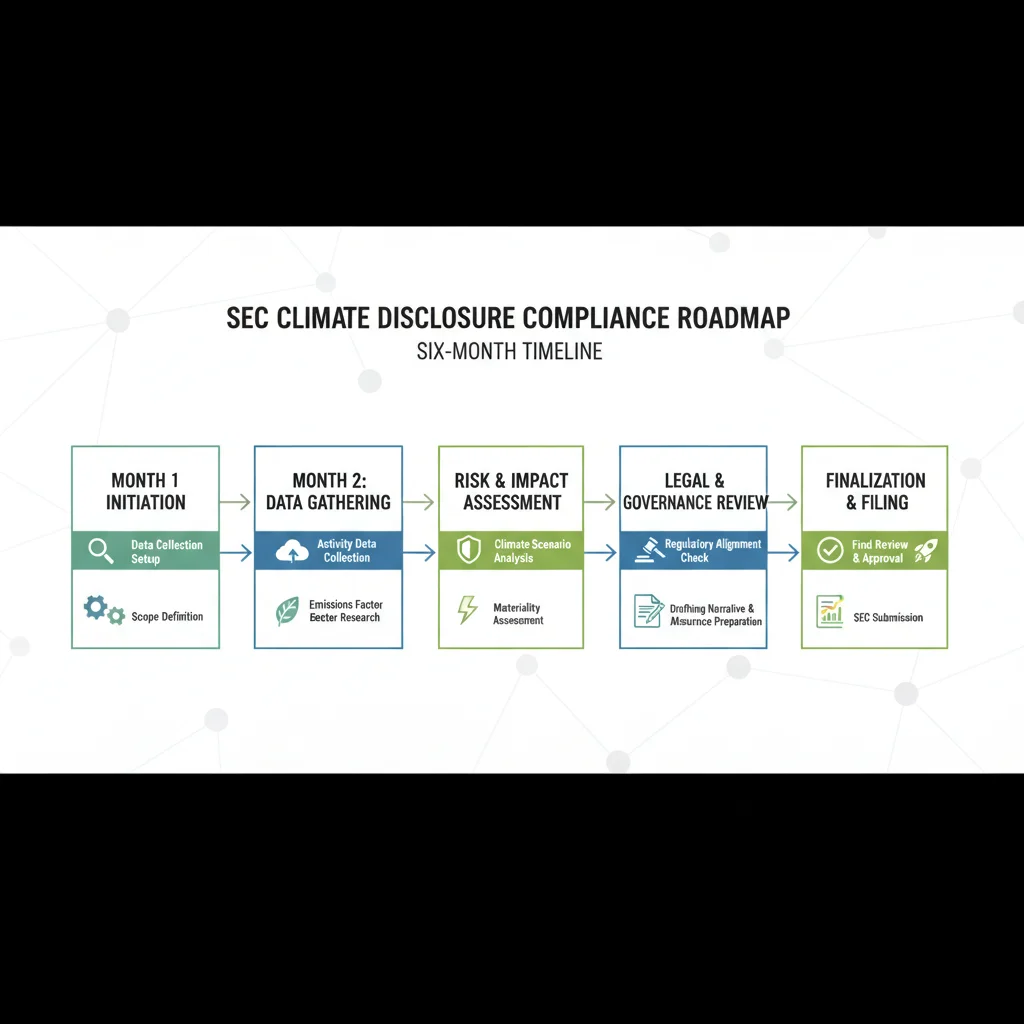
Month 5-6: Disclosure Preparation & Internal Controls
Draft Initial Disclosures
Action: Based on the data collected and analyses performed, begin drafting the required climate-related disclosures for your annual report (Form 10-K). This includes narrative disclosures on governance, strategy, risk management, and metrics, as well as the financial statement impact disclosures. Pay close attention to the language used, ensuring it is precise, factual, and compliant with SEC guidance.
Rationale: Early drafting allows for multiple rounds of review and refinement, ensuring accuracy and coherence in your SEC Climate Disclosure.
Implement Robust Internal Controls Over Disclosure (ICOD)
Action: Develop and implement comprehensive internal controls specific to climate-related information and disclosures. These controls should cover data collection, aggregation, calculation, review, and reporting processes. Ensure that these controls are integrated with your existing disclosure controls and procedures (DCP) and internal control over financial reporting (ICFR).
Rationale: Strong ICOD is essential to ensure the accuracy, reliability, and auditability of your climate disclosures, mitigating risks of misstatements and non-compliance.
Legal and External Review
Action: Engage legal counsel and external auditors to review your drafted disclosures and internal controls. Legal review will ensure compliance with SEC regulations and mitigate legal risks. External auditors can provide valuable feedback on the auditability of your data and controls, especially for GHG emissions assurance.
Rationale: Independent review provides an essential layer of scrutiny and validation, catching potential issues before public filing of your SEC Climate Disclosure.
Board & Senior Management Approval
Action: Present the drafted disclosures and the underlying processes and controls to the board of directors and senior management for review and approval. Ensure they are fully informed of the implications and responsibilities associated with these new disclosures.
Rationale: Ultimate responsibility for SEC Climate Disclosure rests with the board and senior management. Their informed approval is critical.
Prepare for Investor Communications
Action: Develop a strategy for communicating your climate disclosures to investors and other stakeholders. Prepare Q&A documents, investor presentations, and internal talking points to ensure consistent messaging. Be ready to articulate your company’s climate strategy and performance effectively.
Rationale: Transparent and proactive communication can enhance investor confidence and manage expectations regarding your SEC Climate Disclosure.
Challenges and Best Practices for SEC Climate Disclosure
While the 6-month action plan provides a structured approach, companies will undoubtedly face challenges in implementing the new SEC Climate Disclosure rules. Anticipating these hurdles and adopting best practices can significantly smooth the path to compliance.
Data Availability and Quality
Challenge: Many companies, especially those with complex supply chains or decentralized operations, struggle with collecting comprehensive, accurate, and consistent climate-related data, particularly for Scope 1 and Scope 2 emissions. Data often resides in disparate systems or is collected manually, leading to inconsistencies and gaps.
Best Practice: Invest in robust data management systems and automation tools. Standardize data collection protocols across all relevant business units. Implement data validation checks and internal audit procedures to ensure data quality. Consider leveraging technology solutions designed for ESG and climate reporting to streamline data aggregation and analysis for SEC Climate Disclosure.
Materiality Determinations
Challenge: Deciding what constitutes a ‘material’ climate-related risk or financial impact can be subjective and challenging. The SEC’s definition of materiality (information that a reasonable investor would consider important) requires careful judgment and often involves forward-looking assessments.
Best Practice: Conduct a rigorous, well-documented materiality assessment that involves both internal and external stakeholders. Benchmark against industry peers and consider investor expectations. Clearly articulate the methodology used for materiality determinations in your disclosures. Regularly review and update your materiality assessment as your business and the climate landscape evolve.
Integration with Existing Reporting Processes
Challenge: Integrating climate disclosures, particularly the financial statement metrics, into existing financial reporting processes (e.g., 10-K preparation, internal controls over financial reporting) can be complex and resource-intensive.
Best Practice: Treat climate disclosures with the same rigor and control as financial disclosures. Leverage existing internal control frameworks (e.g., SOX compliance) to build robust controls around climate data. Establish clear lines of responsibility between finance, legal, and sustainability teams to ensure seamless integration and consistent reporting for SEC Climate Disclosure.
Evolving Regulatory Landscape
Challenge: The ongoing legal challenges and potential for further modifications to the SEC Climate Disclosure rule create uncertainty and may require companies to adapt their strategies.
Best Practice: Maintain flexibility in your preparation efforts. Focus on building foundational capabilities (e.g., strong data governance, robust internal controls, comprehensive risk management) that will be valuable regardless of the final rule’s specifics. Stay informed about legal and regulatory developments through legal counsel and industry associations. Consider scenario planning to prepare for different regulatory outcomes.
Resource Allocation and Expertise
Challenge: Many companies may lack the internal expertise or resources to effectively manage the complexities of climate data collection, analysis, and reporting.
Best Practice: Invest in training for existing staff or hire specialized talent in sustainability reporting, environmental data management, and climate risk assessment. Consider engaging external consultants or advisory firms to supplement internal capabilities, particularly for initial assessments, system implementation, and assurance readiness for SEC Climate Disclosure.
Looking Beyond Compliance: The Strategic Value of Robust SEC Climate Disclosure
While the immediate focus for public companies is undoubtedly on achieving compliance with the SEC’s new climate disclosure rules, it is crucial to recognize that this initiative offers far more than just regulatory adherence. A well-executed SEC Climate Disclosure strategy can unlock significant strategic value, enhancing a company’s resilience, reputation, and long-term financial performance.
Enhanced Investor Confidence and Access to Capital
In today’s market, ESG factors are increasingly influencing investment decisions. Investors, particularly institutional investors, are actively seeking companies with transparent and robust climate disclosures. By providing comprehensive and reliable information on climate-related risks and opportunities, companies can demonstrate their commitment to sustainability, build trust, and attract a broader base of ESG-focused investors. This can lead to a lower cost of capital and improved access to financing, as lenders and insurers also increasingly factor climate risk into their assessments. Proactive and clear SEC Climate Disclosure signals a forward-thinking management team.
Improved Risk Management and Resilience
The process of preparing for SEC Climate Disclosure forces companies to undertake a rigorous assessment of their climate-related risks and opportunities. This detailed analysis can uncover previously unrecognized vulnerabilities in operations, supply chains, and market positions. By understanding these risks more deeply, companies can develop more effective mitigation strategies, build greater operational resilience, and adapt their business models to a changing climate. This proactive risk management, driven by SEC Climate Disclosure requirements, translates into more robust long-term business planning.
Operational Efficiencies and Innovation
The data collection and analysis required for climate disclosures often highlight areas of inefficiency. For example, tracking Scope 1 and Scope 2 emissions can reveal opportunities for energy efficiency improvements, waste reduction, and process optimization, leading to cost savings. Furthermore, the focus on climate-related opportunities can spur innovation, encouraging companies to develop new sustainable products, services, and technologies that meet evolving market demands and regulatory pressures. This drive for efficiency and innovation is a direct benefit of engaging with SEC Climate Disclosure.
Enhanced Reputation and Stakeholder Engagement
Companies that demonstrate leadership in climate transparency and action can significantly enhance their reputation among customers, employees, and the wider community. A strong climate disclosure record can differentiate a company in competitive markets, attract top talent, and strengthen relationships with key stakeholders. Conversely, a lack of transparency or perceived inaction on climate issues can lead to reputational damage and stakeholder backlash. Effective SEC Climate Disclosure is a powerful tool for reputation management.
Strategic Planning and Long-Term Value Creation
Integrating climate considerations into strategic planning, as encouraged by the SEC rules, enables companies to develop more resilient and sustainable business models. By understanding how climate change will impact their markets, operations, and competitive landscape, companies can make more informed long-term decisions, allocate capital more effectively, and identify new avenues for growth. Ultimately, robust SEC Climate Disclosure is not just about reporting the past; it’s about shaping a more sustainable and profitable future.
Conclusion: Embracing the Future of Corporate Reporting
The SEC’s new climate disclosure rules represent a pivotal moment for public companies. While the regulatory landscape remains fluid, the imperative to understand, measure, and report on climate-related risks and opportunities is unequivocally clear. The 6-month action plan outlined in this article provides a practical and strategic roadmap to navigate these complex requirements, ensuring that public companies are well-prepared for the imminent demands of SEC Climate Disclosure.
This is not a task to be delegated solely to the sustainability department; it requires a concerted, cross-functional effort with strong leadership from the board and senior management. By adopting a proactive approach, investing in robust data governance, strengthening internal controls, and integrating climate considerations into core business strategy, companies can transform a compliance challenge into a strategic advantage.
Embracing the future of corporate reporting means recognizing that climate performance is increasingly intertwined with financial performance. Companies that lead in climate transparency and action will not only meet regulatory obligations but also build greater resilience, enhance investor confidence, foster innovation, and ultimately create sustainable long-term value for all stakeholders. The time for action on SEC Climate Disclosure is now.