Smart Cities US: 4 Emerging Tech Shaping Urban Infrastructure by 2030
The concept of a ‘smart city’ has transitioned from science fiction to a tangible reality, with urban centers across the United States increasingly adopting innovative solutions to enhance livability, efficiency, and sustainability. As we approach 2030, the pace of technological advancement is accelerating, promising to fundamentally reshape urban infrastructure. This comprehensive exploration delves into four key emerging technologies that are poised to revolutionize how U.S. cities function, interact, and evolve, focusing on their profound impact on urban planning, public services, and the daily lives of residents.
The Dawn of Smart City Technologies: A New Urban Paradigm
The vision of a smart city is one where technology is seamlessly integrated into every aspect of urban life, from transportation and energy management to public safety and civic engagement. This integration isn’t merely about adopting new gadgets; it’s about creating interconnected ecosystems that leverage data and automation to optimize resources, reduce environmental impact, and improve the overall quality of life for citizens. The driving force behind this transformation is the convergence of several powerful technological trends, each contributing a unique piece to the smart city puzzle.
Smart City Technologies are not a monolithic entity; rather, they comprise a diverse array of innovations working in concert. These technologies aim to address pressing urban challenges such as traffic congestion, pollution, resource scarcity, and aging infrastructure. By harnessing the power of data analytics, artificial intelligence, and advanced connectivity, cities can move beyond reactive problem-solving to proactive, predictive management, creating more resilient and responsive urban environments. The U.S. is at the forefront of this movement, with numerous cities investing heavily in smart infrastructure projects, setting the stage for a dramatic transformation by 2030.
The journey towards smarter cities is a complex one, requiring significant investment, strategic planning, and collaboration between public and private sectors. However, the potential rewards—economic growth, environmental stewardship, and enhanced citizen well-being—are immense. Understanding the specific technologies driving this evolution is crucial for grasping the future landscape of urban America.
1. The Internet of Things (IoT) and Ubiquitous Sensing
At the heart of every Smart City Technologies initiative lies the Internet of Things (IoT). IoT refers to the vast network of physical objects embedded with sensors, software, and other technologies for the purpose of connecting and exchanging data with other devices and systems over the internet. In an urban context, this translates into a pervasive network of interconnected sensors and devices collecting real-time data on everything from air quality and traffic flow to waste levels and structural integrity of buildings.
Real-Time Data for Smarter Decisions
The proliferation of IoT devices allows city administrators to gain unprecedented insights into urban dynamics. Smart sensors embedded in roadways can monitor traffic patterns, enabling adaptive traffic signal systems that reduce congestion and improve commute times. Environmental sensors can track air and water quality, providing early warnings of pollution spikes and informing public health initiatives. In waste management, IoT-enabled bins can signal when they are full, optimizing collection routes and reducing operational costs. This real-time data collection forms the backbone of intelligent urban management, moving away from static, outdated information to dynamic, actionable insights.
Enhancing Public Safety and Emergency Response
IoT also plays a critical role in enhancing public safety. Smart streetlights equipped with cameras and acoustic sensors can detect unusual activities, gunshots, or accidents, automatically alerting emergency services. Connected surveillance systems can provide law enforcement with real-time situational awareness, improving response times and efficiency. Furthermore, smart infrastructure can assist during natural disasters, with sensors monitoring water levels in flood-prone areas or structural stress in bridges and buildings, allowing for timely evacuation orders and preventative measures.
Challenges and Opportunities
While the benefits of IoT are clear, challenges remain, particularly concerning data privacy and cybersecurity. The sheer volume of data collected necessitates robust security protocols and ethical guidelines to protect citizen information. However, as these challenges are addressed, IoT will continue to be a foundational technology, enabling cities to become more responsive, efficient, and safer places to live. By 2030, expect nearly every piece of urban infrastructure to be ‘smart’ in some capacity, powered by an intricate web of IoT devices.
2. Artificial Intelligence (AI) and Machine Learning (ML) for Predictive Urban Management
The massive datasets generated by IoT devices would be overwhelming without the analytical power of Artificial Intelligence (AI) and Machine Learning (ML). These technologies are the brains behind Smart City Technologies, transforming raw data into actionable intelligence and enabling predictive urban management. AI and ML algorithms can identify patterns, forecast future trends, and automate decision-making processes, leading to more efficient and proactive city services.
Optimizing Resource Allocation
AI algorithms can analyze historical and real-time data to optimize resource allocation across various city departments. For instance, in energy management, AI can predict energy demand based on weather forecasts, time of day, and occupancy rates, allowing for dynamic adjustments in power distribution and reducing waste. In water management, ML models can identify leaks in pipelines or predict periods of high water usage, enabling targeted interventions and conservation efforts. This predictive capability moves cities from reactive maintenance to proactive optimization, saving significant operational costs and resources.
Intelligent Transportation Systems
One of the most impactful applications of AI in smart cities is in transportation. AI-powered traffic management systems can analyze traffic camera feeds, GPS data from vehicles, and public transit schedules to dynamically adjust traffic light timings, reroute vehicles, and even predict congestion before it occurs. This not only reduces commute times and fuel consumption but also lowers carbon emissions. Predictive maintenance for public transit vehicles, informed by ML analysis of operational data, can prevent breakdowns and ensure more reliable service. Furthermore, AI will be crucial for the widespread adoption and safe operation of autonomous vehicles, managing complex interactions and ensuring seamless travel.

Enhancing Citizen Services and Engagement
AI also revolutionizes how citizens interact with their city. AI-powered chatbots and virtual assistants can provide instant answers to common queries, streamline permit applications, and facilitate civic engagement. Predictive policing models, while controversial, aim to identify high-risk areas or predict crime hotspots, allowing for more efficient deployment of law enforcement resources. However, ethical considerations and biases in AI algorithms must be carefully managed to ensure equitable and just outcomes for all residents. By 2030, AI will be deeply embedded in urban governance, making cities more responsive and personalized for their inhabitants.
3. 5G and Advanced Connectivity: The Nervous System of the Smart City
For IoT devices to communicate and AI algorithms to process data in real-time, robust and high-speed connectivity is essential. This is where 5G technology and other advanced communication networks come into play, serving as the nervous system for all Smart City Technologies. 5G offers unprecedented speeds, ultra-low latency, and massive connectivity capabilities, making it a game-changer for urban infrastructure.
Enabling Real-Time Data Exchange
The low latency of 5G is critical for applications requiring immediate response times, such as autonomous vehicles, remote healthcare, and real-time public safety monitoring. Imagine a scenario where a self-driving car needs to communicate instantly with traffic signals, other vehicles, and pedestrians – 5G provides the necessary bandwidth and speed for this complex dance. Similarly, in emergency situations, 5G can ensure that critical data, such as live video feeds from incident sites, reaches first responders without delay, enabling faster and more effective interventions.
Supporting Massive IoT Deployments
One of 5G’s most significant advantages is its capacity to support a massive number of connected devices simultaneously. This is crucial for smart cities, which will feature millions, if not billions, of IoT sensors and devices. From smart meters in homes to environmental sensors across parks and public spaces, 5G can handle the immense data traffic generated by these interconnected systems without compromising performance. This pervasive connectivity allows for a truly integrated urban environment where every element can contribute to the city’s overall intelligence.
Facilitating New Urban Services
Beyond existing applications, 5G will unlock entirely new possibilities for urban services. Augmented Reality (AR) and Virtual Reality (VR) applications could be used for urban planning, citizen engagement, or even enhanced tourism experiences. Remote monitoring and control of infrastructure, from utility grids to building management systems, will become more seamless and efficient. The widespread deployment of 5G infrastructure is a foundational step for any city aspiring to be truly smart, and by 2030, it is expected to be a standard feature in major U.S. urban centers, powering the next generation of smart applications.
4. Digital Twins for Comprehensive Urban Planning and Management
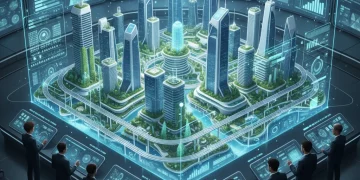
A digital twin is a virtual replica of a physical object, system, or process. In the context of Smart City Technologies, a digital twin is a dynamic, real-time virtual model of an entire city or significant parts of it. This sophisticated technology integrates data from IoT sensors, GIS (Geographic Information Systems), building information models (BIM), and other sources to create a living, breathing simulation of the urban environment. Digital twins are rapidly emerging as indispensable tools for urban planners, policymakers, and engineers.
Simulating and Optimizing Urban Development
With a digital twin, city planners can simulate the impact of new construction projects, infrastructure upgrades, or policy changes before they are implemented in the physical world. For example, they can model the effects of a new high-rise on traffic flow, sunlight exposure in public spaces, or wind patterns. This allows for iterative design and optimization, reducing risks, costs, and unforeseen negative consequences. The ability to test various scenarios virtually empowers decision-makers to make more informed and sustainable choices regarding urban development.
Real-Time Monitoring and Anomaly Detection
Beyond planning, digital twins provide real-time monitoring of urban infrastructure. By continuously ingesting data from IoT sensors, the digital twin can detect anomalies, predict potential failures, and identify areas requiring maintenance or intervention. For instance, it can monitor the structural health of bridges, detect unusual energy consumption patterns in buildings, or track the spread of pollutants. This proactive approach to asset management significantly improves operational efficiency and prevents costly disruptions.
Enhancing Resilience and Emergency Preparedness
Digital twins are also powerful tools for enhancing urban resilience. In the event of a natural disaster, such as a flood or earthquake, a digital twin can simulate the disaster’s impact, identify vulnerable areas, and help emergency services plan evacuation routes and resource deployment more effectively. By providing a comprehensive, real-time overview of the urban environment, digital twins enable cities to respond more rapidly and effectively to crises, minimizing damage and saving lives. By 2030, digital twins are expected to become standard practice for large-scale urban management, providing an unparalleled level of control and insight into the complex workings of a city.
The Broader Impact of Smart City Technologies on Urban Life
The integration of these four Smart City Technologies—IoT, AI/ML, 5G, and Digital Twins—will collectively transform urban life in the U.S. in profound ways. This isn’t just about technological upgrades; it’s about fostering a new era of urban living characterized by efficiency, sustainability, and an enhanced quality of life for residents.
Sustainability and Environmental Stewardship
Smart cities are inherently sustainable cities. By optimizing energy consumption, water usage, and waste management through IoT and AI, cities can significantly reduce their environmental footprint. Smart grids can integrate renewable energy sources more effectively, while intelligent transportation systems can reduce emissions from vehicles. Digital twins can help identify areas for green infrastructure development and monitor environmental health, leading to healthier urban ecosystems. The goal is to create cities that thrive economically while operating in harmony with their natural surroundings.
Economic Growth and Innovation
The development and deployment of Smart City Technologies will spur significant economic growth. It creates new industries, jobs, and investment opportunities in areas like software development, data analytics, sensor manufacturing, and infrastructure engineering. Cities that embrace these technologies will attract talent and businesses, fostering a vibrant ecosystem of innovation. This technological advancement also leads to more efficient public services, which can free up municipal funds for other critical areas, further stimulating local economies.
Improved Quality of Life for Citizens
Ultimately, the objective of smart cities is to improve the quality of life for their residents. Reduced traffic congestion means less time commuting and more time for personal activities. Cleaner air and water contribute to better public health outcomes. More efficient public services, from waste collection to emergency response, make cities more pleasant and safer places to live. Enhanced connectivity and digital services can bridge the digital divide, making information and opportunities more accessible to all citizens. The promise of smart cities is a future where urban environments are not just functional but truly thrive, catering to the diverse needs of their populations.
Challenges and the Path Forward
While the future of Smart City Technologies in the U.S. looks promising, several challenges must be addressed to realize their full potential. Data privacy and security remain paramount concerns. With vast amounts of personal and urban data being collected, robust cybersecurity measures and clear ethical guidelines are essential to prevent misuse and maintain public trust. The digital divide also needs to be addressed, ensuring that all residents, regardless of socioeconomic status, have equitable access to the benefits of smart city initiatives.
Funding is another significant challenge. Implementing these advanced technologies requires substantial investment, often necessitating innovative financing models and public-private partnerships. Furthermore, overcoming bureaucratic hurdles and fostering collaboration between various government agencies, technological providers, and community stakeholders is crucial for successful deployment. Engaging citizens in the planning and implementation process is also vital to ensure that smart city solutions truly meet the needs of the communities they serve.
Despite these challenges, the momentum towards smarter urban environments is undeniable. U.S. cities are increasingly recognizing the imperative to leverage technology to build more resilient, sustainable, and equitable futures. By 2030, the four emerging technologies discussed—IoT, AI/ML, 5G, and Digital Twins—will not only have reshaped urban infrastructure but will have redefined what it means to live in a modern American city.
Conclusion: A Smarter Urban Future by 2030
The journey to transform urban infrastructure through Smart City Technologies is well underway in the United States. By 2030, the pervasive integration of the Internet of Things will provide a continuous stream of urban data, fueling Artificial Intelligence and Machine Learning algorithms to create predictive and adaptive city management systems. This intelligent ecosystem will be powered by the lightning-fast and ultra-reliable connectivity of 5G networks, enabling real-time communication and supporting a new generation of urban applications. Overlaying all of this will be digital twins, offering virtual replicas of our cities for unparalleled planning, monitoring, and optimization.
These four technologies are not developing in isolation; they are converging to create a synergistic effect, each amplifying the capabilities of the others. The result will be U.S. cities that are more efficient in their resource utilization, more resilient to environmental and social challenges, more economically vibrant, and ultimately, more livable for their inhabitants. The transformation will be comprehensive, touching every aspect of urban existence, from how we commute and consume energy to how public safety is maintained and how citizens engage with their local governments.
While there are hurdles to overcome, including issues of data privacy, equity, and significant investment, the trajectory is clear. The commitment from innovative city leaders, technological pioneers, and engaged communities is paving the way for a future where urban infrastructure is not just functional but intelligent, proactive, and deeply responsive to the needs of its people. The smart cities of 2030 will stand as testaments to human ingenuity, demonstrating how technology, when thoughtfully applied, can create a more sustainable, equitable, and prosperous urban world for generations to come.