U.S. Cloud Providers 2026: Performance, Cost, Compliance
Comparing the Top 3 U.S. Cloud Providers for Enterprise in 2026: Performance, Cost, and Compliance Analysis
In the dynamic landscape of modern enterprise, the choice of a cloud provider is no longer just an IT decision; it’s a strategic imperative that profoundly impacts an organization’s agility, innovation, security, and bottom line. As we look towards 2026, the dominance of the ‘big three’ – Amazon Web Services (AWS), Microsoft Azure, and Google Cloud Platform (GCP) – in the U.S. market remains undisputed. However, their offerings continue to evolve rapidly, making a detailed and up-to-date comparison crucial for any U.S. enterprise seeking to optimize its cloud strategy. This comprehensive analysis dives deep into the performance, cost structures, and compliance capabilities of these leading U.S. Cloud Providers, equipping you with the insights needed to make an informed decision that aligns with your business objectives.
The stakes are incredibly high. A misstep in cloud provider selection can lead to spiraling costs, performance bottlenecks, security vulnerabilities, and significant compliance headaches. Conversely, a well-chosen cloud partner can unlock unprecedented scalability, drive digital transformation, enhance operational efficiency, and provide a competitive edge. Our focus here is specifically tailored for U.S. enterprise, considering the unique regulatory environment, market dynamics, and specific needs that businesses operating within the United States face.
Understanding the nuances of each platform – their strengths, weaknesses, and ideal use cases – is paramount. While all three offer a vast array of services, their underlying architectures, pricing models, and approaches to enterprise support and governance can vary significantly. This article aims to cut through the complexity, providing a clear, actionable framework for evaluating these critical U.S. Cloud Providers.
The Evolving Cloud Landscape for U.S. Enterprise in 2026
The cloud market is perpetually in flux, characterized by continuous innovation and aggressive competition. For U.S. enterprise, 2026 brings new challenges and opportunities. The demand for hybrid and multi-cloud strategies is accelerating, driven by desires for vendor lock-in avoidance, disaster recovery, and specialized workload placement. Edge computing is gaining traction, pushing computational power closer to data sources, which has implications for latency and data processing. Furthermore, artificial intelligence (AI) and machine learning (ML) capabilities are no longer niche offerings but integrated components of core cloud services, influencing everything from data analytics to customer experience.
Key Trends Shaping Cloud Adoption in U.S. Enterprise:
- Hybrid and Multi-Cloud Dominance: Enterprises are increasingly adopting strategies that combine on-premises infrastructure with public cloud services, or leverage multiple public cloud providers, to achieve optimal flexibility, resilience, and cost control. This requires robust orchestration and management tools, an area where each of the U.S. Cloud Providers has been investing heavily.
- AI/ML Integration: AI and ML are no longer standalone services but are deeply embedded across various cloud offerings, from intelligent automation in operations to advanced analytics and predictive modeling. The sophistication and accessibility of these AI/ML tools vary significantly between providers.
- Serverless and Containerization: These paradigms continue to revolutionize application development and deployment, offering enhanced scalability, reduced operational overhead, and faster time-to- market. Each provider has strong offerings in these areas, but with distinct ecosystems and preferred approaches.
- Data Sovereignty and Governance: With increasing data volumes and stricter regulations, U.S. enterprises are keenly focused on where their data resides and how it is governed. This amplifies the importance of understanding each provider’s data center locations and compliance certifications within the U.S.
- Sustainability: Growing environmental concerns are pushing enterprises to consider the carbon footprint of their cloud infrastructure. Providers are responding with commitments to renewable energy and more efficient data center operations, a factor that is beginning to influence purchasing decisions, particularly among larger, publicly traded companies.
Navigating these trends requires a strategic approach to cloud adoption. Understanding how each of the major U.S. Cloud Providers addresses these evolving needs is fundamental to long-term success.
Performance Analysis: Speed, Reliability, and Scalability
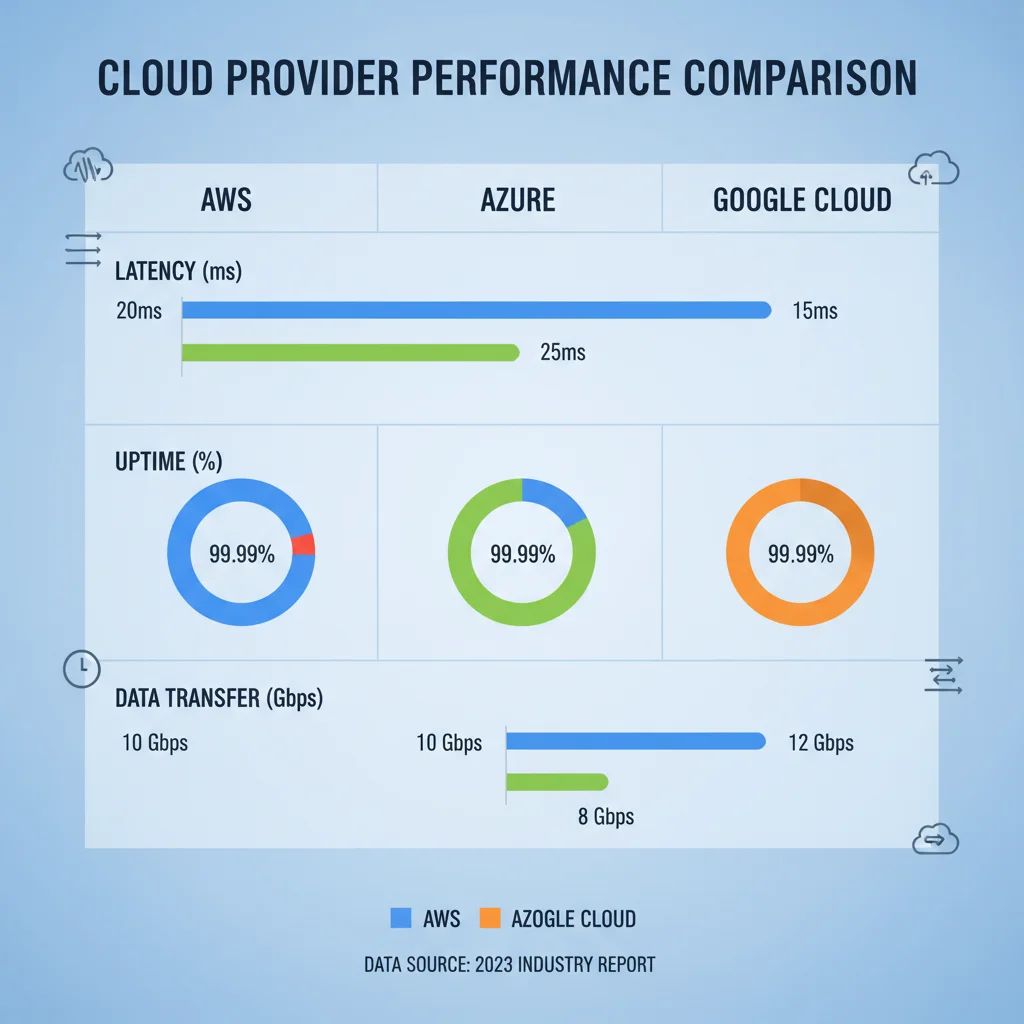
Performance is often the first criterion enterprises consider, and rightly so. It directly impacts user experience, application responsiveness, and operational efficiency. When evaluating the top three U.S. Cloud Providers, we look at several key performance indicators (KPIs): network latency, compute power, storage I/O, and overall reliability (uptime guarantees and disaster recovery capabilities).
Amazon Web Services (AWS): The Pioneer’s Edge
AWS, the market leader, boasts an unparalleled global infrastructure with numerous regions and availability zones across the U.S. This extensive network provides exceptional redundancy and low-latency access for users nationwide. AWS offers a vast array of compute services, from general-purpose EC2 instances to specialized instances for high-performance computing (HPC), machine learning (ML), and graphics rendering. Their network backbone is highly optimized for speed and resilience, ensuring consistent performance even under heavy loads.
- Network Latency: Generally excellent due to widespread U.S. presence and direct connectivity options like AWS Direct Connect.
- Compute: Broadest range of instance types, including Graviton processors, offering strong price-performance. Auto-scaling capabilities are mature and robust.
- Storage I/O: High-performance options with EBS (Elastic Block Store) and S3 (Simple Storage Service) offering various tiers for different I/O needs.
- Reliability: Strong SLAs, multiple availability zones within regions for high availability, and comprehensive disaster recovery services like AWS Backup and CloudEndure.
- Edge Computing: AWS Outposts extends AWS infrastructure to on-premises data centers, and AWS Wavelength brings compute and storage closer to 5G networks for ultra-low latency applications.
Microsoft Azure: Enterprise-Grade Integration
Azure leverages Microsoft’s deep enterprise roots, offering seamless integration with existing Windows Server environments, Active Directory, and other Microsoft products. Its U.S. footprint is substantial, with numerous regions designed to serve government, commercial, and regulated industries. Azure’s performance capabilities are robust, particularly for workloads that benefit from Microsoft’s ecosystem.
- Network Latency: Competitive with AWS, especially for organizations already heavily invested in Microsoft technologies. Azure ExpressRoute provides dedicated private connections.
- Compute: Diverse VM offerings, including specialized instances for HPC, GPU-intensive tasks, and SAP workloads. Azure Arc extends Azure management to hybrid and multi-cloud environments.
- Storage I/O: Azure Disk Storage and Blob Storage provide scalable and performant options, with Premium SSDs offering high IOPS and low latency.
- Reliability: Strong SLAs, availability zones, and a suite of disaster recovery services (Azure Site Recovery, Azure Backup).
- Edge Computing: Azure Stack family extends Azure services to on-premises and edge locations, providing consistent hybrid cloud capabilities.
Google Cloud Platform (GCP): Innovation and Analytics Powerhouse
GCP, while newer to the enterprise market, has rapidly gained ground, particularly for its strengths in data analytics, machine learning, and containerization. Leveraging Google’s global network infrastructure, GCP offers impressive network performance and a strong focus on open-source technologies. Its U.S. presence is growing, with strategic regions designed for optimal reach.
- Network Latency: Often cited for its high-performance global network, which is the same network Google uses for its own services. Global load balancing and premium network tiers contribute to low latency.
- Compute: Strong focus on flexible compute options, including custom machine types and powerful Kubernetes Engine (GKE) for containerized workloads.
- Storage I/O: Persistent Disk and Cloud Storage offer high performance, with particular strengths in global data distribution and archival.
- Reliability: Solid SLAs, regional and multi-regional resource deployment, and robust disaster recovery options.
- Edge Computing: Google Distributed Cloud (GDC) extends GCP’s infrastructure and services to the edge and on-premises, with a strong emphasis on consistent operations.
When assessing performance, it’s crucial to benchmark specific workloads relevant to your enterprise. What performs best for one application might not for another. Consider factors like geographic distribution of your user base, data gravity, and the specific computational demands of your core applications.
Cost Optimization: Understanding Pricing Models and TCO
Cost is a perennial concern for enterprises, and cloud billing can be notoriously complex. Each of the U.S. Cloud Providers employs a pay-as-you-go model, but the devil is in the details. Understanding their pricing structures, discount mechanisms, and tools for cost management is vital to avoid sticker shock and achieve true total cost of ownership (TCO) optimization.
AWS Cost Considerations:
- Pricing Model: Highly granular, pay-as-you-go for virtually every service. Can be complex due to the sheer number of services and pricing dimensions.
- Discount Mechanisms:
- Reserved Instances (RIs): Significant discounts (up to 72%) for committing to 1- or 3-year terms.
- Savings Plans: More flexible than RIs, offering discounts for committing to a consistent amount of compute usage (e.g., $10/hour).
- Spot Instances: Up to 90% savings for fault-tolerant workloads that can tolerate interruptions.
- Volume Discounts: Automatic tiering for services like S3 storage and data transfer.
- Cost Management Tools: AWS Cost Explorer, AWS Budgets, AWS Organizations (for consolidated billing), Trusted Advisor for cost optimization recommendations.
- Egress Fees: Data transfer out of AWS regions can be a significant cost factor, especially for large datasets.
Azure Cost Considerations:
- Pricing Model: Pay-as-you-go, with slightly simpler pricing for core services compared to AWS, but still extensive.
- Discount Mechanisms:
- Azure Reservations: Similar to AWS RIs, offering substantial discounts for 1- or 3-year commitments on VMs, SQL Database, etc.
- Azure Hybrid Benefit: Significant savings for Windows Server and SQL Server licenses with active Software Assurance, allowing you to bring your existing licenses to Azure. This is a major differentiator for Microsoft-centric enterprises.
- Spot VMs: Discounts for interruptible workloads.
- Dev/Test Pricing: Reduced rates for development and testing environments.
- Cost Management Tools: Azure Cost Management + Billing, Azure Advisor for cost recommendations.
- Egress Fees: Also a factor, though often competitive with AWS.
GCP Cost Considerations:
- Pricing Model: Known for more transparent and customer-friendly pricing, including per-second billing for most compute services (after the first minute).
- Discount Mechanisms:
- Committed Use Discounts (CUDs): Similar to RIs/Reservations, offering discounts for 1- or 3-year commitments.
- Sustained Use Discounts: Automatic discounts applied for running VM instances for a significant portion of the month, no upfront commitment required. This is a unique advantage.
- Spot VMs (Preemptible VMs): Significant savings for fault-tolerant workloads.
- Cost Management Tools: Google Cloud Billing, Cloud Console’s cost management features.
- Egress Fees: Competitive, but like other providers, data transfer out can accumulate.
For U.S. enterprise, the choice often comes down to existing licensing investments (e.g., Microsoft’s Hybrid Benefit is compelling for Windows shops) and the predictability of workloads. For stable, long-running applications, commitment-based discounts are crucial. For burstable or fault-tolerant workloads, spot instances offer immense savings. Comprehensive cost management and governance are essential regardless of the chosen provider.
Compliance and Security: Navigating the Regulatory Maze
In the U.S., compliance is non-negotiable, particularly for sectors like healthcare (HIPAA), finance (FINRA, GLBA), government (FedRAMP), and publicly traded companies (SOX). Each of the U.S. Cloud Providers offers a robust security posture and a plethora of compliance certifications. However, the depth of their offerings, the ease of achieving compliance, and their shared responsibility models differ.
Shared Responsibility Model: A Critical Concept
All three providers operate under a shared responsibility model. They are responsible for the security of the cloud (the underlying infrastructure, physical security of data centers, network security). You, the enterprise, are responsible for security in the cloud (your data, applications, operating systems, network configuration, identity and access management). Understanding this distinction is paramount for maintaining a strong security and compliance posture.
AWS Compliance and Security:
- Certifications: Extensive list including FedRAMP (High, Moderate), HIPAA, PCI DSS Level 1, SOC 1/2/3, ISO 27001, ITAR, CMMC, and many more.
- Security Services: A comprehensive suite including AWS Identity and Access Management (IAM), AWS Key Management Service (KMS), AWS WAF (Web Application Firewall), GuardDuty (threat detection), Security Hub, Config, Macie (data discovery and protection).
- Data Sovereignty: Multiple U.S. regions allow for data residency within the country.
- Government Cloud: AWS GovCloud (US) regions are isolated environments designed to host sensitive data and regulated workloads for U.S. government agencies and contractors.
Azure Compliance and Security:
- Certifications: Equally extensive, covering FedRAMP (High, Moderate), HIPAA, PCI DSS, SOC 1/2/3, ISO 27001, ITAR, CMMC, and specific government-focused accreditations.
- Security Services: Azure Active Directory (AAD) for identity, Azure Security Center (now Microsoft Defender for Cloud), Azure Key Vault, Azure Firewall, Azure Sentinel (SIEM), Azure Policy. Strong integration with existing Microsoft security tools.
- Data Sovereignty: Multiple U.S. regions, including dedicated U.S. government regions.
- Government Cloud: Azure Government offers an isolated instance of Azure tailored for U.S. government agencies and their partners, meeting stringent compliance requirements.
GCP Compliance and Security:
- Certifications: Growing list, including FedRAMP (High, Moderate), HIPAA, PCI DSS, SOC 1/2/3, ISO 27001, CMMC. Google has made significant strides in enterprise compliance.
- Security Services: Cloud IAM, Cloud Key Management Service (KMS), Cloud Armor (DDoS protection and WAF), Security Command Center, Access Transparency, VPC Service Controls. Emphasis on ‘security by design’ and Google’s internal security expertise.
- Data Sovereignty: Multiple U.S. regions available for data residency.
- Government Cloud: Google Cloud for Government provides services designed to meet U.S. public sector requirements, often through specific regional deployments.
For U.S. enterprise, the choice among these U.S. Cloud Providers often hinges on specific industry regulations. While all three offer comprehensive compliance programs, the ease of demonstrating compliance and the availability of specialized government clouds can be significant differentiators. It’s crucial to perform a thorough audit of your specific compliance needs and map them against the provider’s offerings and the shared responsibility model.

Other Critical Factors for U.S. Enterprise
Beyond performance, cost, and compliance, several other factors weigh heavily on the decision-making process for U.S. enterprise when selecting from the top U.S. Cloud Providers.
Ecosystem and Vendor Lock-in:
- AWS: Boasts the largest and most mature ecosystem of third-party tools, integrators, and community support. While this offers immense flexibility, it can also lead to deep integration with AWS-specific services, potentially increasing vendor lock-in if not managed carefully.
- Azure: Benefits from Microsoft’s extensive partner network and strong integration with existing enterprise software. This can be a huge advantage for organizations already heavily invested in Microsoft technologies, reducing migration complexity and learning curves.
- GCP: Offers a strong commitment to open-source technologies (e.g., Kubernetes, TensorFlow), which can make it attractive for enterprises looking to avoid proprietary lock-in. Its ecosystem is growing rapidly, particularly in areas like data science and AI.
Support and Managed Services:
- AWS: Offers various support tiers (Developer, Business, Enterprise) with different response times and access to technical account managers (TAMs). A vast network of managed service providers (MSPs) also exists.
- Azure: Provides similar support plans (Developer, Standard, Professional Direct, Premier). Microsoft’s enterprise agreements often include dedicated support resources.
- GCP: Offers various support packages (Standard, Enhanced, Premium) with varying levels of access to experts and response times.
The quality and responsiveness of support can be a critical factor during incidents or complex migrations. enterprises should carefully evaluate the support tiers and consider third-party managed services if internal expertise is limited.
Innovation and Future Roadmap:
- AWS: Known for its rapid pace of innovation, constantly releasing new services and features. This can be a double-edged sword, offering cutting-edge capabilities but also requiring continuous learning and adaptation.
- Azure: Also innovates rapidly, often focusing on enterprise-centric features, hybrid cloud solutions, and AI/ML capabilities that integrate well with its existing product portfolio.
- GCP: A leader in areas like AI/ML, data analytics, and serverless computing. Its innovations often stem from Google’s internal research and development, providing powerful, scalable solutions.
Staying abreast of each provider’s roadmap is crucial for long-term strategic planning. What might be a differentiator today could be table stakes tomorrow.
Making the Right Choice for Your U.S. Enterprise
Selecting the optimal cloud provider from the top U.S. Cloud Providers is not a one-size-fits-all decision. It requires a thorough assessment of your enterprise’s unique needs, priorities, and existing IT landscape. Here’s a strategic approach to guide your decision-making process:
- Define Your Requirements: Clearly articulate your performance needs (latency, throughput), cost constraints (budget, TCO goals), and, most importantly, your regulatory and compliance obligations. What data are you storing? Which industry regulations apply?
- Assess Current IT Landscape: Consider your existing investments in software licenses (e.g., Microsoft, Oracle), hardware, and skilled personnel. A provider that integrates well with your current environment can significantly reduce migration effort and training costs.
- Workload Analysis: Categorize your applications and data by their specific requirements. Some workloads might be best suited for one provider due to specific services (e.g., heavy ML on GCP, Windows workloads on Azure, broad serverless on AWS).
- Pilot Programs and Proofs of Concept (POCs): Don’t commit fully without testing. Run pilot programs or POCs with your top contenders using representative workloads and datasets. This provides real-world performance and cost data specific to your environment.
- Cost Modeling: Engage with each provider’s sales teams to develop detailed cost estimates for your anticipated usage. Leverage their cost calculators and explore all available discount options (RIs, Savings Plans, Hybrid Benefit, CUDs). Don’t forget egress fees and support costs.
- Security and Compliance Audit: Conduct a rigorous audit of each provider’s security controls and compliance certifications against your specific requirements. Understand the shared responsibility model thoroughly and plan for your responsibilities.
- Vendor Lock-in Strategy: Decide on your tolerance for vendor lock-in. Are you aiming for a multi-cloud strategy from the outset, or will you standardize on one provider and mitigate lock-in through architectural choices (e.g., containerization, open-source databases)?
- Future-Proofing: Consider each provider’s innovation roadmap and how well it aligns with your long-term business goals and technological aspirations (e.g., AI integration, edge computing).
- Review Support and SLA: Understand the service level agreements (SLAs) for uptime, performance, and support response times. Evaluate the available support tiers and consider external managed services if needed.
The journey to the cloud is continuous, not a one-time migration. Your chosen partner among the U.S. Cloud Providers should be one that can evolve with your enterprise, offering the flexibility, innovation, and reliability you need for years to come.
Conclusion: Strategic Cloud Partnership for U.S. Enterprise Success
The choice between AWS, Microsoft Azure, and Google Cloud Platform for U.S. enterprise in 2026 is a multifaceted decision that requires a deep dive into performance metrics, intricate cost structures, and rigorous compliance adherence. Each of these U.S. Cloud Providers brings distinct strengths to the table. AWS offers unparalleled maturity and breadth of services, Azure excels with its deep enterprise integration, especially for Microsoft-centric environments, and GCP stands out with its innovation in data analytics and AI/ML, coupled with a developer-friendly approach.
For your U.S. enterprise to thrive in the digital era, the cloud is not merely an infrastructure choice but a strategic partnership. The right provider will empower your organization to innovate faster, scale more efficiently, secure your data more effectively, and meet the ever-tightening regulatory demands of the U.S. market. By meticulously evaluating each provider against your specific needs in performance, cost, and compliance, and by considering factors like ecosystem, support, and future roadmaps, you can forge a cloud strategy that delivers sustainable competitive advantage.
Ultimately, the goal is to select a platform that not only meets your current operational requirements but also positions your enterprise for future growth and agility. The insights provided in this comprehensive comparison aim to illuminate the path forward, enabling you to make a confident and strategically sound decision for your cloud journey in 2026 and beyond.